
Carcass on the Shore: Who Ensures a Dead Dolphin Is Not Left Lying?
Carcass on the Shore: Who Ensures a Dead Dolphin Is Not Left Lying?
A walker in Ses Salines found a heavily decomposed dolphin on the beach. Why do dead marine animals often remain on the shore for a long time — and who should intervene? A reality check with concrete suggestions for the islands.
Carcass on the Shore: Who Ensures a Dead Dolphin Is Not Left Lying?
Key question: Why does a deceased marine animal sometimes remain on the beach for days — and who has to act?
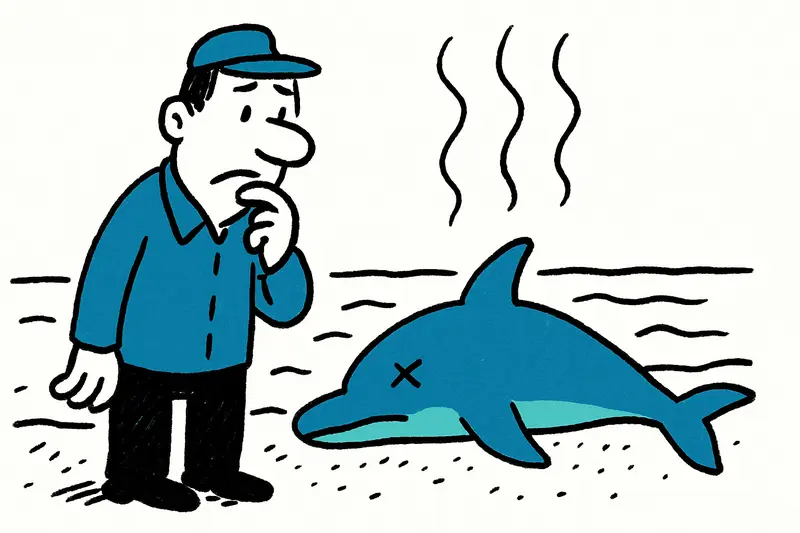
The smell described by residents is familiar from Mallorca too: a sharp, metallic hint of decay, suddenly noticeable over the sand when the sea gives something back that is no longer alive. That afternoon in Ses Salines on Ibiza a walker found a heavily decomposed dolphin on the beach, apparently having been in the water for several days before being washed ashore, a scene similar to a dead striped dolphin at the Club de Mar. The finder apparently did not know whom to call, and the carcass remained where it was.
This is more than an unpleasant scene. It is a small administrative and practical problem that repeatedly arises on the coastal islands: responsibilities are not immediately clear to every resident or visitor, and as a result marine animals rot openly on the beach — creating hygiene issues, potential health risks for people and dogs, and no chance to clarify causes such as disease or fishing entanglement, as in a dead shark recovered at Playa Can Pere Antoni.
A sober analysis reveals three problem areas: First: reporting channels. People rarely know whether to contact the municipality, the national police, the coast guard, or the emergency number 112. Second: local resources. Even if a report is received, small municipalities sometimes lack the personnel or vehicles to remove a heavy carcass from the beach. Third: transparency and monitoring. Dead marine mammals are important indicators of the sea’s health — if they are not systematically examined, valuable information is lost.
What is missing from public discourse: reporting usually only occurs when spectacular animals appear. Routine cases, however, which could provide clues about pollution, fishing nets, or pathogens, remain unaddressed. There is also no clear recommendation for beach users: What is the right behavior when you find a carcass? Do not touch, keep your distance, note the exact position and take photos — these are simple but helpful steps that are rarely communicated.
An everyday scene from Mallorca illustrates this: on a windy morning at the Passeig Marítim in Palma elderly residents push their shopping carts, young people jog, and on the quay a fisherman checks his line. If a rotten body is washed up, the same questions arise as on Ibiza; similar incidents include an injured shark that drifted off the Paseo in Palma. Who do I call? Is this dangerous? These situations are familiar to us — the islands share the same sea and the same gaps in infrastructure.
Concrete solutions that do not require major administrative effort would be feasible:
1. Clear reporting instructions at beaches: Small signs ("For dead marine animals: call 112 / inform the municipality") at main access points would remove confusion. The posters should provide information in Spanish, Catalan, English and German.
2. Simple reporting protocols for citizens: Photograph, note the GPS location, keep your distance. A short checklist that municipalities can make available online and at beach entrances.
3. Faster coordination between municipalities and the coast guard: Many cases only require transport ashore and an inspection by veterinary teams or environmental authorities. An agreed procedure reduces waiting times.
4. Mobile teams or contracts with recovery companies: For heavier cases, island council offices could conclude framework contracts instead of searching for a provider for each carcass.
5. Documentation for research: Where possible, carcasses should be photographed and basic data forwarded to the responsible environmental office — even simple information helps scientists recognize trends.
For beach visitors: do not touch, photograph and report the position, call 112 or inform the local municipal administration. For those responsible: take signals from the public seriously and establish procedures that work quickly and transparently.
Conclusion: A dead dolphin on the shore is not an isolated incident but a small-scale system failure — missing information, unclear responsibilities, scarce resources. This can be fixed: with clear signs at beaches, simple reporting protocols and better coordination between municipalities and the coast guard. The unpleasant smell may not disappear entirely — but at least the question "Who do I call?" would be answered.
Frequently asked questions
What should I do if I find a dead dolphin on a Mallorca beach?
Who is responsible for removing a dead animal from a beach in Mallorca?
Is a dead dolphin on the beach dangerous for people or dogs in Mallorca?
What is the best number to call in Mallorca if I find a dead dolphin?
Why do dead dolphins sometimes stay on Mallorca beaches for days?
Should I take photos if I find a dead dolphin in Mallorca?
Why do dead dolphins matter for marine research in Mallorca?
What should beach visitors in Mallorca do when they smell something rotten on the sand?
Similar News
Urgent Clearing of Palma's Torrents: Flood Prevention or Symptom of Short-Sighted Planning?
The city of Palma is responding to storm forecasts and has cleared several torrents. We ask: Is the short-term clearing ...

Evaneos and Mexico: A Reality Check for Sustainable Travel
Travel advertising often reads like a promise: local, sustainable, unique. But how deep do these promises really go? A c...

From Megapark to the Altar: Party Singer Now Offers Weddings in Mallorca
A well-known party artist combines partying and marriage: instead of a traditional church there are ceremonies at the Me...

The Maricarmen Case: Why an Eviction Is Forcing Spain's Housing Debate
Images of an 87-year-old woman on a stretcher have sparked a debate in Spain that also runs deep in Mallorca. Who protec...
Parking dispute in Els Hostalets: When a gap leads to violence
A parking dispute on Calle Aragón escalated into a mass brawl at night. Why do trivial conflicts here turn bloody so qui...
More to explore
Discover more interesting content

Can Cap de Bou

Townhouse Lleo 72
