
Dead Shark on the City Beach: What the Large Wound Reveals About Mallorca
In the evening a dead shark was recovered at Playa Can Pere Antoni. The visible wound raises questions — from boat traffic to gaps in research. An overview with concrete proposals for better protection and clarity.
Shark Recovered at Can Pere Antoni — More Than a Curious Find
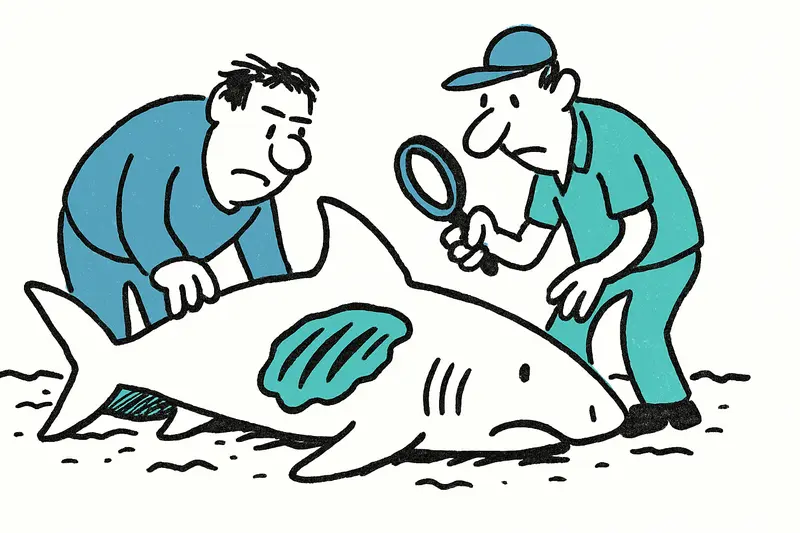
Around 8 p.m. on Friday evening, while the Paseo Marítimo in Palma was still buzzing — cars, voices, the clatter of plates on restaurant terraces — walkers discovered a dead shark drifting in the shallow water off Playa Can Pere Antoni, as reported in Dead shark on Palma's city beach: a sign of a bigger problem?. People quickly gathered, phones flashed in the fading light. Lifeguards and city authorities were informed; later a team from the Fundación Palma Aquarium took over the recovery.
The Wound: Accident, Prey or Something Else?
Particularly notable is a large injury on the animal's flank, a detail also highlighted in Dead Shark at Playa Can Pere Antoni: Bite Marks Raise Questions. At first glance one wonders: propeller damage, a collision with a boat, or a fight with another sea creature? The answer does not only determine the fate of this individual, but touches on broader issues: how safely do we move in the bays, how good is the data basis for such cases, and how quickly do authorities and research institutions respond?
Experts now plan to perform a necropsy, take tissue samples and examine the stomach contents. Initial lab results are expected in a few days, more complex analyses can take weeks. Until then much remains speculation — and that is precisely a problem.
A Core Question That Remains
The central question is not only "What caused the shark's death?", but: What does this case say about human impacts and the gaps in our coastal monitoring? Just because Mallorca is not a typical "shark hotspot" does not mean that encounters are rare exceptions without consequences.
Often Overlooked Aspects
First: boat traffic. In summer months motorboats, jet skis and excursion vessels congregate close to shore. Propeller injuries are not new, but are often only assumed when a carcass is found. What is missing here is a systematic reporting and investigation protocol.
Second: lack of data. Without routine documentation of beach finds, sightings and nearshore accidents, science and administration remain in the dark. Every unanalysed animal is lost knowledge about regional marine ecology.
Third: public behaviour. People film, post, intervene. That can destroy traces or contaminate biological samples. The authorities' plea to keep distance and inform experts is not mere politeness — it protects the investigation.
Concrete Opportunities and Solutions
Practical steps can be derived from such incidents — straightforward, quickly implementable measures:
1. Clear reporting chain: Lifeguards, police and aquariums should have a standardised protocol: secure the site, take initial photos, log samples, and arrange quick transport for examination.
2. Propeller and speed zones: In front of heavily frequented city beaches like Can Pere Antoni, temporary or permanent speed limits and designated boat lanes could help, an idea raised after incidents such as Dead Shark at the Paseo: A Wake-up Call for Better Coastal Protection in Palma.
3. Public information: Signs on the Paseo Marítimo, notices in beach apps and short info sessions for boat rental companies — so fewer curious onlookers erase traces at the scene.
4. Guided citizen involvement: Report sightings, do not touch — apps or hotlines could collect citizen observations and thus complement research data.
5. Networking research: Results from the necropsy should be made openly accessible so that scientists, authorities and interested parties in Palma and beyond can learn from them.
Why This Matters for Mallorca
Mallorca depends on the sea — tourism, fishing, recreation. Dead or injured large fish are not just a sensational event for passers-by and tourist photos. They are indicators: of direct dangers from humans, of changes in the ecosystem, or of species appearing outside known zones. Each of these interpretations has consequences for how we respond and shape policy.
In the end there remains a sober, slightly uncomfortable thought: a single dead shark on the city beach is not an isolated natural event. It can be a signal — and signals should be taken seriously. The coming weeks will show what answers the investigations provide. Until then: keep your distance, inform the experts, and let the Paseo Marítimo continue to run, with the sound of the sea and the gulls' cries as unobtrusive background music.
Frequently asked questions
Why was a dead shark found at Can Pere Antoni beach in Palma?
What should you do if you find a dead shark on a Mallorca beach?
Can boat traffic in Mallorca damage marine animals near the coast?
Why do experts want a necropsy after a shark is found in Mallorca?
Is it common to see sharks near Palma city beaches?
Why is Can Pere Antoni in Palma being discussed after the shark discovery?
What does a dead shark on a Mallorca beach tell us about the sea?
Should beachgoers film or handle a dead animal found in Mallorca?
Similar News
Cafetería San Siro: A Meeting Place on Schinken Street Since 1966
In the middle of Schinken Street, Cafetería San Siro has been offering Mallorcan hospitality for more than six decades —...

From Ballermann to Prison: What the Verdict Against the Femina Operator Means for Palma
The Munich Regional Court convicted a German operator for subsidy fraud. What does the verdict mean for the Femina Club,...
Underpass Verge de Lluc: 19-year-old fights her way out of flooded car – a warning sign for Palma
A 19-year-old recently escaped swimming from her car after the Verge de Lluc underpass held up to one and a half meters ...

When the Floodgates Open Again: Why Palma's Floods Aren't a Coincidence
A sudden heavy downpour around 5 p.m. brought Palma to a standstill: flooded streets, full basements, panicked commuters...
Playa de Palma: Life-saving at Balneario 11 – Lifeguards Act Quickly
A German holidaymaker suffered cardiac arrest at Playa de Palma. Lifeguards resuscitated her on the beach; emergency ser...
More to explore
Discover more interesting content

Can Cap de Bou

Townhouse Lleo 72
