
Dead shark on Palma's city beach: a sign of a bigger problem?
In the evening a dead shark lay just off the seawall at Palma's Passeig Marítim — naked curiosity, no quick answer. Why the animal died remains unclear. Our article puts the scene into context, revealing what it says about beach management, shipping traffic and our proximity to the sea.
Dead shark at Palma's Passeig Marítim: an unusual sight
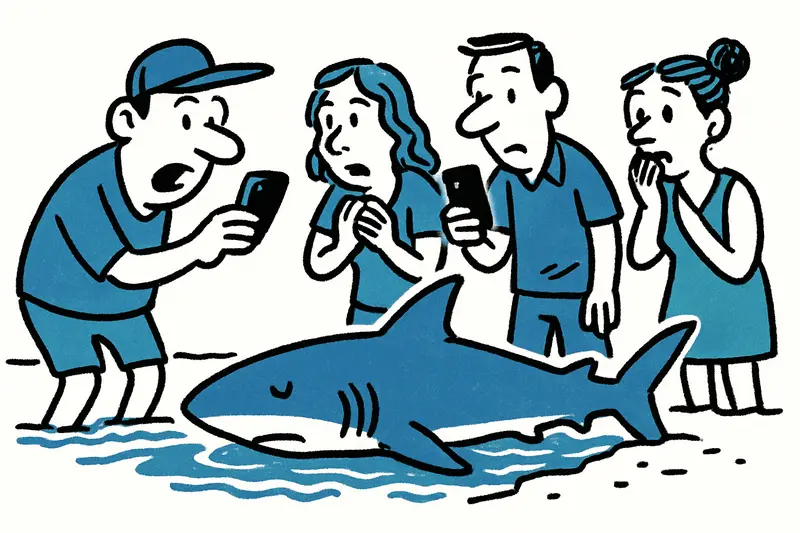
Yesterday evening at around 8:30 p.m. what began as a normal summer walk along the Passeig Marítim turned into a small sensation. It wasn't the harbour view or the sails in the bay that stopped people — it was a dead shark drifting in shallow water not far from the shore. Phone lights, wet shoes and hushed conversations: that was the scene as the animal was repeatedly thrown against the quay wall by the waves.
The key question: accident, attack or human interference?
Shortly after it was found, the central question formed: how did the animal die? Videos taken by bystanders showed a large wound on the body, an issue examined in Dead Shark on the City Beach: What the Large Wound Reveals About Mallorca. To laypeople such injuries appear dramatic at first — thoughts immediately turn to hypotheses: propeller, fishing net, attack by a larger predator. The fact is: a confirmed cause of death can only be determined by an examination. Authorities were informed, but official results are not yet available; similar cases and sampling procedures are discussed in Dead Shark at Playa Can Pere Antoni: Bite Marks Raise Questions.
What is often missing from the public debate
The scene attracted curious onlookers, but it also raises questions that are rarely voiced. First: how well coordinated are the harbour authority, coast guard, environmental agencies and beach wardens? Who decides whether a beach must be closed, and what information do residents receive immediately?
Second: what role does increasing ship traffic and recreational use of the bay play? In heavily used city harbours the risk of collisions between marine animals and watercraft rises — propeller injuries to marine animals are not a fantasy image, but a plausible cause that must be investigated. Third: how quickly are beachgoers and tourists informed to avoid unnecessary risks?
Recovery and its difficulties
Yesterday waves and tides made recovery difficult. Eyewitnesses reported that the animal was thrown against the quay wall several times and washed back into the sea — a procedure that is complicated both for rescuers and for the animal itself. Emergency teams explicitly asked people not to touch the animal and to keep the area clear. Good advice: carcasses can transmit pathogens or parasites, and touching them also contaminates traces that could be important for an investigation.
Concrete steps that would make sense now
It's not enough to wait for official lab results and wonder afterwards. Some sensible measures Palma could consider in the short term:
1. Clear communication chain: uniform rules about who is informed (harbour authority, coast guard, ministry of environment) and a fast press channel for citizens.
2. Rapid sampling: a swift necropsy of the animal clarifies whether external injuries match internal findings — and whether foreign objects such as metal parts from ships are present.
3. On-site prevention: temporary closures, use of drones to monitor the bay and better signage at city beaches that indicates behaviour rules when marine animals are sighted.
4. Data exchange with harbour operators: information about recent maintenance, accidents or unusual vessel movements can help reconstruct incidents.
5. Awareness raising: lifeguards, boat operators and beach managers should be regularly trained to report dead marine animals properly and to keep their distance.
Why this event should concern us
A dead shark on the city beach is more than a curious social media item. It is a reminder of how closely urban life and the sea are connected — with all the conflicts and dependencies that entails. For many residents the evening was disturbing: a dog owner said they had "never seen anything like this here"; that likely applies to most people. But precisely because such observations are rare, we need functioning procedures so that curiosity does not become a danger to people or to science. Local coverage has framed similar incidents as a call for improved coastal protection in Dead Shark at the Paseo: A Wake-up Call for Better Coastal Protection in Palma.
The conclusion
Until investigations are complete, much remains speculative. What is clear, however, is that Palma should use the incident to review communication channels, strengthen preventive measures and improve cooperation between the port, the coast and environmental authorities. For beachgoers the rules remain: keep your distance, do not touch and call 112 if in doubt. And anyone walking the promenade the next evening may again hear the sounds of the city — but this time with the knowledge that the sea around the corner is more complex than postcards make it seem.
We will continue to follow the story and report as soon as authorities release findings on the cause of death.
Frequently asked questions
What should you do if you see a dead shark on a beach in Mallorca?
Why do dead sharks sometimes appear near Palma’s city beaches?
Can you swim at a Palma beach if a dead marine animal has been found nearby?
What should beachgoers in Mallorca avoid doing when they find a dead marine animal?
How is a dead shark in Palma normally investigated?
Is ship traffic in Palma Bay a risk for marine animals?
What should tourists in Palma do if they see a dead shark on the promenade?
What can Mallorca authorities do to respond better when a dead marine animal is found?
Similar News

When the Phone Falls Silent: Concern for Sarah Joelle in Mallorca — and What It Reveals
After days without a response, the TV personality's unreachability in Mallorca sparked concern. Shortly afterwards an al...

Ultraluxury on the Ground: Four Seasons Jet in Palma — a Reality Check for Formentor and the Island
A high-priced flight crosses Mallorca and its guests stay for days at the Formentor resort. What does the island get bes...
Death of a Witness and the Justice Backlog: Why the Kegel Brothers Trial Matters in Mallorca
A witness in the Playa de Palma fire case has died, and the trial against eight German holidaymakers has been delayed un...

Champagne Reception, Red Carpet and Mini Originals: The Pre-Nit del Art at Gallery Mensing
Almost 400 guests, champagne, pop-art feats by Tom Boston and a raffle for the Parkinson's foundation: Gallery Mensing t...

Break-in in Cala Rajada: How Three Tourists Were Robbed in Their Sleep
In the early morning hours a holiday home near Son Moll in Cala Rajada was visited by a burglar. Three German holidaymak...
More to explore
Discover more interesting content

Can Cap de Bou

Townhouse Lleo 72
