
Cardiac arrest in Llevant: Hiker dies — what must change?
Cardiac arrest in Llevant: Hiker dies — what must change?
A 64-year-old hiker died of a cardiac arrest in the Parc Natural de Llevant. Why do people die in the backcountry — and how can we provide faster help in future?
Cardiac arrest in Llevant: Hiker dies — what must change?
Guiding question: Could faster help, better equipment or more preparation have prevented the death?
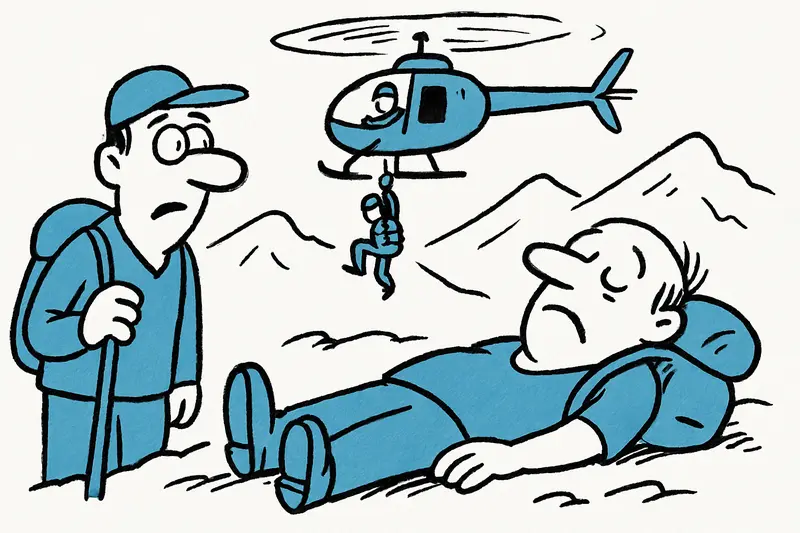
Early on Wednesday afternoon a distress call was placed from a popular hiking area in eastern Mallorca: a 64-year-old man had collapsed on a route in the Parc Natural de Llevant. Mountain rescue teams (GREIM) and the Artà fire brigade were alerted, and a helicopter (Milana) brought rescuers into the hard-to-reach terrain. Resuscitation efforts were unsuccessful and the man died; the body was recovered by the forensic service in the evening. These sober facts are painful, but they also raise concrete questions; local reporting such as Cardiac Arrest on Can Picafort Beach: Questions Remain and Ideas for the Future underscores how sudden incidents prompt broader debate about prevention and response.
The first question is the one asked at the start: How long does help actually take in the field? A 112 call at around 14:30, the alerting of specialist personnel, a helicopter approach — all of this sounds like a functioning system. Yet the operation ended tragically. In such cases every minute counts; cardiac arrest outside hospitals is often fatal without the immediate use of an Automated External Defibrillator (AED) and good chest compressions, as reflected in other recent coverage such as Cardiac Arrest While Swimming in Colònia de Sant Pere: A Death and the Question of Prevention.
Critical analysis: On Mallorca, the popular hiking regions are not always as equipped as the promenades in Palma. Many villages have defibrillators, but they are not available across the board at all access points to nature parks or at the refuges. Added to that is mobile reception: in parts of Llevant the connection is patchy, meaning the exact position can be given by radio but cannot be reliably transmitted via an app. Volunteers and rescuers report obstacles such as unclear signposting, poorly marked access routes for rescue vehicles, and a lack of information for hikers about emergency procedures; questions about village preparedness are raised in pieces like Cardiac Arrest in Caimari: Are Mallorca's Villages Prepared for Medical Emergencies Involving Tourists?.
What is missing from the public debate? First, a discussion about a publicly accessible AED network along the most popular trails. Second, a clear registration and maintenance system for technical devices. Third, more practical first-aid offerings for locals and seasonal workers, who are often the first on the scene. Instead of abstract app debates there is a need for locally visible measures: Which routes are prioritized? Who inspects the access routes? How often are devices checked?
A small everyday scene that makes the problem tangible: A few steps above the Finca s’Arenalet a group of hikers walks, their boots scraping over old limestone, the scent of pine in the air, the church bells of Artà ringing in the distance. A helicopter thunders over the ridge and rips the calm apart; conversations fall silent. Many rescues look like that: idyllic, suddenly life-threatening.
Concrete solution approaches that could work locally:
• Install AED locations at all official trailheads and at staffed refuges and register them in a public map database. Visible signs should point to the nearest defibrillator.
• Regular maintenance and a contact person in every town council (Ajuntament) for the devices — defibrillators must be operational, batteries and pads have expiry dates.
• Free, short-format first-aid and AED courses in the larger towns of the east of the island (Artà, Capdepera, Manacor), especially during the season also for tourism service providers and hosts.
• Improved trail signage with clear coordinate information and marked rescue access routes; a uniform marking for emergencies that is understandable offline as well.
• Publicly funded pilot projects for mobile rescue stations on weekends and during peak times along heavily frequented routes.
Many of the proposals cost money, they require political priority and local coordination. But it is not only about budget: it is about organization, communication and responsibility. Municipalities must decide whether to invest more in prevention, or whether we will continue to hope for the best when something goes wrong.
Conclusion: A cardiac arrest can turn any hike into a tragedy. The technology (AEDs, apps, helicopters) exists; the question is how we distribute it wisely and how we train people so they do not hesitate in an emergency. The loss on a sunny April afternoon in Llevant should not lead us to resignation but should spur us on: more visibility, clearer routes, practiced helpers — these would be concrete steps so that help arrives faster when it is most needed.
Frequently asked questions
What is the weather usually like in Mallorca in October?
Can you still swim in Mallorca in October?
What should I pack for Mallorca in October?
Is October a good time to visit Mallorca?
What can you do in Mallorca if the weather is mixed in October?
What is Palma like in October?
Is Sóller worth visiting in October?
Is October a good month for hiking in Mallorca?
Similar News
More water than last year: Mallorca's reservoirs breathe easier
September rain refilled the Tramuntana's reserves: overall fill around 35 percent, Cúber at 40.42 percent, Gorg Blau at ...
Three Luxury Hotels in Banyalbufar: Lots of Money, Many Questions
A Danish investor plans three exclusive accommodations in Banyalbufar — including the historic Son Valentí. The announce...
2.1 tonnes of cocaine on sailing yacht off Spain's coast – a reality check for the coastguard
A 14-metre yacht was seized with 2.1 tonnes of cocaine. Who monitors the ports, how does the international hunt succeed ...
Heat Bonus in Mallorca: 100 Euros Extra for Outdoor Staff at MarSenses
MarSenses pays employees who worked outdoors in August an extra €100 as recognition. Lighter uniforms, reduced hours for...
Renovating in Mallorca: What You Really Can Do Without Neighbour Consent
Many think they can do whatever they want in their apartment. That's partly true — but only as long as structural elemen...
More to explore
Discover more interesting content

Can Cap de Bou

Townhouse Lleo 72
