
Carriages Without Horses: Palma Plans E-Carriages – a Reality Check
Carriages Without Horses: Palma Plans E-Carriages – a Reality Check
Palma plans to switch to electric carriages in 2027. The prototype was shown near the cathedral. What is the technology worth — and what is missing from the debate?
Carriages Without Horses: Palma Plans E-Carriages – a Reality Check
What the attractive idea can do, what it conceals and what a fair transition could look like
Key question: Will replacing horse-drawn carriages with electrically powered vehicles really end animal suffering — or will the city merely shift a problem behind another facade?
In the late afternoon, when the bells of the Seu ring over the Passeig del Born and taxis honk at the curb, tourists often stand puzzled in front of the bridled wagons. The prototype presented by manufacturer Carrulet together with representatives of the carriage drivers in Palma attempts to change precisely this picture: classic silhouette, wood look, but instead of clattering hooves a quiet whir of an electric motor. The facts the city names: approval and adjustment of municipal regulations are still pending, commissioning is planned for 2027. There are currently 28 carriage licences; according to the carriage drivers' association more than half are interested in switching, but acquisition costs amount to around 45,000 euros per vehicle.
Critical analysis: Technically the model does not sound impossible. Manufacturer specifications state a range of around 160 kilometres or an operating time of up to 14 hours and improved suspension. But the words “manufacturer specifications” are important: in practice it is charging infrastructure, maintenance, real usage profiles and climatic conditions that determine whether the carriages actually perform as promised. What if a shift runs longer? Who pays for replacement batteries, service and electricity? And: a switch without clear standards on safety, noise emissions and speed could visually relieve the historic old town, but create new complaints.
The economic situation is equally unclear. The trade points to Alcúdia, where according to the manufacturer ten electric carriages already operate and turnover has allegedly increased. Even if that is true: Mallorca is not a uniform market. Tourist seasons, narrow passages in the old town, parking and charging conditions distinguish Palma from Alcúdia. The carriage drivers' association rightly warns of a "very slow transition" if there are no subsidies. 45,000 euros is for many individual operators an existential investment.
What is missing in the public debate: two things are barely heard. First: a reliable financial concept. Not every owner of an old carriage has access to credit lines or investors. A mere purchase offer to the industry without leasing, trade-in or subsidy models is not a solution. Second: clear animal welfare and labour standards for the transition period. As long as horses are kept, binding controls on husbandry, water and rest times and emergency plans are needed — regardless of whether e-carriages are introduced.
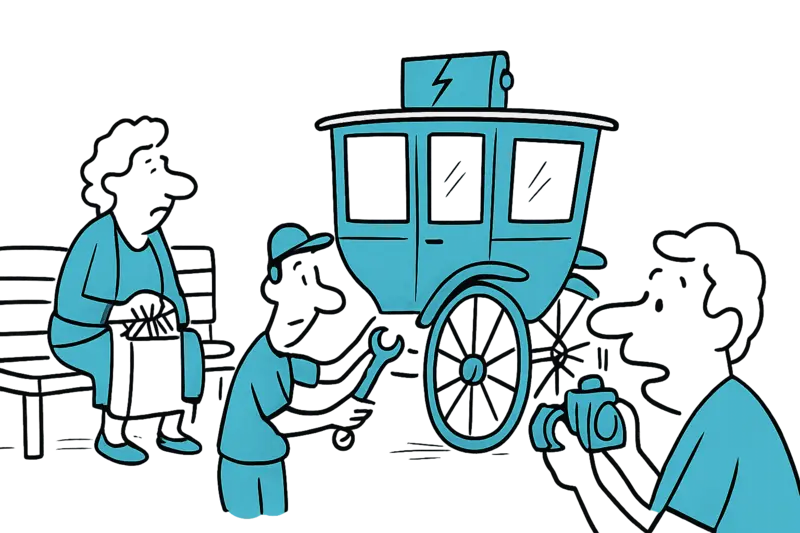
Everyday scene: On a Thursday morning an elderly Mallorcan woman with a shopping bag sits on a bench near the cathedral and watches a young carriage driver oil the wheel bearings of a wagon. A tourist asks for permission to take a photo. The driver shrugs: "If the city helps, it would be easier." I have been hearing such conversations for months on the Plaça de la Seu. That is often where it is decided how quickly new ideas are adopted.
Concrete approaches: The city administration should set up a phased programme. 1) Pilot phase: five to ten e-carriages to be tested on different terrain (old town, promenade, suburbs). 2) Financial instruments: a combination of grants, municipal leasing models, low-interest loans and a buyback fund for old wagons. 3) Technical standards: charging density points at defined stopping places, minimum requirements for battery life, emergency systems and noise limits. 4) Social rules: retraining for horse owners/drivers, co-determination rights in fleet purchases, transitional arrangements to cushion income losses. 5) Transparency: publication of test data, costs and user satisfaction after six months.
Legal hurdles and communication must not be forgotten. The announced 15-day participation procedure is a start, but too short to seriously bring together technology, financing and interest groups. A longer, moderated dialogue format with clear milestones would be more sensible.
Concise conclusion: The e-carriage is not a cure-all, but a chance — provided the city does not merely approve a vehicle, but organises a genuine transition. Without financial help, concrete technical requirements and binding protective rules for animals and employees, the project risks failing in two ways: as an expensive token solution or as an unfair imposition on small operators. Palma can be a role model if the attractive prototype becomes a practical programme — otherwise it will remain a pretty photo in front of the cathedral.
Frequently asked questions
Are electric carriages a viable replacement for horse-drawn carriages in Palma?
What financing options exist to support Palma’s e-carriage transition?
What technical and safety standards are being considered for Palma's e-carriages?
How will animal welfare and worker protections be addressed during the transition?
When could Palma start testing e-carriages and what would the phased plan look like?
Are electric carriages affordable for small operators in Mallorca?
How could e-carriages affect tourism in Palma's old town?
What is the current status of regulations and public involvement for Palma’s e-carriage project?
Similar News

Record season, empty coffers: Who really benefits from the tourism boom?
Full hotels and more flights: the numbers sound impressive — yet many locals feel no benefit. A reality check with an ev...

Pool ordered for €46,000 – €23,000 paid, no work carried out: A fraud case in Palma
A homeowner in Palma transferred €23,000 for the construction of a pool. Weeks later it emerged that no building applica...

Summer greetings from the Pitiusas island: Gottschalk and Krüger enjoy the sun on Ibiza
A friendly photo of Thomas Gottschalk and Mike Krüger on Ibiza evokes memories of their shared film years and shows that...

Occupied in a Few Days: When Property in Mallorca Turns into a Dispute
Six young men were arrested in Palma after homeowners returned and could no longer open their own door. A case that rais...
Serious fall at Port d’Andratx: Who protects cyclists on this route?
A 66-year-old German cyclist fell between Port d'Andratx and Camp de Mar, hit his head and was taken to hospital. One ac...
More to explore
Discover more interesting content

Can Cap de Bou

Townhouse Lleo 72
