
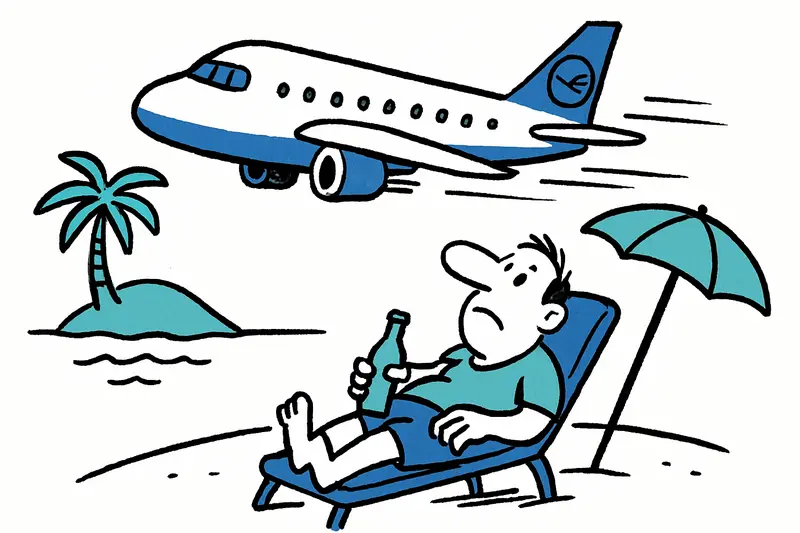
The Crane over the Island: Why Lufthansa's Anniversary Sparks a Mallorca Debate
The Crane over the Island: Why Lufthansa's Anniversary Sparks a Mallorca Debate
A hundred years of Lufthansa are a reason to celebrate — and to ask how the airline infrastructure shapes Mallorca's future. A reality check between nostalgia, noise and the climate bill.
The Crane over the Island: Why Lufthansa's Anniversary Sparks a Mallorca Debate
One hundred years of Lufthansa: that sounds like colonial luggage full of anecdotes. The aircraft that first landed at Son Sant Joan in 1963 brought not only passengers in suits and ties to the island. It helped lift Mallorca out of the shadow of local fishing villages and into the travel catalogues of a booming Federal Republic.
My guiding question is clear: How does the history of a long‑established airline square with the pressing problems Mallorca faces today — noise, seasonal fluctuations, climate impact and dependence on mass tourism? Local debates are reflected in coverage such as When the Germans Stay Away: Opportunity or Risk for Mallorca?.
A short walk describes the tension better than any statistic: on a cold January morning a taxi driver stands in front of the terminal, smoking, his hands bundled up. Behind him the runway gleams, and nearby regional buses are making their rounds. During the day you hear the regular drone; in the evening it gets quieter — until a night overflight makes the windows vibrate. People on Passeig Mallorca in a café tap on their phones and look at flight apps as if takeoffs and landings had become part of the cityscape.
Historically the connection runs deep: Condor was already there in the 1950s, Son Sant Joan opened in 1960, and in 1963 Deutsche Luft Hansa set foot on the sand. Recent coverage of carrier changes, for example Condor says 'farewell' to Leipzig — what Mallorca makes of it, underlines that networks continue to evolve. Later the airline wrote sad chapters — the 1977 hijacking remains a dark echo — and also spectacular moments, like the landing of the A380 in 2010. Today the network is complex: year‑round connections, summer flights, subsidiaries like Eurowings and Discover complement the offering.
The positive side must not be downplayed: airports create jobs, bring visitors to hotels and restaurants, and fill the tills of small businesses inland. The downside is visible: streets around the airport bear more traffic, property prices and rents react to demand, and some neighborhoods suffer from noise spikes.
What is too often left out of public debate are the climate costs per short‑haul flight and the consequences for Mallorca's ecosystem. There is a lack of clear dialogue about how flights, which mainly serve seasonal holiday flows, can be reconciled with climate targets in the long term. The question of growth limits — how many takeoffs and landings Son Sant Joan can cope with — is rarely discussed soberly.
On a local level, concrete strategies are also missing: how do we channel tourism revenues so that noise protection, noise remediation and nature conservation projects directly benefit? Who pays for better insulation in schools near approach and departure routes? Such answers are often missing because discussions are limited to anniversary celebrations or ticket prices.
Concrete proposals for Mallorca — not theories, but practical steps:
1. Targeted steering fees: Airport charges tiered by noise index and CO2 emissions would make particularly loud or inefficient aircraft more expensive. Revenues should be earmarked for soundproofing and island ecology.
2. More precise slots and seasonal contingents: Instead of unchecked growth, certain capacities could be limited in high‑summer weeks to smooth peaks. By contrast, regional changes such as Small Airport, Big Impact: What Weeze's Growth Means for Mallorca show winter scheduling can help balance demand and relieve summer pressure.
3. Promotion of sustainable flying: Investments in biofuel testing and incentives for airlines to use more efficient aircraft. On‑ground power instead of running auxiliary engines at the gate also reduces noise and exhaust for adjacent neighborhoods.
4. Transparency in route decisions: Airlines should disclose local impacts before expanding: expected nights with increased noise, additional taxi traffic, accommodation capacity. Public discourse needs numbers instead of marketing phrases.
5. Strengthening local value creation: More cooperation between the airport, hotels and local craftsmen so that a larger share of airline revenue stays on the island. Training programs for aviation professions provide longer‑term employment opportunities.
One‑sentence conclusion: The relationship between Mallorca and major airlines like Lufthansa is not just a nostalgic chapter but an open project we must shape politically and locally. The island has experienced aviation's stories — the elegance of the early years, tragedies, giant jets and digital frequent‑flyer programs. Now it's about arranging these experiences so that residents, nature and the economy are not played off against each other.
The challenge is pragmatic: good technology, smart rules, and a bit of courage to set uncomfortable limits. Otherwise only the sound of a passing plane and a bill Mallorca pays later will remain of the romance.
Frequently asked questions
Why is Lufthansa often part of the Mallorca tourism debate?
How busy is Palma Airport in Mallorca during the year?
Does living near Mallorca Airport mean dealing with aircraft noise?
What is the climate impact of short-haul flights to Mallorca?
Is Mallorca too dependent on mass tourism and air travel?
What are the main ideas for reducing airport pressure in Mallorca?
What changed at Mallorca Airport since the early days of commercial aviation?
What should residents in Palma consider about flights over the city?
Similar News

Haute Nuit in Puerto Portals: Fashion, Art and Indulgence by the Water
On October 2 the Lobster Club in Puerto Portals will be transformed into a stage for curated fashion, art and culinary e...

Magaluf: Watchtower Alarm – Lifeguards Pull Unconscious Beachgoer from the Water
After a drama in the late afternoon, two lifeguards at Magaluf beach rescued an unconscious 44-year-old man. He was stab...

Turquoise in the City: How dangerous is the color play of the Sa Riera?
The Sa Riera in Palma suddenly turned turquoise — a pretty motif, but behind the effect lies a discharge of saline waste...

Jeckliner at Sunnesching: Cologne spirit sets sail from Palma
In September 2027 the Mein Schiff 2 briefly becomes a floating carnival stage: four days with Cologne bands, comedy and ...
Finally Home: Mike and Leyla Heiter Buy Villa with Sea View in Mallorca
The reality TV couple Mike and Leyla Heiter have bought a house in Mallorca with a roof terrace and sea view. An Instagr...
More to explore
Discover more interesting content

Can Cap de Bou

Townhouse Lleo 72
