
Dead Dolphin in Peguera — a Lesson for Beach Protection
Dead Dolphin in Peguera — a Lesson for Beach Protection
A young dolphin was first seen alive at Palmira Beach in Peguera and was found dead at the boat dock the next day. The scene reveals gaps in communication, equipment and procedures for dealing with marine animals along Mallorca's coasts.
Dead Dolphin in Peguera — a Lesson for Beach Protection
Anyone who comes to Palmira Beach on a hot August afternoon is usually looking for shade, cold drinks and a bit of peace. This time, however, it was excited voices, the screeching of seagulls and the humming of outboard motors when a young dolphin drew the attention of bathers — first alive, then hours later dead at the quay wall.
The facts are simple: a juvenile was seen close to shore the day before. The next day lifeguards initially kept the animal in sight near the shore; later it swam beyond the buoy line and moved out of the rescuers' view. Hours later it reappeared near the boat landing — this time lifeless. Beachgoers helped bring the animal ashore; some took photos. Rescue personnel prohibited touching or moving the animal and pointed out that the responsible authorities would need to be informed. Experts will now determine why the animal died; similar investigative concerns were raised in Mystery at the Mole: Striped Dolphin as a Warning for Palma's Sea.
Key question
Who bears responsibility on a beach when a marine mammal appears: the curious crowd, the lifeguards on site, or the authorities who decide later? And how can well-meaning assistance be prevented from becoming an additional burden for the animal?
Critical analysis
The situation in Peguera reveals a recurring mix of compassion and helplessness. People act instinctively: pull it out, cover it, take pictures — the intention is often good. It becomes problematic when this leads to uncoordinated action. Dead or severely injured marine mammals can carry pathogens, tissue damage can obscure or erase traces that would be important for a later investigation. This echoes cases like Body Recovered off East Coast: A Sign of Larger Problems at Sea?. Lifeguards are trained for bathing accidents but are not everywhere equipped with special gear for larger marine mammals. And when an observation goes beyond the buoy line, there is often no boat or means for continuous monitoring, a lack of readiness also highlighted after the Dead Shark at the Paseo: A Wake-up Call for Better Coastal Protection in Palma.
What is missing from public discourse
Outrage and sadness on social media do not replace clear procedures. There is a lack of visible information for beach visitors: how should I behave if an animal is stranded? Who do I call? Who will come and in what timeframe? A unified emergency plan, visibly posted at all heavily frequented beaches, is usually nowhere to be found. It is also not widely known which institutions on Mallorca can respond immediately to animal strandings and which samples are needed for a mortality investigation; coverage of other strandings such as Dead Shark on the City Beach: What the Large Wound Reveals About Mallorca underlines the need for clearer protocols.
A scene at the beach
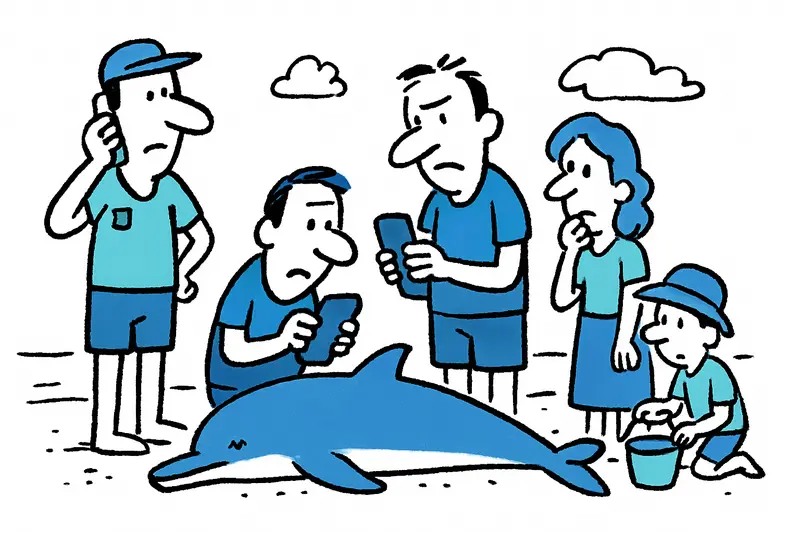
On Palmira Beach the sunbeds lay close together, the chiringuito emitted the smell of frying oil and the heat had already dimmed. Children with buckets paused briefly in their sandcastle building as people at the water's edge turned their heads. Two fishermen on the quay shook their heads, a lifeguard furrowed his brow and made a phone call, while some tourists still tried to take a selfie with the animal from a supposedly safe distance. Such images stick: not only the dead body but the conversation about what could have been done better.
Concrete solutions
1) Clear signs at beaches with a short code of conduct: keep your distance, do not touch, call this number. 2) A central hotline for marine mammal incidents, available 24/7 and communicated across the island. 3) Basic training for lifeguards together with marine biologists, including equipment (cover sheets, lifting slings, sample containers). 4) Mobile response teams or at least a networked boat that can quickly go out for observation. 5) A standard protocol for recovery and subsequent necropsy: which samples to take, who analyzes them and how quickly results should be available. 6) Public outreach in multiple languages in tourist centers to raise awareness and promote correct behavior.
Conclusion
The incident in Peguera is not an isolated case but a reminder that beach culture and nature conservation speak past each other without clear rules. Curiosity and compassion are good — but they must be guided. Mallorca needs visible procedures and immediately available help so that a dead dolphin does not only provoke emotion but leads to structural improvements. Otherwise, after every sad scene the same question remains: did we at least learn something this time?
Frequently asked questions
What should I do if I spot a marine mammal near a Mallorca beach?
If a juvenile dolphin is seen near Palmira Beach in Peguera, who handles such incidents?
What practical measures could Mallorca beaches adopt to better handle marine mammal strandings?
After a dolphin death on Mallorca, how is the cause determined?
Why is touching or moving a stranded dolphin not advised on Mallorca beaches?
Are Mallorca lifeguards trained to deal with large marine mammals?
How can Mallorca improve visitor awareness about marine mammal strandings?
What is the balance between compassion and procedure when a marine mammal appears on Mallorca’s beaches?
Similar News

Palma's Subway Project: Environmental Review Begins — More Questions Than Answers
The environmental review for Palma's planned subway extension to Son Espases has started, raising concerns and unanswere...

When Tents Return by the Sea: Palma Between the Congress Palace and Sleeping Places
Tents repeatedly appear in Albert Camus Park and on the beach at Can Pere Antoni. Why don't evictions solve the problem ...
Alleged Rape in Palma: How Home Videos Changed the Investigation
A woman reports an assault in Palma. Secretly recorded videos are said to have supported her account. Why migrant women ...

After Major Partners Exit: Palma Rewrites the Rules for the Waterbus
The port authority has changed the rules for the planned waterbus: removal of rigid minimum revenue guarantees, higher u...
Rats in Llucmajor: How Uncollected Garbage Became a Health Problem
In Llucmajor, uncollected trash bags, overflowing containers and rain are leading to increased rat sightings. An assessm...
More to explore
Discover more interesting content

Can Cap de Bou

Townhouse Lleo 72
