
When Help Takes Too Long: Fainting at the Airport and Gaps in the Emergency Network
When Help Takes Too Long: Fainting at the Airport and Gaps in the Emergency Network
A 19-year-old airport employee lost consciousness. An ambulance did not arrive until about 40 minutes later. Why does help take so long at a busy airport?
When Help Takes Too Long: Fainting at the Airport and Gaps in the Emergency Network
How a young employee almost became a test case for emergency planning
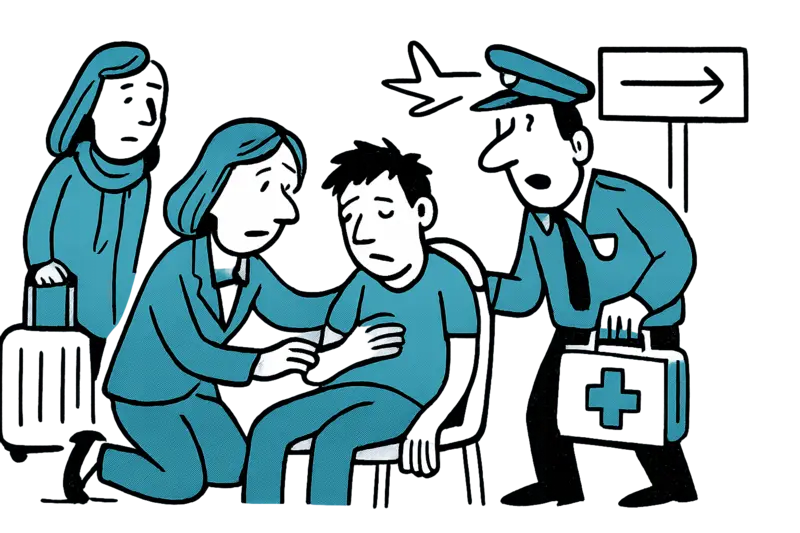
It was an evening like many at the counters in Palma: announcements in three languages, the rattle of rolling suitcases, the clink of the coffee machine in the small gate bar. Around 8 p.m. on an October day, a 19-year-old airport employee suddenly felt unwell – chest pain, dizziness. A colleague sat him down on a chair, seconds later he was gone.
That is the sober fact. Also established: the young man lay unconscious, a passenger who identified himself as a German police officer began first aid, checked breathing and pulse and put him in a stable position. Only after about 35 to 45 minutes did professional rescue teams arrive. The next day the same employee fainted again – again with long waits for medical help.
Key question: Why does rescue take so long at an airport where dozens of people work and travel in a confined space? That sounds rhetorical, but it is a question authorities, operators and the people on site must ask themselves.
Critical analysis: Airports are considered high-traffic places with an increased risk of medical emergencies. Nevertheless, incidents like this reveal typical weaknesses: unclear responsibilities between airport management and emergency services, insufficient staffing during off-peak hours, missing or hard-to-reach defibrillators and poor internal alert chains. If only two employees are on duty and the distances between the gate, access tunnel and parking lot are long, every response is slowed. In addition, an ambulance that is not permanently stationed at the airport can be delayed by city traffic, as reported in New ambulances, empty seats: How a drivers license shortage is slowing Mallorca's emergency services.
What is often missing in the public debate: hard numbers. What were the average response times of emergency services on weekends and in the evening hours over the past twelve months? Where exactly are automatic external defibrillators (AEDs) located, and are they accessible around the clock? What internal trainings have airport employees received for lifesaving immediate measures, and how often are these refreshed? Without these data, much remains tactical feeling and anecdote.
Legal and labor-related questions are also rarely discussed: What duty of care does the airport have toward young employees who spend a lot of time alone at service counters? In a factory hall or supermarket, duty rosters and breaks are already discussed – the same standards should apply at the airport, especially at night, as highlighted by Another accident at Palma Airport: Worker falls on construction site — who protects the employees?.
A brief everyday scene: Passeig Mallorca has a different light in the evening, the palms cast long shadows, a taxi honks as it drops off a passenger. Inside at the counter a young woman with a red scarf waits, her breathing visibly quickens as she gets to the front of the line. No ambulance in sight, only a few colleagues, a passenger who can help by chance. This is not Hollywood drama, this is Mallorca as we know it – loud, warm, improvising.
Concrete measures that could have an immediate effect:
1) Expand and make AED network visible: Every larger waiting lounge, every gate and every service counter area needs a clearly marked, 24/7 accessible device plus short information panels for laypeople.
2) Mandatory first aid training: All frontline and night staff at airports should complete a compact first aid course at least once a year, supplemented by interval refreshers and short practical exercises on site.
3) Stationary emergency teams or fast first-responder routes: Either paramedical teams should be stationed directly at the airport or formal agreements with emergency services should be made to define “green corridors” through the city for faster access.
4) Transparent alarm chain and technology: An internal alarm system so that with one push of a button airport management, security service and terminal operators as well as the emergency services are informed in parallel. GPS-based routing for incoming ambulances can save minutes.
5) Aftercare duties and documentation: When an employee returns, there must be mandatory check-ins and work interruptions. Employers are responsible for preventing recurrences.
Of course, not all problems can be solved locally. Emergency service planning, city infrastructure and budget issues fall to other authorities. But where an airport has operational authority, many things can be changed immediately: site maps in visible locations, drill alarms, simple first aid kits at counters.
What remains is a clear message: honorable help from those present by chance – in this case a German-speaking police officer and later a woman who introduced herself as a nursing assistant – must not replace the island’s safety net, as shown in Port d'Andratx: Tourist Resuscitated by Bystanders and Police After Cardiac Arrest. A dense network of devices, training and organizational clarity would increase the chance that at the next emergency it is not the minutes but the rescue routes that are optimized.
Conclusion: The story of the 19-year-old is not an isolated case in the world of airports, but it is a wake-up call for Palma. It is not enough to rely on luck and random help. Authorities, operators and health services must work together to ensure that at a place where people from around the world come together, the time to professional care becomes measurably shorter. Until then: anyone in the terminal should know where the nearest AED is located and not be afraid to act themselves – because often first aid begins with the person next to you.
Frequently asked questions
Why can emergency response times be slow at Palma de Mallorca Airport, and what factors contribute?
Where should AEDs be located at Palma de Mallorca Airport to improve access?
How often should frontline staff at Palma de Mallorca Airport receive first aid training?
What is meant by 'green corridors' and how could they help emergency access in Mallorca?
What should happen after a medical incident involving airport staff?
What duty of care do airports have toward young employees who work late or alone?
What can bystanders or travelers do during an airport medical emergency in Mallorca?
Why is improving the emergency network important for Mallorca, beyond the airport itself?
Similar News
Toilet Emergency over the Atlantic: What the Madrid–Dallas Incident Reveals About Flight Safety and Passenger Thinking
Six of eight toilets failed on a Madrid–Dallas flight; the crew made a precautionary landing in New York. A harrowing ex...

When Inca Gets Stylish: How Much Space Remains for Locals?
Scaffolding suddenly shapes the streets of Inca. Who benefits from the renovations in the historic centre — and who gets...
Arrest after alleged assault in El Molinar: Who protects guests and staff?
A young woman filed a complaint after allegedly being sexually groped in a restaurant on Palma's waterfront promenade. T...
Two Emergency Landings Minutes Apart at Palma Airport — A Reality Check
At Son Sant Joan Airport, air traffic controllers and emergency crews had to respond twice on an October morning: a jet ...
When they defended two women — and ended up blood-soaked in hospital
On Palma's nightlife promenade an intervention against sexist harassment escalated: two young men were seriously injured...
More to explore
Discover more interesting content

Can Cap de Bou

Townhouse Lleo 72
