
Two Emergency Landings Minutes Apart at Palma Airport — A Reality Check
Two Emergency Landings Minutes Apart at Palma Airport — A Reality Check
At Son Sant Joan Airport, air traffic controllers and emergency crews had to respond twice on an October morning: a jet with cabin pressure issues turned back, and another aircraft landed with a sick passenger. Why the outcome was benign — and which questions should be asked more often on Mallorca.
Two Emergency Landings Minutes Apart at Palma Airport — A Reality Check
How well prepared are we when several problems pile up in the same airspace?
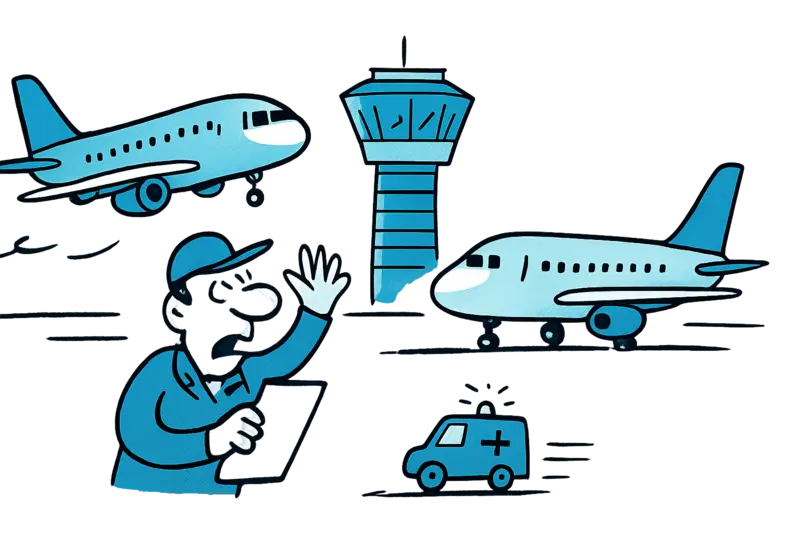
In the early morning of that October day the weather in Palma was mild and around 21 °C. Cafés on Passeig Mallorca put cups of espresso in the sun, suitcases rolled across the parquet in the arrivals hall at Son Sant Joan — and people worked behind glass in the airport control zone. Within a short time they had to coordinate two precautionary landings.
The first aircraft, a jet from the airline Air X on the Faro–Palermo route, reported cabin pressure-equalization problems during the flight. According to the account @controladores, the aircraft was turned over the eastern half of Menorca, an emergency descent was carried out, and the aircraft was diverted to land in Palma. Air traffic control instructed the crew to land on runway 24L (left).
Shortly afterwards another aircraft from Palermo had to land with a medical incident on board. Air traffic control assigned that flight to runway 24R (right) and simultaneously alerted emergency services, which were standing by on the apron. Both situations ended without major incidents; the runways were reopened and general flight operations continued.
Key question: Are the current procedures and resources at Palma Airport sufficient to safely handle two unforeseen events in quick succession?
The short answer: at least on that morning, yes. The longer answer requires a closer look. In practice, “turned out well” does not automatically mean “optimally prepared.” An emergency descent due to pressure problems is uncomfortable for crew and passengers and requires an immediate medical assessment after landing. Similar recent events, like the Heart-stopping moment over Son Sant Joan: Why the Eurowings plane climbed again, highlight the unpredictability. A sick passenger needs rapid care and often multilingual coordination. Two simultaneous incidents test capacities: response routes for fire and ambulances, availability of ambulances and emergency doctors, free apron space, and air traffic control’s ability to reschedule arrivals and departures; previous episodes such as Frightening Seconds over Palma: Two Flight Attendants Injured illustrate how injuries can complicate operations.
One element is missing from the public discussion: concrete numbers and transparency about resources. How many rescue teams are available at the same time? How many operational patient transports are there at the airport outside peak season? Is staff regularly trained for multi-incident scenarios? These questions usually remain unanswered because technical details are rarely published by airport operators and aviation authorities. This lack of transparency has consequences, as coverage of an Emergency Landing at Son Sant Joan: Questions Over Arrests and Procedures shows.
Another blind spot is communication with travelers. Many passengers experience emergency landings as confusing and frightening. Announcements in the arrivals hall are often only in Spanish and English; German-language information is not always immediately available, even though a large share of travelers would benefit. An upset passenger with a roller suitcase and a small child has different information needs than a business traveler looking for a connecting flight.
Concrete, low-cost measures that would bring big benefits locally:
•More transparency and training: Airport operators and authorities (AENA, AESA) could publish semi-annual reports summarizing training, the number of available rescue resources and drill results.
•Joint multi-scenario drills: Not just single exercises, but simulations with multiple simultaneous events — medical emergency plus technical problem — strengthen coordination between the tower, fire brigade, emergency services and ground staff.
•Better passenger communication: Standardized emergency texts in several languages, delivered via app push, loudspeakers and arrival screens, would reduce unrest and speed up procedures.
•More on-site medical first response: A dedicated shift of trained staff familiar with aviation medicine can accelerate decisions on follow-up care and plan hospital admissions.
•Regular coordination with the islands: The diversion of flights near Menorca shows that islands and control levels must work together quickly. Formal communication channels between Balearic control centers should be documented and tested.
An everyday scene helps to put this into perspective: anyone sitting in the cafeteria in Terminal 1 looks out over the aprons and the tower windows. You see the flashing vehicles, hear the rumble of buses, and sense how quickly routine and alarm can sit side by side. In such a moment you realize that good technology and experienced teams make a big difference — but also that transparency and training prevent a “turned out well” from not being enough next time.
Conclusion: Procedures at Son Sant Joan worked on that October morning. Two precautionary landings were handled professionally. Nevertheless, the episode is a wake-up call: a transport hub must be able not only to mobilize emergency capacities ad hoc, but to make them plannable and comprehensible to the public. A bit more openness, a few joint drills and clearer information for passengers would noticeably increase safety — and spare travelers a lot of stress.
Frequently asked questions
Are Palma de Mallorca Airport's emergency procedures capable of handling two problems at once?
Why is there limited public data about emergency resources at Palma de Mallorca Airport?
What kind of drills should Palma Airport run to prepare for multiple incidents at once?
How can passenger information be improved during emergency landings at Mallorca airports?
What role does on-site medical first response play during an emergency landing at Palma?
Why is coordination between Balearic control centers important near the islands?
What was the weather like in Palma during that October morning, and does it affect air travel?
What practical tips can travelers use to cope with emergency landings at Palma Airport?
Similar News
Arrest after alleged assault in El Molinar: Who protects guests and staff?
A young woman filed a complaint after allegedly being sexually groped in a restaurant on Palma's waterfront promenade. T...
When they defended two women — and ended up blood-soaked in hospital
On Palma's nightlife promenade an intervention against sexist harassment escalated: two young men were seriously injured...
Thief takes salon security — and even steals the camera
In Palma a man stole the tip jar and the surveillance camera from a massage salon. A neighbor filmed the act and handed ...
From Workshop to Luxury Villa: What a €19.5 Million House Reveals About Palma's Market
A historic town house on Carrer de la Pelleteria was converted into a 1,000-sq m residence and is on the market for €19....

FC Germania Mallorca: Why does the lead always slip away in stoppage time?
After the 1-2 at C.A. Pal ne da Tesa questions arise: are these coincidences, a shortage of personnel, or a deeper probl...
More to explore
Discover more interesting content

Can Cap de Bou

Townhouse Lleo 72
