
Discovery in Palma: School Construction Uncovers Civil War Air-Raid Shelter
Discovery in Palma: School Construction Uncovers Civil War Air-Raid Shelter
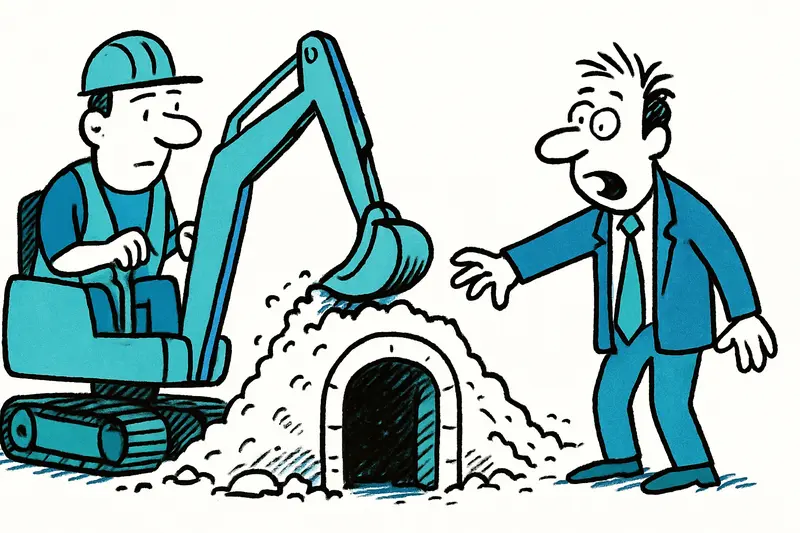
During expansion work at IES Ses Estacions near Plaça d'Espanya, workers came across a well-preserved air-raid shelter from the Spanish Civil War. The facility is planned to be used in lessons; securing it and minor plan changes were necessary.
Discovery in Palma: School Construction Uncovers Civil War Air-Raid Shelter
A buried entrance, remains of wiring and niches for lanterns — suddenly history is very close
It was one of those days when the dust from excavators and the squeak of construction machinery between Plaça d'Espanya and the schoolyards of Palma are part of the routine, a context also examined in Collapse at Palma's City Wall: What Needs to Happen Now. While digging the foundations for the extension of IES Ses Estacions, the wheel of a machine stuck in a hollow. When the site manager cleared the wheel, a narrow, earth-cut entrance emerged: a tunnel system that had apparently lain hidden for decades.
On-site analysis revealed that it is an air-raid shelter from the time of the Spanish Civil War, built for the employees of the former Sociedad Agrícola Mallorquina that once stood here. According to measurements, the shelter extends up to 14 meters deep. Fragments of electrical wiring are still visible in the passageways, and there are small niches in the walls, likely for candles or lanterns. A staircase leads further down behind a rusted grille door, and there are at least two entrances — one is bricked up, the other is buried.
It was not only the technical condition that surprised investigators: a concrete element placed during the school's construction in the early 1990s had apparently breached a tunnel wall at the time without the workers paying further attention. In any case, the underground space remained undiscovered until the current work revealed it, a reminder of issues explored in Wall Collapse at Palma Airport: More Than an Accident — How Safe Are the Major Works Really?.
The finds had immediate consequences for the school. Foundation plans had to be adjusted so the historic structure would not be damaged. Securing the site cost around €15,000, as became clear during a visit by the Balearic education minister, raising questions about infrastructure safety similar to those in Weapons Depot at the Airport: How Safe Is Mallorca Really?. The extension itself — a project of around €2.8 million — continues; the work is expected to be completed in March. The new building is intended, among other things, to provide places for vocational training programs and to relieve the classrooms.
What sounds dry in numbers is something else for the neighborhood and the pupils: a tangible memory. During breaks you can now hear the children whispering about the discovery, and teachers talk in the schoolyard about how lessons change when history is not only found in books but is accessible on the school grounds. These small everyday scenes — a pupil listening curiously at a fenced-off grille, or a teacher studying site plans with a class — make the discovery special.
Experts on site described the space as well preserved. Units that once served civilian protection measures were at the time linked to military installations; a tightly meshed grille separates areas that experts say were connected to a barracks. These historical configurations explain why certain parts of the tunnel were built closed off or with restricted access.
The decision to use the bunker as an educational element in the future carries far-reaching opportunities, and it has already prompted community debates akin to Munitions Bunker Near Son Sant Joan: Why Mallorca's Citizens Should Have a Say. Concrete proposals are already on the table: controlled tours for classes, accompanying materials for history lessons, on-site information that provides historical context, and close coordination with restorers and safety specialists. A digital tour is also conceivable so that all pupils — not only those on site — can become familiar with the facility.
Such measures would achieve two goals at once: the space would remain protected, and remembrance culture would be made tangible and locally anchored. For many residents this is a reassuring thought; instead of filling in an old construction relic, the structure is given a new purpose.
In the end, the find is an example of how urban development and history are intertwined, as other local projects show in Demolition in Palma: When Reconstruction Replaces the Original. Between the clatter of machines and the murmur on the Passeig or around Plaça d'Espanya, a hidden piece of Palma has come back to the surface. The next step will be how the school, the community and the experts gently integrate this heritage into the learners' everyday lives — with safety, transparency and respect for the traces of the past.
Outlook: In future, those standing in front of IES Ses Estacions will see not only a construction site but also an opportunity: a local time capsule that enables remembrance and gives students direct access to history. A small, meaningful gain for the city and local education.
Frequently asked questions
What was discovered during the school construction work in Palma?
How deep was the air-raid shelter found in Palma?
Can the air-raid shelter in Palma be visited by students?
Why did the Palma school construction have to be changed after the discovery?
What signs show that the shelter in Palma was still in relatively good condition?
Is the Civil War shelter near Plaça d'Espanya in Palma connected to military use?
What will happen to the hidden shelter at IES Ses Estacions in Palma?
What should you know if a similar underground structure is found during construction in Mallorca?
Similar News
Injured captain, big plans: Germania Mallorca before the away match in Consell
The newly founded FC Germania Mallorca travels to Consell on Saturday. Captain Bastian Müller is out injured, but coach ...
Palma, Palma de Mallorca, Palma‑Mallorca: What is it really about?
The debate over the city's name is more than grammar: it concerns identity, law and branding policy. A sober reality che...
Warning to Bathers: Nipping Fish in Cala Major and Other Coves — a Reality Check
In Cala Major and several beaches around Mallorca, bathers report painful “nips”. Who are the animals, why are they gett...

Rental Car Theft in El Arenal: What This Incident Reveals About Our Gaps
A teenager steals a running rental car in El Arenal, flees on foot, climbs over walls and is caught by the Guardia Civil...
Red Rope in Palma's Library: What Helps Against Selfie Tourism — and What's Missing
Palma's city library cordoned off an area with a red rope to keep selfie tourism away from reading and working activitie...
More to explore
Discover more interesting content

Can Cap de Bou

Townhouse Lleo 72
