
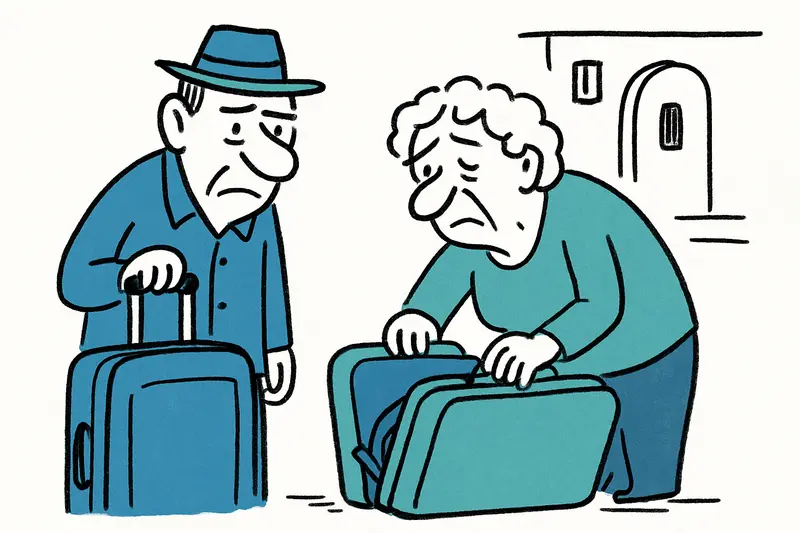
When Rent Becomes a Farewell Letter: How Rising Housing Costs Are Driving Pensioners off Mallorca
María and Paco stand for many pensioners who have to give up their long-time apartments in Mallorca. Rising rents, high additional costs and the spread of short-term rentals are changing neighborhoods — and the problem is often discussed only in fragments.
When Home Becomes a Financial Trap
It does not start with a big bang, but with the quiet click of the front door that is closed behind you for the last time. For María and Paco, who lived for almost thirty years in an old town apartment, saying goodbye is not a romantic new beginning. The rent has multiplied, as reported in Rent-price shock 2026: How Mallorca is heading toward a social crisis, pensions remain small, and even everyday things — electricity, water, bread — suddenly demand calculations at the kitchen table. Those who hear the fans hum in summer and the church bell ring at noon know: something was lost here long before the suitcases were packed.
Central question
How can Mallorca remain livable for the people who are rooted here, without denying the economic forces that make the island attractive? This question runs through conversations on street corners, in bakeries and at the Santa Catalina market — where one used to see the same faces and today often only tourist groups.
More than just high rents
The problem is often reduced to one sentence: "Rents are too high." That is true, but it is too short. Several levers work together on Mallorca: an overheated property market, owners who see apartments as investments, and the growing number of holiday rentals that turn entire neighborhoods into short-term rental zones. This dynamic is amplified by contract and legal changes, as illustrated in Housing Price Shock in Mallorca: How Legal Large Rent Increases Threaten Tenants. Alongside these are quieter cost factors that get lost in debates. Electricity and water prices that fluctuate with climate change; maintenance costs that older owners often cannot immediately cover; and the fact that many pensioners paid low contributions into the pension fund — typical consequences of precarious self-employment.
Underestimated aspects
Vacant second homes are a visible annoyance: apartments left unused for months while young families cannot find a place to live. Equally important is administrative opacity: who owns which property? How many apartments are operated as holiday rentals without proper registration? The lack of transparency complicates political intervention and makes short-term solutions ineffective.
Social costs also play a role. When older neighbors move away, a network of mutual help and local knowledge collapses. The small pharmacy, the baker, the doctor on the next calle — all of that fades when demand falls. Squares become quieter, street conversations rarer. The sound of scooters remains, but the echo of community grows thinner.
Why this concerns us
Displacement is not an abstract problem for planners and politicians. It changes everyday spaces: playgrounds without children, cafés that more quickly become a second living room for tourists, and shop doors that stay closed more often. Social mixing disappears. For an island that lives from its vibrant togetherness, this is a long-term loss of value.
Concrete, realistic approaches
We do not need a great state miracle, but a number of pragmatic measures that work together:
1. Temporary rent caps and indexing — where displacement is acute, temporary ceilings could help, linked to local incomes and inflation rates. Such measures respond to cases like When €800 Suddenly Becomes €1,300: How Minimum Lease Periods Are Pushing Tenants Out in Mallorca.
2. Incentives for long-term rentals — tax relief for landlords who rent to locals and offer long-term contracts.
3. Vacancy management — municipal programs that actively rent second homes or promote their conversion into permanent housing.
4. Decentralized expansion of social housing — not only in Palma, but also in smaller municipalities. The solution must not lie solely in the capital.
5. Transparency and registration — a public register for holiday rentals and ownership structures to make speculation visible and taxable.
6. Strengthening local initiatives — neighborhood projects, tenant cooperatives and community land trusts can create long-term social stability.
Looking ahead
María and Paco are not only packing things; they are saying goodbye to a daily life shaped by small rituals: greeting the neighbor, going to the market, chatting on the bench. Such things cannot be packed into a box. Their story is not an isolated case but a warning signal, as shown in When Rent Decides: How Villages Lose Their Families. If we do not pay attention, whole neighborhoods will become places where one is only ever a visitor.
The question remains: What balance do we create between Mallorca's economic attractiveness and the right to an affordable, communal life? There are answers — and they begin locally: with politics, but also with neighborhoods that stick together and give a voice to new, fair rules.
Frequently asked questions
Why are long-term residents leaving Mallorca because of rent increases?
What is making housing so expensive in Mallorca?
How are rising living costs affecting pensioners in Mallorca?
What can Mallorca do to keep local people in their homes?
Are holiday rentals part of Mallorca’s housing problem?
What happens to a neighborhood in Mallorca when older residents move away?
Is Palma the only place in Mallorca affected by the housing crisis?
What are realistic ways to make housing more affordable in Mallorca?
Similar News
The End of the Cheap Ride? Why Mallorca Is Hit Harder by the Fuel-Price Shock
Gasoline and diesel average close to two euros per liter. What this means for commuters, supply chains and renters in Ma...
Relaxed liquid rules in Munich: What Mallorca travelers will notice
At Munich Airport the 100-milliliter rule will be lifted at all checkpoint lanes — thanks to new CT scanners passengers ...
For 45 Years on Mallorca — and Then This: How a Market Visit in Santa Ponsa Became a Lesson
A woman who has lived on the island for decades lost money and important documents at the Mercat Setmanal in Santa Ponsa...
10 percent surcharge on the beach: How legal and transparent is the extra charge at Playa de Muro?
A German part-time resident noticed days after a restaurant visit in Playa de Muro that the bill included a flat ten per...
Body near the Llevant Market: What this death says about our city
A man was found dead on Sunday afternoon near the Llevant Market. Police say the death appears natural. The scene raises...
More to explore
Discover more interesting content

Can Cap de Bou

Townhouse Lleo 72
