
Employee in Cala Major dies after cardiac arrest: What lessons remain?
A 61-year-old woman collapsed at a fast-food stand in Cala Major. Despite almost hour-long resuscitation attempts by SAMU 061 she could not be saved. A reality check on first-aid preparedness in the workplace.
Employee in Cala Major dies after cardiac arrest: What lessons remain?
Key question: Could more on-site first-aid preparedness have saved her life?
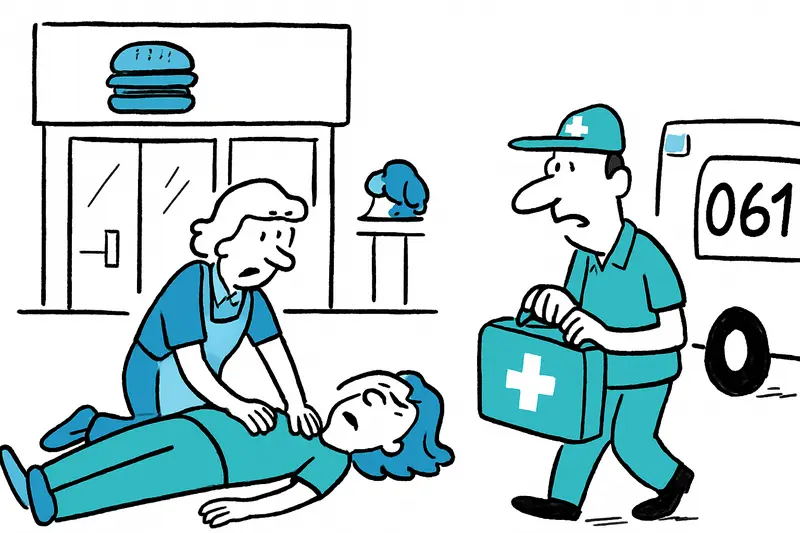
On a late Sunday afternoon, around 4:15 pm, a shift at a fast-food restaurant in Cala Major was abruptly interrupted: a 61-year-old woman, a Bulgarian national, felt unwell while working and collapsed. Colleagues called emergency services; SAMU 061 personnel initially arrived with basic equipment. After a brief stabilization, a cardiac arrest occurred during transfer to the fully equipped ambulance. The rescue team performed resuscitation measures that lasted nearly an hour — without success.
The sober facts are clear. The more pressing question is: what is missing in Cala Major and similar tourist spots so that such situations are less often fatal?
First observation: Cala Major is loud and full in August. Between beach umbrellas, children's laughter and the constant flow of buses and scooters, restaurants sit close together. Looking at the fast-food venue you often notice: space is tight, staff turnover quick, pressure high. In such an environment, small shortcomings in emergency preparedness can have major consequences.
Critical analysis: Many tourist businesses lack systematic preparation for medical emergencies. This affects three levels: equipment, training and organization. Equipment mainly means defibrillators (AEDs). In some places an AED hangs in the town hall or on the promenade, but not in every establishment. Training means enough staff must be trained in resuscitation — not just one certified colleague per shift, but a sufficient number of people who can quickly take over in critical moments. Organization concerns communication with emergency services: how quickly do employees recognize the situation, how is the emergency call described precisely, who ensures access and guidance?
What is often missing from the public debate is the perspective of the employees themselves. Many waitresses and kitchen staff are seasonal workers, often with language barriers or without comprehensive onboarding. Their experiences and fears rarely appear in discussions about tourism quality or safety. Concrete figures are also lacking: how many businesses in bathing resorts have an easily accessible AED? How often are trainings repeated instead of only at the start of employment?
An everyday scene from Mallorca: it is hot, the air smells of sunscreen and fried fries. E-scooters rattle along the Passeig promenade, guests argue over the bill in front of cafés, and behind a glass partition a young colleague explains to a newcomer in simple English and Bulgarian words where the napkins are. It is precisely in such small moments that, in an emergency, it is decided whether someone can react quickly enough.
Concrete solutions that can be implemented immediately:
• Make defibrillators accessible: mandatory labeling and visibility of AEDs in all heavily frequented tourist zones. A clearly visible AED can drastically shorten the time to first defibrillation.
• Mandatory first-aid for shift staff: regular refresher courses (e.g., semi-annually) covering practical CPR and AED use. Trainings should be offered in multiple languages.
• Emergency plans with short role descriptions: everyone must know who calls, who clears access, who provides chest compressions. Short checklists in the back office help avoid panic.
• Public map and signage: a simple, digitally linked map of AED locations and first-aid points at the island level would give orientation to rescuers and laypeople.
• Strengthen employer responsibility: health checks for older seasonal workers, flexible break rules in heat, and an open reporting system for pre-existing medical conditions can be preventive without stigmatizing.
These measures cost time and money, but they are tangible: an AED plus training is far cheaper than the toll of lost lives that shocks residents and visitors alike.
Punchy conclusion: the death of the woman in Cala Major is a tragic sign that hectic tourist life and medical emergency preparedness are not in sync. We cannot undo the event. But we can ensure that in future more people at the workplace know how to help and that the necessary tools are where they are needed. In an island community like Palma it would not be rocket science to make AED availability, regular training and clear emergency procedures the norm. It would be a practical matter, not a political one.
Frequently asked questions
What lessons can Mallorca businesses take from the Cala Major incident about on-site first aid?
How quickly should an AED be accessible in Mallorca’s tourist hotspots?
How often should Mallorca tourism employers train staff in first aid and CPR?
What should an emergency plan look like for Mallorca tourist businesses?
What concrete steps can Cala Major businesses take to improve emergency preparedness?
How do language barriers affect safety in Mallorca’s tourist industry?
Why would a public map of AED locations be useful across Mallorca?
What safety concerns arise from August crowds at Mallorca beaches like Cala Major?
Similar News
Shot Down over Romania: What the Deployment of Spanish F-18s Means for Europe
Two Spanish F-18s destroyed an unidentified drone over Romania. We take a closer look at why the drone's origin remains ...
Kismet off Mallorca: Glamour, Questions and the Silent Downside of the Mega-Charter
The 122-meter superyacht Kismet is anchored off Mallorca. Luxury is visible — but what does the island actually gain? A ...
Lightning Hits the Hills: Bushfire at Es Putxet Raises Questions About Prevention
A thunderstorm lightning strike ignited a bush fire near Es Putxet on Saturday afternoon. 2.1 hectares burned; six aircr...
Cliff Jumping in Mallorca: One Jump, Many Questions
After the serious accident of a 17-year-old at Cala Varques: Why do cliff edges so often end up in hospital beds? A real...
Reality Check Sa Calobra: When Photo Stops Paralyze the Mountain Road
The narrow access to Sa Calobra gets stuck in traffic every summer day: 700–800 private vehicles face only around 300 pa...
More to explore
Discover more interesting content

Boat Tour with BBQ along Es Trenc Beach

Private transfer from Mallorca Airport (PMI) to Pollensa
