
Lightning Hits the Hills: Bushfire at Es Putxet Raises Questions About Prevention
Lightning Hits the Hills: Bushfire at Es Putxet Raises Questions About Prevention
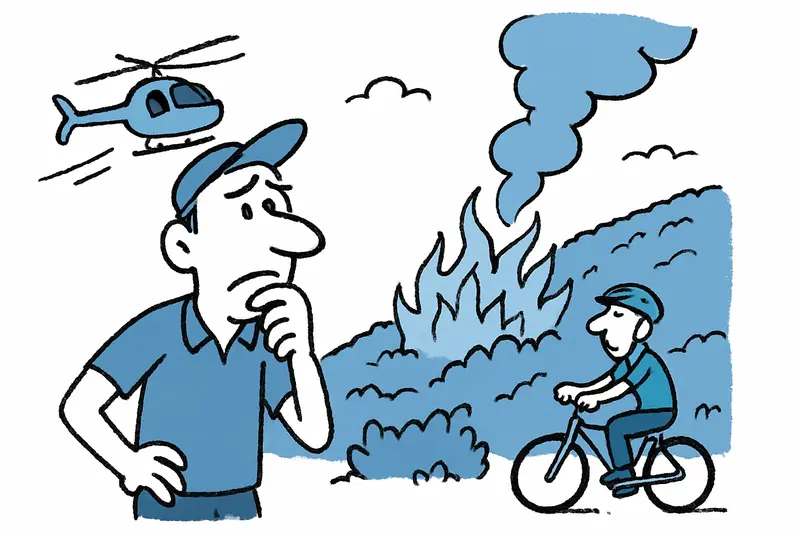
A thunderstorm lightning strike ignited a bush fire near Es Putxet on Saturday afternoon. 2.1 hectares burned; six aircraft and dozens of personnel extinguished it. Time for a reality check.
Lightning Hits the Hills: Bushfire at Es Putxet Raises Questions About Prevention
2.1 hectares burned between Alaró and Consell — crews brought the flames under control within hours
On Saturday at around 3 p.m. a lightning strike in the area of Es Putxet ignited a fire that spread across scrubland and, according to authorities, affected around 2.1 hectares. The response was swift: 34 wildfire fighters, three technicians, three environmental officers, three fire engines, numerous police officers from neighboring municipalities, civil protection volunteers and six aircraft, including the helicopter "La Milana", were deployed. At 6:25 p.m. officials reported that the fire was under control.
Key question: Are our preparations and tactics sufficient when natural forces like lightning hit dry vegetation? That's the question I am left with as I see the faint plume of smoke over the hills in the evening and still hear the distant whirr of the helicopters.
Short analysis: The rapid mobilization of air and ground units likely prevented a worse outcome. Six aircraft for a small, steep theater of operations is not a given and shows that capacities exist. Still, the fact remains that a single lightning strike was able to set several hectares alight within minutes. In recent years we have seen scenes like this more often — short, intense thunderstorms and, at the same time, parched bushes and gorse, as in the Wildfire in s'Albufera: Six Fires Quickly Extinguished — but Questions Remain.
What often gets lost in public debate: firefighting alone is only half the battle. Prevention — such as maintenance of burn areas, functioning water reservoirs nearby, clearly passable access routes and regular clearing along paths — often determines whether a bushfire becomes a larger inferno. Also: who actually checks the pruning and clearing measures on private plots on the steep slopes between Alaró and Consell? As recent events like the Field fire in Inca: An injured firefighter and the question of better protection underline, prevention and protection for crews matter just as much as response times.
An everyday scene: at the Binissalem market an elderly winemaker packs her boxes of grapes while helicopters buzz in the distance. The smell of smoke mixes with the scent of freshly baked ensaimada. Further up on the Camí d'Alaró a cyclist stops, stares toward the Tramuntana and mutters that the fire hotspots of this summer are already all too familiar. These are the small perceptions that show: the danger is not abstract, it touches people, roads and businesses here locally, as in the Field fire near Manacor: What the operation on the Ma-15 reveals about Mallorca's fire risk.
Concrete starting points that could be checked immediately: better lightning detection systems coupled with local alarm management; proactive maintenance of water reservoirs and fire ponds in critical zones; closer coordination between neighboring municipalities for rapid ground teams; targeted support for volunteer organizations and local training for dealing with small fires; mandatory fire-safety plans for newly planted olive groves and stone terraces.
Technically feasible and not utopian: sensors on hills that send heat and smoke signals in real time, combined with drones for rapid reconnaissance — not as a replacement for helicopters, but as a complement so that initial decisions can be made faster. And above all: clear access routes so that fire engines do not end up in dead ends, which unfortunately happens too often on narrow country tracks in Mallorca.
Another detail that is often overlooked: landscape management is also a question of economic incentives. Farmers and owners of small plots need support so that they can cut hedges, create firebreaks or remove biomass without being financially disadvantaged. Otherwise the task is left undone and the vegetation becomes a ticking time bomb.
The political visit on site — Minister Joan Simonet and the mayor of Alaró, Llorenç Perelló — is important for visibility. Crucial, however, is that such visits are translated into concrete measures, for example in budget lines for local equipment, improved coordination of flight resources in the high season and regular training exercises in which volunteers and professionals participate together, as called for after the Heavy Deployment in Inca: Firefighter Injured — and the Big Questions That Follow.
Reminder: a fire that was quickly brought under control is no guarantee against future events. The combination of dry summers, steep topography and isolated thunderstorms remains a combustible mix. Those living in Alaró, Consell or Binissalem know the narrow roads, the old dry stone walls and the small-scale property plots — all of which make prevention more complex than on large contiguous areas on the mainland.
Conclusion: Praise for the emergency services for the swift response; concerns about the next time remain. We should take the incident as a wake-up call and not only applaud when the water bombers turn away. Concretely that means: more focus on prevention, better local infrastructure and reliable support models for those who actually maintain the land. That way an acute firefighting response becomes an effective long-term protection for the island.
Frequently asked questions
What happened during the Es Putxet bushfire near Alaró and Consell?
How do authorities prepare for wildfires in Mallorca?
What can residents do to reduce fire risk on Mallorca's hills?
How does weather influence fire risk in Mallorca?
What role do sensors and drones play in detecting fires on Mallorca?
Why is clear access for fire engines important in Mallorca?
What fire-safety measures are suggested for private plots on Mallorca’s slopes?
What lessons does the Es Putxet fire offer for Mallorca’s future prevention?
Similar News
Shot Down over Romania: What the Deployment of Spanish F-18s Means for Europe
Two Spanish F-18s destroyed an unidentified drone over Romania. We take a closer look at why the drone's origin remains ...

Kismet off Mallorca: Glamour, Questions and the Silent Downside of the Mega-Charter
The 122-meter superyacht Kismet is anchored off Mallorca. Luxury is visible — but what does the island actually gain? A ...
Cliff Jumping in Mallorca: One Jump, Many Questions
After the serious accident of a 17-year-old at Cala Varques: Why do cliff edges so often end up in hospital beds? A real...
Reality Check Sa Calobra: When Photo Stops Paralyze the Mountain Road
The narrow access to Sa Calobra gets stuck in traffic every summer day: 700–800 private vehicles face only around 300 pa...

Am I old-fashioned? Why revealing swimwear in Mallorca is a small cultural debate
A presenter is surprised by skimpy bikinis in Cala Santanyí. An opportunity to talk about gaze, respect and everyday lif...
More to explore
Discover more interesting content

Boat Tour with BBQ along Es Trenc Beach

Private transfer from Mallorca Airport (PMI) to Pollensa
