
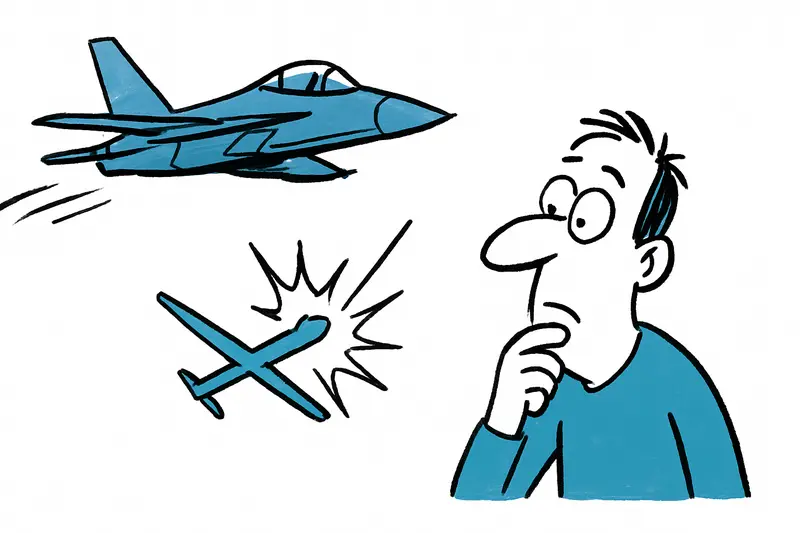
Shot Down over Romania: What the Deployment of Spanish F-18s Means for Europe
Shot Down over Romania: What the Deployment of Spanish F-18s Means for Europe
Two Spanish F-18s destroyed an unidentified drone over Romania. We take a closer look at why the drone's origin remains unknown, what risks this poses for NATO's eastern flank, and what the incident means for us in Mallorca.
Did the drone come from Russia? A question that remains open
The night operation in Romanian airspace raises more questions than answers. NATO air policing Spanish F-18s, deployed as part of a NATO mission, shot down an unidentified drone in the early hours after it entered Romanian airspace 24 kilometres north of Galați. The maneuver was carried out between the towns of Băleni and Cudalbi near the border with Moldova. The drone's origin and who sent it have not been confirmed.
Key question
How dangerous is the information gap when states resolve an airspace breach by shooting down an unmanned aerial object without being able to clearly determine its origin and purpose?
Critical analysis
The shootdown itself shows that NATO alert chains work: radar detection, quick response times, and local decision-making authority. That is reassuring. However, the incident also reveals structural uncertainties. First: if an object cannot be identified, it remains unclear whether it was conducting reconnaissance, a deliberate provocation, or simply a navigational error. Without an on-site forensic investigation — wreckage, electronics, frequency logs — analysis remains speculative. Second: public relations and military decisions proceed in parallel. Reports praise the operation and professionalism, but few details follow. This is understandable for operational security reasons, but it creates an information vacuum that fuels speculation and political tensions.
Third: proximity to Ukraine is not an abstract factor. Romania shares a border of about 614 kilometres with Ukraine and has experienced airspace violations more frequently in recent years. In such an environment, escalation dynamics can develop quickly when neither origin nor intent are transparent. Fourth: the role of allied air forces, here Spain with its 12th squadron, is important, but the responsibility for diplomatic clarification and joint transparency lies with NATO and the respective states, as domestic debates such as Trump threatens NATO expulsion: What Spain's defense row means for Mallorca indicate.
What's missing in the public debate
Concrete information about wreckage finds, technical data of the drone (size, propulsion, payload, communication channels) and the subsequent procedure is missing: Who will conduct the investigation? Will there be a joint NATO analysis? Without such answers, the debate remains at the level of politicians invoking solidarity and military officials emphasizing operational freedom. The civilian perspective — impact assessments for neighbouring regions, humanitarian risks and civil aviation — is underrepresented, as local incidents such as Drone over Palma Airport: Guardia Civil Investigates – How Safe Is Our Airspace? have shown.
Everyday scene from Mallorca
On Mallorca the event feels far away, as local reporting shows in With Drones over the Mediterranean: Palma's Voices from the Gaza Flotilla: people sit outside cafés on Passeig Mallorca in Palma, the smell of fresh café con leche mixes with exhaust fumes, and fishermen in the port of Portixol stack their nets. But if air defence in Europe's east intensifies, restaurants and charter skippers on our coast also appear in the flowchart of measures: more flights over the Adriatic, possible route changes, increased NATO patrols in the Mediterranean. That is the concrete connection between a shootdown near Galați and everyday life on our shore.
Concrete solutions
1) Transparency initiative: NATO and affected states should at least publish a short technical report that names basic characteristics of the drone and the method of detection without endangering operational sources. 2) Joint forensic teams: an alliance procedure for investigating downed unmanned systems can curb speculation and clarify responsibilities. 3) Civil communication: airlines, ports and local authorities should be informed quickly so that civilian operations are not unnecessarily disrupted. 4) Preventive rules: the Alliance should develop clearer rules and procedures for handling unidentified drones — for example, graduated measures before engagement, standardized data-sharing protocols and defined escalation thresholds.
What to do now politically and practically
It is not enough to celebrate successful operations alone. Defence must be linked with diplomacy. EU states on the eastern flank need coordinated processes for dealing with border violations, reconnaissance flights and propaganda maneuvers. At the same time, civilian authorities at the borders need more support: better radar coverage at low altitudes, training for aviation personnel and clearer reporting chains from civilian sightings to military authorities.
Concise conclusion
The shootdown of a drone over Romania shows that military responsiveness exists. What is missing is the bridge from military action to a publicly available, technically substantiated explanation. As long as that bridge is missing, every night operation remains a potential source of political uncertainty. For Mallorca this means: we should continue to monitor the stability of Europe's flanks because geopolitical reactions rarely stop at island borders.
Frequently asked questions
How are unidentified drones handled in European airspace, and what does the process look like for Mallorca residents?
Why is identifying a drone's origin and purpose crucial after an incident, and what does that mean for Mallorca?
What role do joint forensic investigations play after a drone downing, and could they involve Mallorca?
How could rising security tensions in Eastern Europe affect flights and maritime traffic around Mallorca?
What steps should Mallorca's airlines and ports take to stay informed during European airspace incidents?
What does Spain’s involvement in NATO air defense say about the broader security picture for Mallorca?
How should Mallorca’s civilian authorities prepare for potential disruptions from European security incidents?
How can authorities balance military action with public communication during drone events in Mallorca?
Similar News

Rats in Llucmajor: How Uncollected Garbage Became a Health Problem
In Llucmajor, uncollected trash bags, overflowing containers and rain are leading to increased rat sightings. An assessm...

Sly Distraction Scam at Ballermann: How Tourists Became Targets — and What Must Be Done Now
Five suspected pickpockets were arrested. Their method: distract, secure the loot, return the wallet — without the cash....
Eviction in El Arenal: Who protects neighbors — and who protects the homeless?
A vacant hotel on Carrer Girona was cleared and secured. The neighborhood breathes a sigh of relief. But the action trea...

'La Tapita' loses its home: Who will protect Palma's last affordable meeting places?
The bar 'La Tapita' on Simó-Ballester Street will close at the end of December. For neighbors, police officers and small...
Million Heist at Bulgari: Who Is Responsible for Palma's Security Gaps?
Three men stole jewelry worth around one million euros – the crime series began at the end of September and was likely c...
More to explore
Discover more interesting content

Can Cap de Bou

Townhouse Lleo 72
