
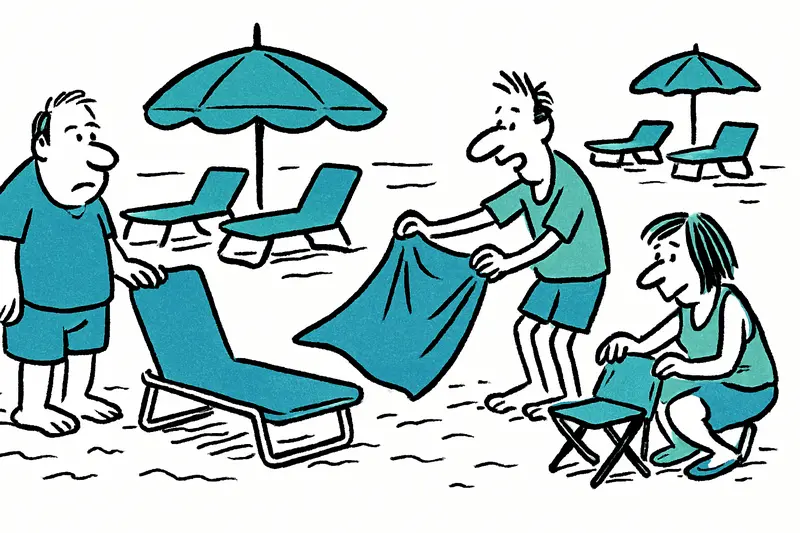
Empty Sunbeds on the Coast: Why Vacationers Will Spread Their Towels Again in 2025
On promenades like in Can Picafort, rows of sun umbrellas sit unattended — a sign of tighter travel budgets, digital headaches and the aftereffects of the coronavirus. What does this mean for rental operators and municipalities?
An unfamiliar sight on the promenade
Last week, just before noon in Can Picafort: the promenade buzzes, the ice cream parlors are doing their best, and yet the beach is surprisingly empty. Not empty in the usual sense — not gaping gaps between people — but rows of umbrellas and sunbeds left unattended. Instead, families spread out their own towels, older couples carry creaky camping chairs from the trunk, children build sandcastles right by the water. The wind brings the distant cries of seagulls, somewhere a parasol rattles, and the sea sparkles as always. Only the familiar clatter of metal frames is missing.
The question nobody likes to ask out loud
Why are the rental lines suddenly no longer the first choice? The answer is a mix of price trends, changed spending patterns and habit. Flights, fuel and accommodation have become more expensive; the average family's travel budget has shrunk, and extras like sunbeds and beach service get cut, as fewer bookings for sunbeds are reported. For visitors who spend only a day at the beach, renting often no longer pays off. For small operators who used to count on selling two sunbeds per guest, a stable income component is collapsing.
What is often overlooked
The public debate quickly turns into "guests vs. locals" or "service vs. cheap vacations." Less noticed is how much rental businesses depend on daily cycles: weekends and holidays fill the tills, weekdays see fluctuating tourist numbers. Many renters have fixed costs — permits, insurance, staff — that cannot simply be scaled down with a few fewer rented beds. When occupancy falls, the consequences are: reduced working hours, shortened opening times or simply shutting down.
There is also a regulatory shadow: permits for beach sales and sunbeds vary greatly by region, some municipalities allow only fixed stands, others impose strict rules on waste disposal and spacing. That makes adjustments expensive — a flexibility small entrepreneurs now need is often lacking.
The digital spark and its consequences
One dispute in an online group was enough to rekindle an old debate: a single complaint post escalated, likes and countercomments followed, and suddenly operators found themselves on the defensive. Reputation online acts like a thermometer — negative headlines deter, positive reviews attract. But instead of investing, many operators now lack the funds for a digital presence or booking systems. The result: customers look for simple, cheap alternatives and bring their own equipment.
A Europe-wide trend, locally very different
Mallorca is not an isolated case. On Italian beaches or on the German Baltic Sea coast, people are rethinking as prices rise. But the consequences differ regionally: on Mallorca, the growing importance of public beach sections and smaller providers could lead to a slowdown — less bed industry, more room for spontaneous beach visits. That has pros and cons: less commercialization means more space for locals, but small service providers risk losing income.
What municipalities and providers could do now
Some ideas are on the table, some rather mundane, others politically sensitive:
Flexible concepts: Instead of rigid daily prices, dynamic rates, half-day slots or combo offers (sunbed plus drink) could stabilize demand. Small alliances of renters could run joint booking platforms to increase visibility.
Regulatory fine-tuning: Municipalities could make permits more flexible in time or allow seasonal reductions of areas so that operating costs fall without harming public access.
Local support: Short-term grants for digitization or marketing would help many operators reach customers again — provided they can access the funds.
A practical approach: More information on the promenades (price lists, combo offers) and simple booking QR codes can turn curiosity into revenue — without great effort.
A look ahead
The current development does not require a big bang, but adaptation. Small businesses must rethink their margins, municipalities must find the balance between service and public space. Some of this may sound nostalgic — the era of always fully occupied sunbeds may be over — but it also opens up space for new ideas: seating areas, pop-up offers, local art on the beach or temporary cultural events.
In the end, it remains a pragmatic decision for many vacationers: save 10 euros and spread your own towel, or make the day comfortable? On the way back to the promenade I unpacked my small camping chair from the trunk — not out of despair, but because it is an answer to a changed everyday life. And the sea? It goes on, calm and relentlessly beautiful.
Frequently asked questions
Why are more people bringing their own towels to Mallorca beaches in 2025?
Is it still worth renting sunbeds on Mallorca beaches?
When is the best time to visit Mallorca beaches if you want a quieter experience?
What should I pack for a beach day in Mallorca if I do not want to rent anything?
Why are beach rental businesses in Mallorca under pressure?
What is special about the beach scene in Can Picafort right now?
Can Mallorca municipalities change the rules for beach sunbed rentals?
Are there alternatives to traditional sunbed rentals on Mallorca beaches?
Similar News

Release after bloody attack in Palma: Why the court's decision raises questions
An 18-year-old who allegedly inflicted a serious neck injury on a man at Plaza Gomila using a wristwatch wrapped around ...
Kidnappings in Inca: Three young men forced into car trunks and abused in the forest – a reality check
In Inca, three 18-year-old men were forced into car trunks by masked assailants at the Plaça des Bestiar, taken to a for...
Spreading Massification: The Brake That Still Has Much Work to Do
Marga Prohens announces limits on volume tourism. The measures sound harsh — but are they enough to save everyday life, ...

Through the Keyhole onto the Party Yacht: How Daniela Katzenberger Is Planning Her 40th on Mallorca
Daniela Katzenberger turns 40 and wants to celebrate it on the island — likely with a boat, cake and her mother. A relax...
By Boat Instead of the Road: Palma's Water Bus — a Reality Check
The 'Bus Nàutic' launches in two stages — but questions remain over interim operations, fares and environmental requirem...
More to explore
Discover more interesting content

Can Cap de Bou

Townhouse Lleo 72
