
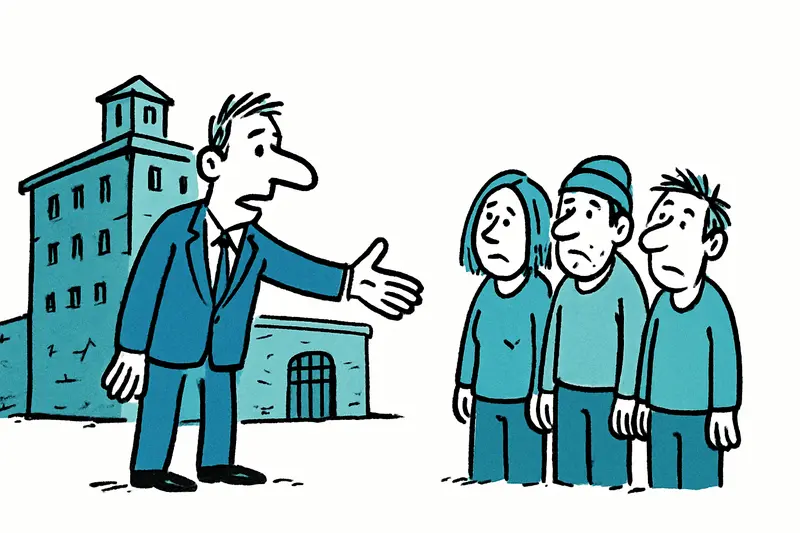
After the Eviction of Palma's Old Prison: Who Will Care for the People Now?
After the Eviction of Palma's Old Prison: Who Will Care for the People Now?
The former prison in Palma has been cleared; 51 people left the site. The city wants to secure the area – but what happens socially next? A reality check from Palma.
After the Eviction of Palma's Old Prison: Who Will Care for the People Now?
On 11 June 2026 the last group of residents left the old prison in Palma. According to the authorities, 51 people vacated the site; some of them are temporarily housed in residential containers. Mayor Jaime Martínez described the operation as an important turning point for the city. According to the administration, the area will be monitored around the clock and then sealed up; a comparable municipal approach was used at Son Banya before the eviction: Court confirms Palma as owner — and now?.
Key question
Can a police eviction and the locking up of a building really solve the social problem – or does the city thereby shift people and responsibility to other places?
In short: The eviction eases the immediate situation around the walls. But it does not answer why people stayed for years in a vacant prison. Three levels exist side by side here: the safety of the site, short-term emergency accommodation and long-term prospects for those affected.
A look at the facts: Access to the site is now blocked, checks are meant to prevent reuse. The short-term solution for some of the former inhabitants are containers – a pragmatic emergency shelter that can be provided quickly, but is no substitute for permanent housing. The number 51 is not just a statistic; behind it are people with very different stories: unemployment, mental strain, broken families or missing papers, trends also highlighted in When Work Isn't Enough: Palma and the Growing Number of Homeless People. None of this can be fixed with concrete and fences.
What is missing so far in the public debate: figures on follow-up care. Which social services were informed? Are there individual plans for the people in the containers? Who covers housing benefits, psychotherapy or help finding work? The administration talks about security and order, but concrete data on prospects are missing or communicated only sparingly.
The situation is also part of everyday city life: In front of a small café near the site residents sit, a neighbour brings food bowls to her cat, a delivery driver swears about the detour. Some glance at the high walls, others look away. Such scenes show that the issue is not abstract – it is part of urban life, with smells, voices and traffic that never fully stops; nearby public spaces suffer too, as noted in Parc de la Mar neglected: Who will save Palma's living room at the foot of the cathedral?.
Critical analysis: An eviction can be necessary when buildings are unsafe or when illegal conditions prevail. But without a clear follow-up strategy it creates new problems. Container solutions carry risks: lack of privacy, bureaucratic hurdles when accessing social benefits, and the danger that people remain in a holding pattern. A sealed building reduces visibility – the city sees less, but the problem is not gone.
What is often overlooked are the interfaces: municipal social work meets regional health services and aid organisations. If these actors are not closely coordinated, blind spots arise. Example: Who ensures that someone with a long-term alcohol problem does not simply end up back on the street after the container solution? Who handles family reunification or people without residency status?
Concrete solutions Palma should now pursue: 1) Individual support teams made up of social workers, health services and legal advisers that develop a clear plan for each person; 2) Time-limited rental subsidies combined with placement on the housing market, instead of relying solely on emergency accommodation; 3) Interim uses of the site with a clear social component – for example projects for affordable housing or workshops that create employment, approaches linked to ideas such as When Offices Go to Sleep: Palma's Plan to Revive the Old Town; 4) Transparency reports by the city: who is taken where, which services are involved, what goals exist in six and twelve months; 5) Involvement of local neighbourhoods so that decisions are negotiated and not just imposed.
A city that locks up walls must not lose sight of the people. Successful models elsewhere combine short-term security with medium-term prospects: from technical securing of the area to binding social planning. That also means freeing up resources for psychotherapy, addiction care and for staff who do outreach work.
Pointed conclusion: The eviction of the old prison may make the immediate problem zone disappear – there is now less that is visible. But responsibility does not end at the wall. Without binding plans and transparent reports there is a risk that people will be pushed into other corners of Palma. Those who want order must also organise care; seeing the two separately is short-sighted and costly for urban society.
Frequently asked questions
What is the weather usually like in Mallorca in late March?
Can you swim in Mallorca in early spring?
What should I pack for Mallorca in March?
Is March a good time to visit Mallorca?
What is Alaró like in spring?
Is Fornalutx worth visiting in March?
What is Lluc like at this time of year?
What should visitors know about hiking in Mallorca in spring?
Similar News
More water than last year: Mallorca's reservoirs breathe easier
September rain refilled the Tramuntana's reserves: overall fill around 35 percent, Cúber at 40.42 percent, Gorg Blau at ...
Three Luxury Hotels in Banyalbufar: Lots of Money, Many Questions
A Danish investor plans three exclusive accommodations in Banyalbufar — including the historic Son Valentí. The announce...
2.1 tonnes of cocaine on sailing yacht off Spain's coast – a reality check for the coastguard
A 14-metre yacht was seized with 2.1 tonnes of cocaine. Who monitors the ports, how does the international hunt succeed ...

Heat Bonus in Mallorca: 100 Euros Extra for Outdoor Staff at MarSenses
MarSenses pays employees who worked outdoors in August an extra €100 as recognition. Lighter uniforms, reduced hours for...
Renovating in Mallorca: What You Really Can Do Without Neighbour Consent
Many think they can do whatever they want in their apartment. That's partly true — but only as long as structural elemen...
More to explore
Discover more interesting content

Can Cap de Bou

Townhouse Lleo 72
