
Long Breath at the Airport: Why a Fainting Incident in Palma Raises Questions About Emergency Management
Long Breath at the Airport: Why a Fainting Incident in Palma Raises Questions About Emergency Management
A 19-year-old employee at Palma airport lost consciousness; according to his account about 40–45 minutes passed before emergency services arrived. Who is responsible for such delays — and what needs to change in the short term?
Long Breath at the Airport: Why a Fainting Incident in Palma Raises Questions About Emergency Management
Key question: How can it happen that a young airport employee, by his own account, had to wait almost an hour for professional medical help — and what lessons should Mallorca draw from this?
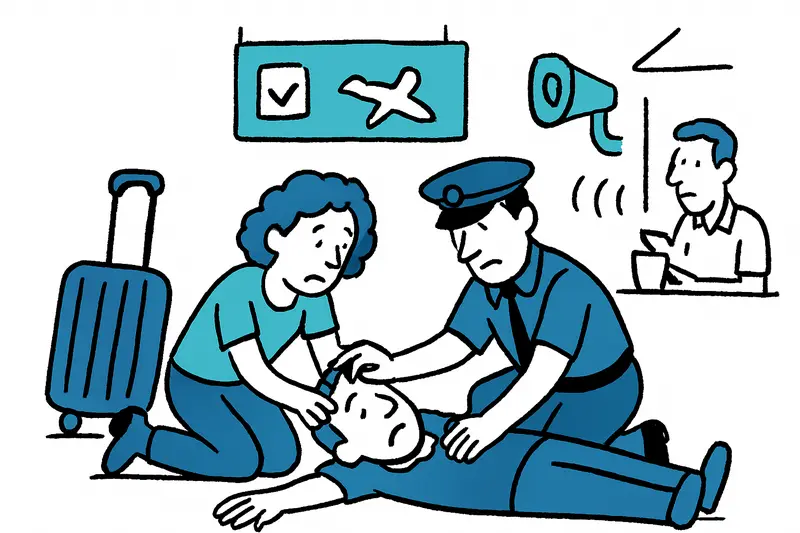
In the evening, around 8 p.m., in one of the busier areas of Palma airport: rolling suitcases clatter, speakers flash announcements in Spanish and Catalan, and a cortado steams at a bistro counter. Where the night shift is only just beginning, a 19-year-old employee complained of chest pressure and dizziness; a colleague briefly sat him down, then he lost consciousness. According to his account, only two staff members were on duty, a few people provided first aid — and a German police officer who was a passenger on site took over vital checks of breathing and pulse.
The affected person's description names a long waiting period: he said he regained consciousness after 35–40 minutes, and the ambulance arrived only after about 40–45 minutes. The next working day he is said to have collapsed again; once more, he stated it took about half an hour for help to arrive. In the same week another emergency was even more dramatic: an older passenger suffered cardiac arrest at the gate and died.
Critical analysis
If the reported times are correct, we are no longer dealing with isolated mistakes but with structural gaps. Airports are public spaces with high footfall and specific risks: long distances to medical care, changing shift patterns, high noise levels and stress among staff. That a professional ambulance arrives significantly later than expected can have various causes: physical distance to ambulance stations, unclear alarm routes within the airport, prioritization of other missions or simply understaffing during peak times. Recent instances such as Storm Chaos in Palma: Why a Storm Slows the Airport So Much — and What Needs to Change show how extreme weather strains resources.
Important: the employee's report is a central source of information — eyewitness accounts are valuable, but not automatically the whole truth. There are no reliable timestamps, logs from the internal alarm system, information on the location and accessibility of AEDs (automated external defibrillators) on site, or figures on how many medical incidents the airport records in a year. Without these data the public debate remains incomplete. Recent operational failures, for example Water in the Check‑in: Drops Again, Questions at Palma Airport, underline the need for transparency.
What is often missing from the discourse
First: the perspective of night and late-shift workers. At the frontline, employees suffer from fatigue and thin staffing levels; their health complaints are rarely captured in statistics. Incidents like Another accident at Palma Airport: Worker falls on construction site — who protects the employees? underline this problem. Second: the condition of the emergency infrastructure. It is not enough to count only the arrival time of a vehicle — what matters is the question of location, traffic conditions and cooperation between the airport operator and the emergency control center. Past events such as Power Outage and Storm: What the Incident at Palma Airport Really Reveals illustrate these vulnerabilities. Third: regular drills and clear responsibilities. In many facilities procedures are documented but rarely tested realistically, especially when staffing is thin.
Everyday scene from Palma
Anyone walking along Terminal A in the evening knows the picture: security staff with flashlights, bar staff clearing the last tables, and couples waiting for their flight. In this atmosphere a collapse is not a private matter. When a colleague goes down, you hear the permanent rolling of trolleys, the dull announcements, the clatter of coffee cups — and often only then the frantic calls for help. Scenes like this show: first aid begins with the willingness of those present, but it needs reliable structures in the background.
Concrete solutions
- Visible and functioning AED stations at all high-traffic gates, well marked and accessible to everyone. - Immediate plans: a clear alarm route for medical emergencies that simultaneously notifies internal contacts, security services and the 112 control center. - Mobile medical teams or a paramedical service during peak times, such as evenings and weekends, when there are significantly more passengers and less staff in the terminal. - Regular, practical training for airport staff, including scenarios under stress and with language barriers. - Rotation plans to reduce fatigue; health checks for customer-facing employees to detect early warning signs. - Publication of response times and baseline figures for airport emergencies to create transparency and enable evaluation of measures.
Pointed conclusion
It is not a catastrophe if a passenger or employee needs medical attention one evening. It is different when help is noticeably delayed. Mallorca depends on tourism and functioning infrastructures; an airport that has to improvise in emergencies is a problem for everyone — travelers, employees and emergency services. The report by the young employee is a reason to examine procedures, plug gaps and assign clear responsibilities. Otherwise it remains a matter of chance whether someone on site will receive rapid professional care — and that must not be our answer.
Frequently asked questions
When is the best time to visit Mallorca for good weather and manageable crowds?
Is it safe to swim at Mallorca's beaches year-round?
What should I pack for a Mallorca trip in spring or autumn?
What should families look for in a Mallorca beach?
What makes Palma de Mallorca a good base for exploring the island?
Is Sóller worth a visit from Palma, and what’s it like as a day trip?
What should I know about visiting Cap de Formentor?
Are the beaches near Alcúdia good for families?
Similar News
When the Bakery Falls Silent: Ca Na Juanita and the Crisis of the Island Bakers
The bakery "Ca Na Juanita", founded in 1910 in Alaró, is up for sale. Why are operators giving up after decades — and wh...
Hollywood Glamour in Palma: Diane Kruger to Attend the Evolution Film Festival
German actress Diane Kruger will be honored with the Icon Award at the Evolution Mallorca International Film Festival. A...
Pothole, Speed, Question Mark: How Safe Are Mallorca's Rally Stages Really?
New clues about a pothole and excessive speed have emerged in the fatal Porsche crash on the MA‑10. What does this say a...
Lifesaving at Palma Provincial Court: Forensic Doctor Begins Resuscitation, SAMU Transports Man to Hospital
On Monday a 53-year-old man suffered cardiac arrest at the Palma provincial court on Avinguda d'Alemanya. An on-duty for...

Lured to Palma with a Fake Job Offer – Forced into Prostitution: What Is Missing from the Debate?
A young woman from South America traveled to Palma hoping for work — instead of a restaurant job she faced sexual exploi...
More to explore
Discover more interesting content

Can Cap de Bou

Townhouse Lleo 72
