
Feels Like 51.1°C in Sa Pobla: What Mallorca Really Needs Now
Feels Like 51.1°C in Sa Pobla: What Mallorca Really Needs Now
The third heatwave brings record values — not only measured, but especially felt in towns like Sa Pobla. A reality check: what this means for everyday life, health and infrastructure on the island — and which concrete measures are still missing.
Feels Like 51.1°C in Sa Pobla: What Mallorca Really Needs Now
The figures from this week sound like they're from a different climate: in Sa Pobla a felt temperature of 51.1°C was recorded on Tuesday, even though the thermometer showed 36.9°C and the humidity was around 60 percent. Campos also reported extreme strain (felt 48°C with a maximum of 39.2°C). In Palma nighttime temperatures did not fall below 27.7°C in the Portopí harbor district, and the air there was still well above 90 percent humid in the morning. This mix of heat and humidity makes the difference between "hot days" and a sustained burden for island society, as reported in Heatwave reaches 42 °C: How Mallorca should cope with the new temperature peak.
Key question
How much of what we now feel — sleep disturbances, weakened harvests, stressed emergency services — is acute weather pain and how much is a new normal for which Mallorca is simply unprepared?
Critical analysis
The discrepancy between measured temperature and the "felt" temperature is not a meteorological trick: humid air reduces the body's ability to cool itself by sweating. Added to that, urban areas, harbor districts and narrow streets hardly cool down at night — a pattern seen in When Palma Is Sweating by Mid-Morning: Heat Alert, Risks and What's Missing Now. The consequence is not just an unpleasant feeling. Chronically high nighttime temperatures impair sleep and thereby the performance of entire work shifts — from kitchen staff at the beach to farm workers in the fields around Sa Pobla. Energy demand for air conditioning rises, as does drinking water consumption. In the short term we see more heat exhaustion rescue operations; in the medium term, crop losses and long-term health consequences threaten if nothing is done.
What's missing in the public discussion
There is a lot of debate about records, and less about practical consequences: how are construction companies, delivery services and farmers supposed to organize their shifts if the hottest hours are also the most productive for them? Where are binding plans for cool refuge points in municipalities without large administrative budgets? And why does hardly anyone talk about black roofs, missing street trees and the need to rethink public spaces before heat-related deaths and longer power outages become an issue — concerns highlighted in When Mallorca Cooks: How Prepared Is the Island for the Next Heatwave??
Everyday scene from Mallorca
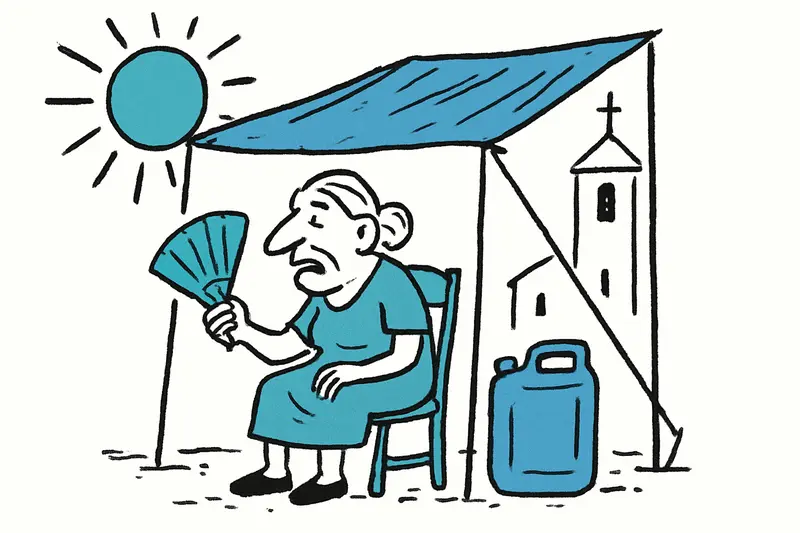
Afternoon in Sa Pobla: on the square in front of the small church an old woman sits in the shade of a tarp and fans herself for hours. Tractors roll more slowly than usual in the streets, and drivers take frequent water breaks. In Palma there is the smell of heated asphalt along the Avingudes, pedestrians clutch cooling water boxes, and ice cream shops have queues stretching to the next intersection. These everyday images show: heat here is not an abstract statistics problem, but something that directly affects people and professions, as illustrated by Nearly 40 °C: Mallorca's Daily Life Under Heat Stress — How the Island Can Respond.
Concrete solutions
1) Short term: Municipalities must make heat-adapted working hours mandatory (start earlier, siesta-like breaks during the hottest hours). Public cooling centers with water supplies and shade must be set up and communicated now. Mobile water stations for fields and construction sites should be subsidized.
2) Medium term: Street greening and shade sails in centers like Palma improve the microclimate. Painting roofs white and greening facades reduce heating. Municipalities can create incentives for climate-friendly air conditioning and better insulation in old buildings.
3) Long term: Adapt agricultural support programs — heat-resistant varieties, modernized irrigation and insurance models against heat-related crop failures. Expand energy infrastructure for peak loads and promote local storage capacities. And of course: ambitious local emission reduction targets combined with planning requirements for new development that take heat protection into account.
Why this makes sense for Mallorca
The island lives on tourism, agriculture and daily vibrancy in its towns. If heat disrupts the working day and nights remain tropical, the economy, health and quality of life suffer. Measures that create shade today and cool nights pay off in fewer hospital admissions, more stable harvests and lower electricity loads.
Conclusion
The felt 51.1°C in Sa Pobla is less a meteorological sensation than a warning sign. Mallorca's decision-makers and municipalities must treat heat as an everyday risk: practical, local and quick to implement. Otherwise hot summers will soon cease to be the exception and become the norm — with far-reaching consequences for everyone who lives and works here.
Frequently asked questions
What is the difference between a measured temperature and a felt temperature during Mallorca heatwaves?
What practical steps can Mallorca take now to cope with extreme heat?
How does extreme heat affect sleep, work, and health in Mallorca during heat waves?
What should travelers or residents pack for hot summers in Mallorca?
Which areas in Mallorca experienced extreme heat and what does that mean for nights?
Are there plans for cooling refuges or shade in Mallorca's towns?
How can Mallorca’s urban spaces be adapted to reduce heat?
How might Mallorca support farming and agriculture to cope with heat stress?
Similar News

More water than last year: Mallorca's reservoirs breathe easier
September rain refilled the Tramuntana's reserves: overall fill around 35 percent, Cúber at 40.42 percent, Gorg Blau at ...

Three Luxury Hotels in Banyalbufar: Lots of Money, Many Questions
A Danish investor plans three exclusive accommodations in Banyalbufar — including the historic Son Valentí. The announce...
2.1 tonnes of cocaine on sailing yacht off Spain's coast – a reality check for the coastguard
A 14-metre yacht was seized with 2.1 tonnes of cocaine. Who monitors the ports, how does the international hunt succeed ...

Heat Bonus in Mallorca: 100 Euros Extra for Outdoor Staff at MarSenses
MarSenses pays employees who worked outdoors in August an extra €100 as recognition. Lighter uniforms, reduced hours for...

Renovating in Mallorca: What You Really Can Do Without Neighbour Consent
Many think they can do whatever they want in their apartment. That's partly true — but only as long as structural elemen...
More to explore
Discover more interesting content

Can Cap de Bou

Townhouse Lleo 72
