
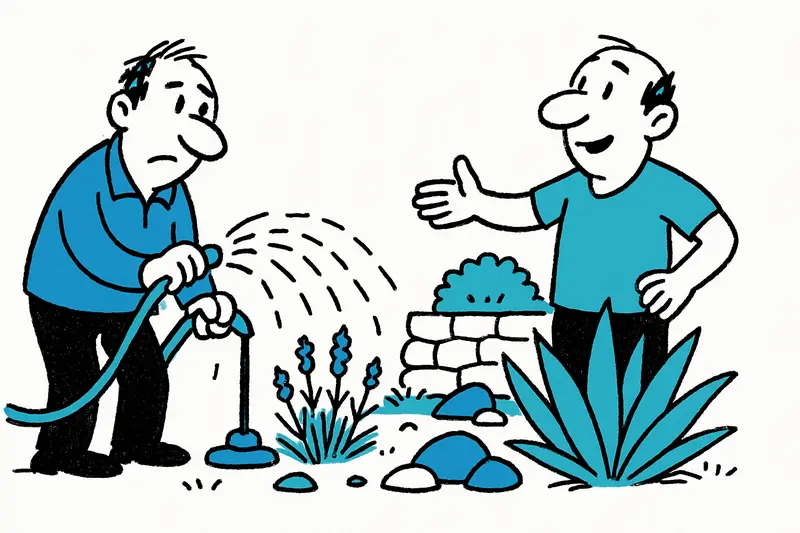
Less Watering, More Flair: How Fincaplantas Creates Dry, Beautiful Gardens in Mallorca
In Llucmajor, a small team shows how Mediterranean gardens can thrive with little to no supplemental water. Less lawn, more lavender, less effort — and a contribution to the island's water-saving balance.
Gardens that cope with the island's atmosphere
On Mallorca we talk a lot about sun, sea and tapas. Between the cicadas' buzzing and the market bustle in Llucmajor, another, very practical topic has slipped into everyday life: Water scarcity in Mallorca. The silent lawn sprinklers in many neighborhoods are an unmistakable sign — classic green lawns simply cost too much here.
This is exactly where a small team from Llucmajor comes in. For about 13 years they have been designing and building gardens that fit the island's atmosphere: drought-resistant plants, shady seating areas, stones, mulch and an eye for the right microclimate. The result seems almost paradoxical: less irrigation, less work — and still cozy.
Practical rather than pompous
Last week at the market, between the scent of freshly baked ensaimada and the merchants' chatter, I met a customer. Her garden was not a green carpet landscape, but lavender along the fence, agaves like small sculptures and thyme peeking out between dry stone walls. "I don't have time to water anymore, and it still looks cozy," she said. A sentence that carries more weight on the island than anywhere else: beauty doesn't have to be bought with high water consumption.
What it looks like in practice
The building blocks are simple but carefully combined. Important are native or Mediterranean species that tolerate dryness: olive plantations in Mallorca, rosemary, lavender, rockroses, sage, shrubs and grasses that don't demand daily watering. Soil preparation makes a big difference — more permeable soil, mulch, gravel beds and targeted infiltration zones change the microclimate.
What most people notice immediately: significantly less maintenance, lower costs and no constant retrofitting of irrigation systems. For the homeowner that means more free time, and there's still plenty to discover with the eye. For the island it means less pressure on groundwater and pipelines, as noted in reports on Mallorca's water balance.
A family business with practical experience
The company works as a small team, brings its own equipment and manages projects from the first sketch to the finished planting list. For many homeowners this is a clear advantage: one contact person, one process, no five different trades that need coordinating. On-site visits often bring more clarity than long theory sessions at the desk.
Interested people can inquire by phone or WhatsApp: +34 686 148 289. Email: info@fincaplantas.com. The website offers examples, but a short visit on site is usually more revealing — and shows quickest how the wind blows here and where the shade falls.
Who this makes sense for
These garden concepts suit fincas, new builds, owners with little time or those who deliberately want to save water. Municipalities and neighborhoods also benefit: gardens remain attractive even when irrigation restrictions apply. A small, honest tip: look at the neighborhood. Often the best ideas come from a chat under the village plane tree.
Looking ahead
On Mallorca not only the plant list is changing, but also the mindset. Standards like lush green lawns are becoming the exception, not the rule. It's quiet, sometimes uncomfortable — but it's also an opportunity: less resource use, more resilient gardens and a landscape image that fits the island. When the Tramuntana is not bringing air, in the evening you can hear the insects humming and the contented murmur of people who have found their place in the garden.
In the end it's a simple equation: less water, less effort, still a garden that lives. On Mallorca this is already more than a trend — it is increasingly the sensible option.
Frequently asked questions
How do you create a beautiful garden in Mallorca without using much water?
Which plants grow well in Mallorca with little watering?
Is a traditional lawn a good idea for a garden in Mallorca?
What makes a Mediterranean garden easier to maintain in Mallorca?
Can you still have a cozy garden in Mallorca if you save water?
Why are more Mallorca homeowners replacing grass with drought-resistant planting?
What is Fincaplantas in Llucmajor known for?
Is a low-water garden a good option for a finca in Mallorca?
Similar News
Bloody clash in Canòdrom Park: What is missing in addressing violence on Mallorca's streets?
At midday on October 23, an 18-year-old man was critically injured in Canòdrom Park in Palma. The attack raises question...

Palma raises bus fares: Who pays the bill for public transport?
Single tickets rise from €2 to €3, airport trips have a reference price of €4.50. It remains unclear whether residents w...

Palma's New Indoor Pool: Sea View, Sunbeds and Space for Everyone
At Aigua Dolça, near the Paseo Marítimo, Palma has a new municipal indoor pool. For a small fee people can now train, re...

How Four Burglars Emptied Ten Houses with a Simple Trick — and What It Means for Mallorca
Four men used the impressioning technique, posed as delivery workers and accepted two years in prison. A reality check f...

Bundles of Drugs, Containers and Open Questions: A Reality Check for Mallorca
3.3 tonnes of marijuana, 80 kilos hidden in golf-ball vending machines and a 44-year-old German released on conditions i...
More to explore
Discover more interesting content

Can Cap de Bou

Townhouse Lleo 72
