
Fire at the Son Hugo Parking Lot: Was it Arson — and Who Protects the Caravan Community?
Fire at the Son Hugo Parking Lot: Was it Arson — and Who Protects the Caravan Community?
A fire at the Son Hugo sports complex parking lot destroyed several caravans and traumatized residents. The National Police are examining the possibility that the fire was set intentionally. A reality check on what's missing and what should happen immediately.
Fire at the Son Hugo Parking Lot: Was it Arson — and Who Protects the Caravan Community?
National Police investigating possible intentional causes, residents left vulnerable
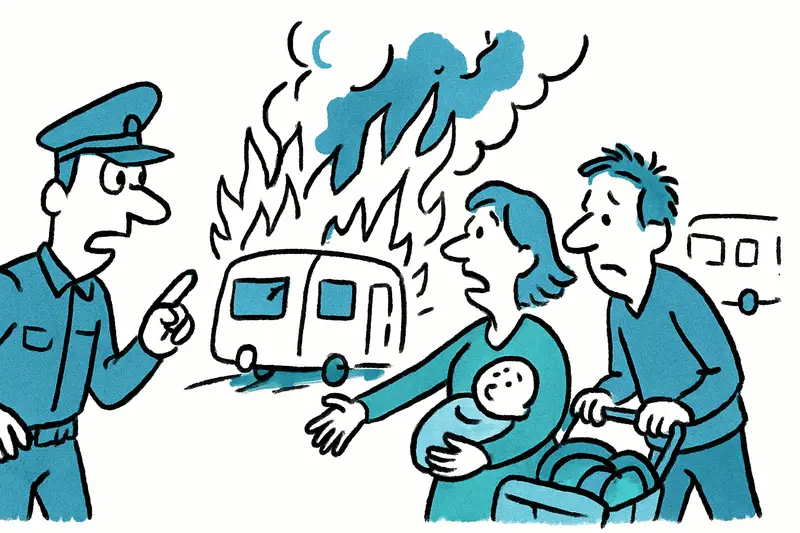
At midday, around 12:45 p.m., a fire broke out on the large parking lot of the Son Hugo sports complex in Palma, spreading quickly from one caravan to neighboring vehicles. At least three caravans were completely destroyed and another was heavily damaged. The National Police have launched an investigation and do not rule out arson; witnesses reported that shortly before the outbreak several people who apparently did not belong to the permanent community of site residents ran away.
The Palma fire brigade responded with a large deployment. Several explosions or deflagrations — likely caused by propane gas cylinders or other pressure containers igniting — worsened the situation. Emergency services and police supported the extinguishing efforts; three people received medical treatment on site: a man for a mild case of smoke inhalation and two women after panic attacks. A resident who helped fight the fire suffered burns to one hand and smoke inhalation.
An estimated 150 to 200 people live on the parking lot; many of them work on the island and found no affordable alternative to living in a caravan at Son Hugo. For at least one family with minor children and a baby a few months old, the fire destroyed their only shelter. The municipal police have therefore involved social services to organize emergency accommodation at short notice.
Key question
Was the fire set intentionally — and why is an entire community being housed on an unsecured parking lot without protection?
Critical analysis
The factual record is sparse but telling. Witnesses who saw people running away are an indication that justifies the National Police in examining deliberate action. Explosions suggest that flammable liquids or gas cylinders were involved; this increases the risk of chain reactions and explains the speed of the spread.
At the same time, the incident exposes structural weaknesses: on a parking lot that is used permanently as a living area, fire protection measures are usually lacking — spacing between vehicles, fixed water connections, secure storage for gas cylinders, escape routes and the ability to move vehicles quickly. If it is verifiably true that 150–200 people live there, this is no longer a temporary emergency but an improvised settlement that requires regulation, infrastructure and oversight.
What is missing so far from the public debate
The debate often focuses on the question "was it arson or not?". That is important but too narrow. There is a lack of concrete engagement on three levels: first prevention — what simple measures could have reduced the extent; second housing policy — why people live permanently on parking lots; third victim protection — how quickly are families put to safety and who bears the cost of rebuilding?
Everyday scene from Palma
Anyone who has walked past the Son Hugo parking lot knows the sounds: buses on the nearby road, the thump of youths playing on the sports field, the smell of fried fish from a kiosk on warm days. Today that mixed with a different reality: sirens wailing, neighbors handing out blankets and water-filled canisters, men pushing loaded handcarts out of the danger zone, a child clutching a blanket. For many locals the settlement is not an abstract problem but the face of people you see on the school run, in the supermarket or on building sites.
Concrete solutions
1) Short term: The city must have a clear emergency plan for such communities — rapid sheltering, initial medical care, psychological support and a small emergency fund for destroyed belongings. 2) Medium term: Official pitches with water connections, fire extinguishers, defined minimum distances between vehicles and secure storage areas for gas cylinders would massively reduce risks. 3) Preventive: Regular fire safety checks, information campaigns in multiple languages and basic training for residents (using fire extinguishers, safe storage of fuels). 4) For investigations: better video surveillance of parking zones, anonymous reporting channels and witness protection to deter targeted arson. 5) Politically: promote affordable housing alternatives so people do not have to move onto parking lots in the first place.
Conclusion
The fire at the Son Hugo parking lot is more than an investigative case. It is a wake-up call: when hundreds of people live together on a parking lot, it is not only about individual perpetrators or unfortunate circumstances but about missing infrastructure and the need for political action. The National Police must clarify whether intent was involved. The city must deliver: emergency shelters, fire protection and a perspective for those affected. Otherwise we will see the same scene again in a few months — with the same outcome.
Frequently asked questions
What steps can residents take to reduce fire risk in Mallorca caravan communities?
How does emergency response work when a caravan community is affected by a fire in Mallorca?
What happened at the Son Hugo parking lot in Palma and what are the immediate concerns?
Could parking-lot living become regulated in Mallorca?
Was arson confirmed in the Son Hugo fire, and what does the investigation focus on?
What immediate support did residents receive after the Son Hugo fire?
What fire safety improvements could reduce risk in Mallorca caravan communities?
What should travelers know about Mallorca’s weather and packing for outdoor days?
Similar News
When Help Takes Too Long: Fainting at the Airport and Gaps in the Emergency Network
A 19-year-old airport employee lost consciousness. An ambulance did not arrive until about 40 minutes later. Why does he...
Toilet Emergency over the Atlantic: What the Madrid–Dallas Incident Reveals About Flight Safety and Passenger Thinking
Six of eight toilets failed on a Madrid–Dallas flight; the crew made a precautionary landing in New York. A harrowing ex...
When Inca Gets Stylish: How Much Space Remains for Locals?
Scaffolding suddenly shapes the streets of Inca. Who benefits from the renovations in the historic centre — and who gets...
Arrest after alleged assault in El Molinar: Who protects guests and staff?
A young woman filed a complaint after allegedly being sexually groped in a restaurant on Palma's waterfront promenade. T...
Two Emergency Landings Minutes Apart at Palma Airport — A Reality Check
At Son Sant Joan Airport, air traffic controllers and emergency crews had to respond twice on an October morning: a jet ...
More to explore
Discover more interesting content

Can Cap de Bou

Townhouse Lleo 72
