
Fire at El Arenal Yacht Club: Why a Burned Luxury Yacht Raises More Questions Than Answers
Fire at El Arenal Yacht Club: Why a Burned Luxury Yacht Raises More Questions Than Answers
In El Arenal a luxury yacht burned almost completely during the night. The fire department prevented worse — but the incident reveals gaps in how port risks are managed.
Fire at El Arenal Yacht Club: Why a Burned Luxury Yacht Raises More Questions Than Answers
Guiding question: How safe are our ports — and who ensures at night that a sea of flames doesn't become a catastrophe?
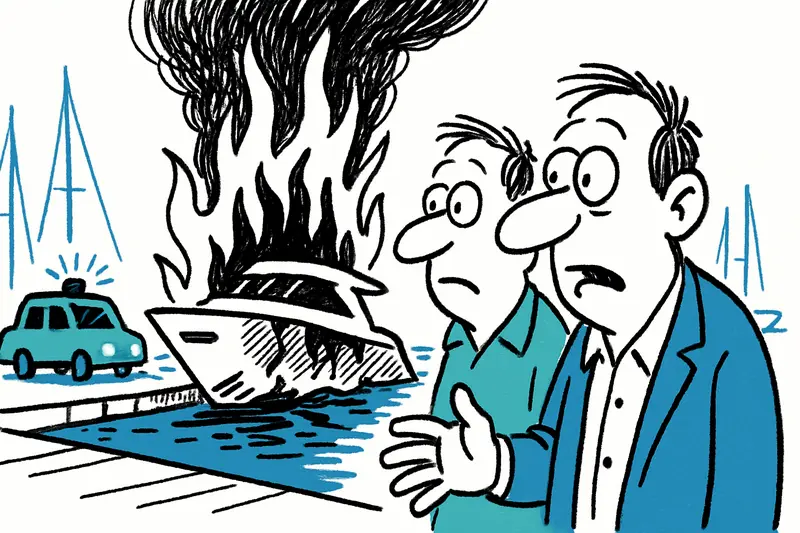
In the early hours of Thursday, the El Arenal Yacht Club was transformed shortly before two in the morning into a scene more familiar from drills: flamestowers meters high, thick smoke and the blue lights of emergency vehicles cutting through the dark bay. A luxury yacht was so badly damaged that it burned almost completely; estimates place the insured value at around one million euros. Investigations into the cause of the fire are still ongoing. Similar incidents have been reported, for example Boat in Flames off La Savina: A Wake-up Call for Recreational Boat Safety. Firefighters, the Llucmajor local police and the Guardia Civil prevented worse: the fire did not spread to neighboring boats and there were no injuries. Investigations into the cause of the fire are still ongoing.
In short: a stroke of luck amid misfortune. But luck alone is no safety concept for ports. When a boat goes up in flames in a busy recreational harbor, it affects more than just the owner. Smoke and heat endanger people ashore, the environment is threatened by leaking fuels, and harbor operations suffer in a place that depends on tourism.
Emergency crews worked on extinguishing the blaze for more than three hours. Eyewitness accounts describing meter-high flames show the intensity of the fire; photos from the area document how the flames lit up the night. The priority of the fire department apparently was initially to prevent the fire from spreading. That is standard tactic — but what does the length of the operation tell us about available resources, accessibility and the supply of firefighting water in the harbor?
Critical analysis
From a locally rooted perspective, several questions arise: How reliable are electrical installations at berths? Who regularly inspects tanks, shore power connections and gas installations on recreational boats? Are firefighting water points sufficiently distributed in the harbor, and are hoses and pump capacities adequate for modern yachts with large fuel capacities? Even more important: are there binding fire protection regulations for private berths and who enforces their compliance?
The Guardia Civil is investigating — that is right and important. But investigations shed light on what happened. Public discussion and concrete proposals are often lacking. In conversations I overheard at the harbor in recent days, boat owners and harbor workers sounded unsettled: one told me on the promenade that inspections are heard of regularly, but everyone keeps their own paperwork. A harbor master’s office that routinely and transparently conducts checks would give many users security — both at night and during the day.
What is missing in the public discourse
The debate often centers on the material damage and the spectacular images. A similar focus followed a blaze on the city promenade, as seen in Fire on the Paseo Marítimo: A Blaze, Many Questions. Technical weaknesses, regular inspections and the role of harbor operators receive less attention. Environmental risks from leaked oil, legal responsibility for inadequately secured berths and the question of preventive investments in firefighting infrastructure remain too often underexposed. Equally rarely is there discussion about how practical fire safety rules can be communicated to smaller boat owners without overwhelming them.
Everyday scene from Mallorca
Anyone who walks along the Passeig Marítim of El Arenal in the morning knows the mix of sea air, barefoot early risers and the distant buzzing of boats. In such moments nobody thinks of fire. And yet the sound of the sirens that cut through the promenade that night lingers: a stark reminder of how quickly everyday life can turn into an alarm. Local accounts of other blazes along the promenade are available in Car on the Paseo Marítimo in Flames – Bang, Smoke and Many Questions. Harbor workers who maintain berths during the day often know how risks could be mitigated — but do not always have the authority or the means to do so.
Concrete solutions
- Regular, mandatory safety checks for shore power connections, refueling points on the quay and gas installations on yachts, carried out or certified by the port authority.
- Clear maintenance and reporting obligations for operators of recreational berths; protocols must be accessible to operators and authorities.
- Expansion of the harbor's firefighting water supply: additional outlets, better hydrant distribution and mobile pumps that can deliver sufficient capacity even for larger yachts.
- Mandatory training for harbor personnel and regular exercises with realistic scenarios, including environmental and oil-spill response.
- Information campaigns for boat owners: simple checklists and mandatory safety briefings when renting and when registering berths.
Conclusion
The fire at the El Arenal Yacht Club was a warning signal. It resulted in property damage — and that is not insignificant. But it could have been worse. The current opportunity must be used to openly identify safety gaps and implement pragmatic steps: locally, realistically and with clear responsibilities. Otherwise, after the images of the flames only stagnation will remain — and that would be the most costly aftermath of all.
Frequently asked questions
How common are boat fires in Mallorca ports?
What makes a yacht fire in Mallorca so dangerous?
What should boat owners in Mallorca check to reduce fire risk?
Who is responsible for fire safety in Mallorca marinas?
What happens after a yacht fire in El Arenal, Mallorca?
Are Mallorca marinas prepared for large boat fires at night?
Is it safe to walk around El Arenal Yacht Club after a fire?
What fire safety improvements could help Mallorca ports?
Similar News
Car on MA-13 near Inca in flames – a safety check for the island
A vehicle caught fire on the MA-13 towards Alcúdia on Tuesday afternoon. The driver was uninjured, the car was destroyed...
Real Estate in Mallorca: Fewer Buyers, Higher Prices — What's Behind It?
Sales on Mallorca are falling, yet prices continue to climb. Why fewer transactions do not equal relief — and what shoul...
Just Bought — Already Trouble: Water Damage in the Heiters' Villa and What Owners in Mallorca Should Know Now
A newly purchased sea-view property — and within days a water damage. What risks lurk in new properties in Mallorca, and...

Rich, Richer, Mallorca? A critical look at the growing super-rich bubble
Numbers: Around 3,600 millionaires in the Balearic Islands hold a combined €27.6 billion. What this concentration of wea...
Chain reaction on the MA-1: Eight injured in rear-end collision near Portopí
On Tuesday morning there was a crash at the Andratx exit to the MA-1 towards Palma: a rear-end collision between a car a...
More to explore
Discover more interesting content

Can Cap de Bou

Townhouse Lleo 72
