
Heat Shelters for Mallorca — a Reality Check
The state plans to set up a network of heat shelters on Mallorca by next summer. What's still unclear: who pays, who is responsible and how will people get there? A critical look with concrete, everyday proposals from the island.
Heat shelters for Mallorca — a reality check
Key question: Are state-provided administrative buildings sufficient refuge against extreme heat — and who ensures they actually help?
The announcement that a state network of climate refuge locations should be in place by next summer meets mixed feelings here on the island. On the Ramblas and in the side streets of the old town you now hear the clack of brooms in winter rather than the hum of air conditioners. Still, conversations with neighbours show that memories of hot July days run deep, such extremes are documented in Nearly 40 °C: Mallorca's Daily Life Under Heat Stress — How the Island Can Respond. The idea that administrative buildings could be opened during the hottest months sounds reasonable at first. On paper, town halls, libraries or cultural centres can be repurposed quickly. In practice, however, many questions remain.
Critical analysis: The biggest weakness is not the intention but the details, as noted in When Mallorca Cooks: How Prepared Is the Island for the Next Heatwave?. What standards apply to these rooms? Who bears the operating costs for air conditioning or emergency power? How will it be ensured that people without private transport — such as elderly residents in neighbourhoods like La Soledat or families without regular work — can reach the centres? And how will temporary refuges be linked to existing municipal measures such as drinking water fountains, shade islands or greener urban planning?
In discussions around the announcement, a look at day-to-day logistics is often missing: opening hours, language barriers, transport and information. On Mallorca many people are out of reach of German or Spanish local media: seasonal workers, retirees with limited mobility, tourists in holiday rentals. An open town hall is of little use if no one knows it's open — or how to get there. In addition, the current energy price situation means that operating large cooled spaces can be expensive; that immediately affects municipal budgets.
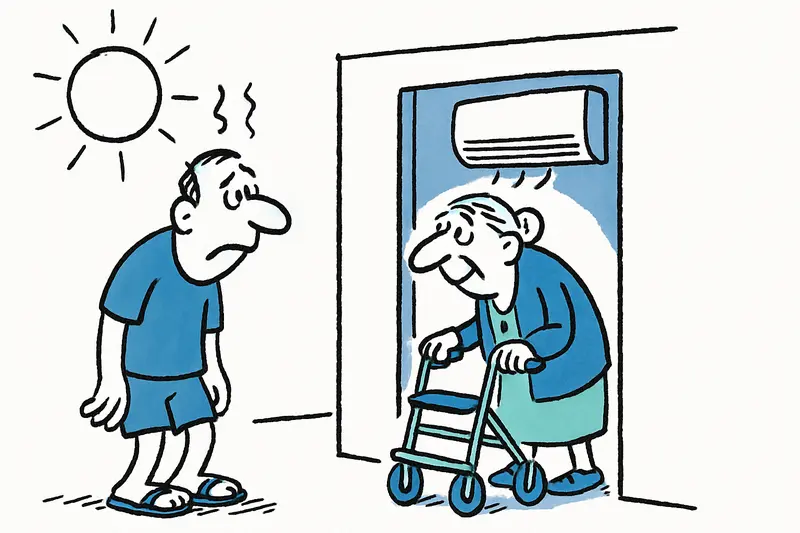
Everyday scene: On a hot afternoon in Palma's Carrer Sindicato an elderly woman pushes her rollator past, a vendor at Mercado Olivar lowers his awning and young people seek shade under the plane trees on Passeig des Born. Such scenes are repeated across the island. When heatwave warnings come, it is precisely these people who need help first — not hotels with their generous pools, this contrasts with debates about using hotels in emergencies discussed in Hotels as an Emergency Measure: Between Humanity and Routine on Mallorca.
What is missing in the public discourse: a clear allocation of responsibilities between the state, regions and municipalities. Announcements remain vague about whether there will be binding 최소 criteria for heat shelters — room temperature, maximum length of stay, medical equipment, accessibility. Hardly discussed is the protection of people without a fixed residence or of seasonal workers who often live in cramped accommodation, as highlighted in No official heat protection for the homeless in Mallorca.
Concrete approaches that could work on Mallorca:
- Set standards: Simple minimum requirements for every refuge: shading, access to drinking water, seating, barrier‑free access and backup power for cooling.
- Local maps and transport: Cooperation with public transport providers to set up temporary lines or shuttle services during warnings; maps for residents distributed through neighbourhood associations and pharmacies.
- Multilingual information: Notices in Catalan, Spanish, English and German distributed in supermarkets, markets and holiday accommodations — so we reach workers and guests alike.
- Energy costs and backup: State subsidies for operating cooling in public spaces and solar-battery kits for emergencies; smart timers so that rooms are only brought to temperature when needed.
- Neighbourhood networks: Training for volunteers in communities, simple checklists for vulnerable people and direct telephone or WhatsApp hotlines that name clearly reachable contacts.
- Long term: More urban greenery, façade greening and binding requirements for thermal retrofits of public buildings — these are investments that permanently reduce heat stress.
On the topic of disinformation: the announced tightening in the fight against false information is important, but it needs local implementation. Weather service data must be presented in an understandable way and communicated early. Daily heat warnings via local radio stations, notices in municipalities and clear behavioural guidance for hoteliers and landlords so that tourists also know how to act, as recommended in Heat alert on Mallorca: How well is the island prepared for infernal heat days?.
Conclusion: Setting up state heat shelters is a step in the right direction. What matters is that the political push becomes concrete, funded measures that reach people — not just empty halls in administrative buildings. If the island administration, municipal utilities, neighbourhood associations and health services jointly organise standards, transport solutions and multilingual information, such spaces can save lives. Until then the announcement remains a good intention that still requires a lot of work.
Frequently asked questions
Are heat shelters in Mallorca likely to help during extreme summer weather?
What should a good heat shelter in Mallorca provide?
How can older people in Mallorca reach a heat shelter if they do not drive?
When do heat shelters in Mallorca matter most?
What kind of information should Mallorca residents get during a heatwave?
Are town halls and libraries in Mallorca suitable as heat refuges?
What happens to homeless people during extreme heat in Mallorca?
What long-term changes could reduce heat stress in Mallorca?
Similar News
Injured captain, big plans: Germania Mallorca before the away match in Consell
The newly founded FC Germania Mallorca travels to Consell on Saturday. Captain Bastian Müller is out injured, but coach ...
Palma, Palma de Mallorca, Palma‑Mallorca: What is it really about?
The debate over the city's name is more than grammar: it concerns identity, law and branding policy. A sober reality che...
Warning to Bathers: Nipping Fish in Cala Major and Other Coves — a Reality Check
In Cala Major and several beaches around Mallorca, bathers report painful “nips”. Who are the animals, why are they gett...

Rental Car Theft in El Arenal: What This Incident Reveals About Our Gaps
A teenager steals a running rental car in El Arenal, flees on foot, climbs over walls and is caught by the Guardia Civil...
Red Rope in Palma's Library: What Helps Against Selfie Tourism — and What's Missing
Palma's city library cordoned off an area with a red rope to keep selfie tourism away from reading and working activitie...
More to explore
Discover more interesting content

Can Cap de Bou

Townhouse Lleo 72
