
'Zombie' fern of the Tramuntana: What desiccated greens teach us about Mallorca's future
Found on the rugged walls of the Serra de Tramuntana: seemingly dead ferns that turn green again after rain. Why this matters — for hikers, gardeners and Mallorca's agriculture.
'Zombie' fern of the Tramuntana: What desiccated greens teach us about Mallorca's future
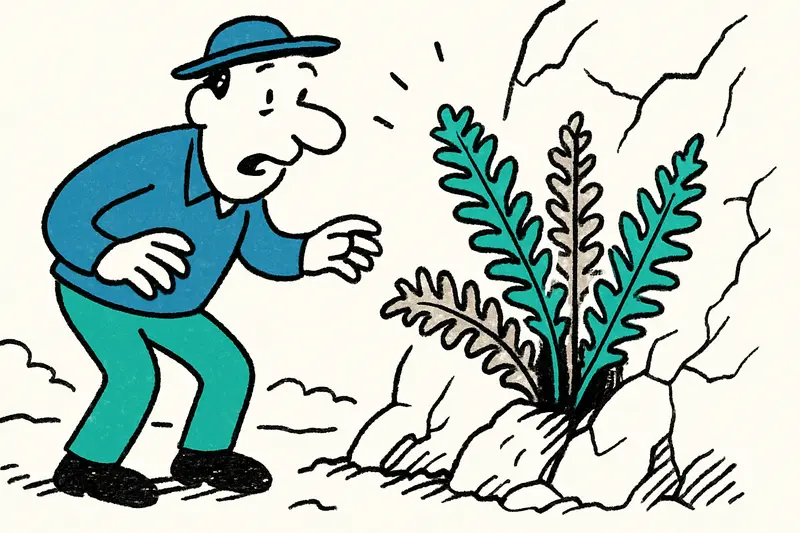
One early morning on the way to Fornalutx, when the church had only just tolled its first bells and a cold breeze carried the scent of wet limestone, I noticed something: in shady crevices hung bronze-coloured, seemingly dead leaves. A few days after the rain they were green again. Not a fantasy movie, but everyday life in the Serra de Tramuntana. Locals half-jokingly call such plants 'zombie' plants — and they raise an important question:
Key question: Can these resurrection artists help make Mallorca more drought-resilient?
Biologists at the Universitat de les Illes Balears study species like the fern Ceterach officinarum, as described in Helecho 'zombi' de la Tramuntana: Lo que las plantas resecas nos enseñan sobre el futuro de Mallorca. What looks like passive drying-out is actually a sophisticated survival mode. In drought the plants downregulate parts of their metabolism, reduce cell activity and protect delicate structures. Once moisture returns, repair mechanisms start: cells refill with water, protective molecules neutralize damage, and photosynthesis restarts.
Mosses and ferns are the classics of this "desiccation tolerance." In the Tramuntana they use rock niches, old dry-stone walls and the shade of pines to create microclimates where temperature and humidity swings are less extreme. Anyone who has hiked between Lluc and Fornalutx knows the rustle of leaves and the soft trickle in hidden pockets of the mountains — that's where these little survivalists live.
Why this goes beyond mere curiosity
If rainfall becomes more erratic, this is not just a botanical curiosity. The researchers have a clear goal: to understand the mechanisms and see which of them could be transferred to crop plants — whether through classical breeding, genomic support or agronomic measures. A reality check is important: corn will not become a fern. But the principle of managing stress signals efficiently or limiting cellular damage could help stabilise yields.
There are, however, hurdles that rarely appear in sunny features. The genetics of such adaptations are complex. Some protective mechanisms are the result of many small changes accumulated over long periods. And then there is the question of ethical and ecological consequences if genetic engineering or highly interventionist methods were used. Here in Mallorca additional local factors come into play: small plots, diverse crops and strict landscape protection rules; for another perspective on environmental change around the island see Sea off Mallorca: When the Underwater Meadow Disappears.
Concrete opportunities and solutions — not just in the lab
The Tramuntana itself offers clues: microclimate management, sensible terracing, preservation of dry-stone walls and shade-providing vegetation create conditions where crops experience less stress. Research can provide two things: firstly, insights into which metabolic pathways are particularly effective; secondly, practical recommendations for gardeners and farmers — such as companion plants, soil improvement measures or adapted irrigation strategies.
Concrete proposals that could grow from research and everyday practice:
1. Protection and mapping — Map and protect microhabitats in the Tramuntana. These places are research archives and genetic treasure chests at the same time.
2. Citizen science — Involve hikers, gardeners and schools — and follow local guidance on observing wild plants as in Mushroom Season in Mallorca: Foraging with Respect — Risks, Rules and Useful Tips: who will collect observations of 'resurrection' plants? Mobile photos with location and date can support researchers.
3. Research transfer — Start practical pilot projects with farmers to transfer ideas from the lab to the field — without false promises.
4. Low-threshold agricultural practices — Building humus, mulching, shade islands and terrace upkeep: small measures with big effects on water retention.
Between conservation and use
It would be a mistake to rely solely on technical solutions. The quickest protection for these plants is to avoid destroying the crevices, walls and shaded gaps where they live. Tourism, wall renovations without ecological assessment and invasive species can wipe out habitats before we can even study their secrets. A note to everyone: please do not dig them up. These 'zombie' plants are not souvenirs.
In the end it is a typical Mallorcan picture: on steep terraces a small world grows that endures a lot — and asks only a little consideration from us. On the next hike, when a light wind moves through the pines and the clatter of boots on old steps is heard, it's worth looking more closely at the rocks. Under the bronze veil life may be waiting — not a ghost, but hard-won adaptation. And perhaps, researchers hope, also a building block for a more resilient island.
Note: observe yes, dig up no. Let's leave these little survivors where they function best.
Frequently asked questions
What are the 'zombie' ferns found in the Serra de Tramuntana in Mallorca?
How do drought-tolerant plants survive the dry summer in Mallorca?
Why are Mallorca researchers interested in so-called resurrection plants?
Where can you see drought-adapted ferns and mosses in the Tramuntana?
Is the hike between Lluc and Fornalutx good for spotting unusual plants?
Can Mallorca’s drought-resistant plants help agriculture cope with less rain?
What should hikers do if they find rare ferns or mosses in Mallorca?
Why are dry-stone walls important for plants in the Tramuntana?
Similar News

"Expensive chaos" and many open questions: What clients can do when a lawyer suddenly stops responding
Several clients complain that a well-known German lawyer in Mallorca has been unreachable for months. Key question: What...
TV tip: 'The Last Problem' — Mallorca as the setting of a classic crime
A classic whodunit on Mallorca: A new miniseries set in spring 1959 brings storm, an isolated hotel and a dense web of s...
Nipping Sea Creatures: Why Bathers in Cala Major and Elsewhere Should Be Cautious
In Cala Major, bathers have reported being nipped by small fish. What is behind it, how can problems be avoided — and wh...
Forced eviction in Santa Catalina: When a 65-year-old slept in her car and showered on the beach — a question of responsibility
The story of Pilar López from Santa Catalina represents a problem affecting many Mallorcans: How can an island with a bo...
New traffic rules from October 1: What Mallorca visitors and locals need to know
From October 1, 2026, Spain will implement far-reaching changes to traffic regulations. Important for Mallorca: greater ...
More to explore
Discover more interesting content

Can Cap de Bou

Townhouse Lleo 72
