
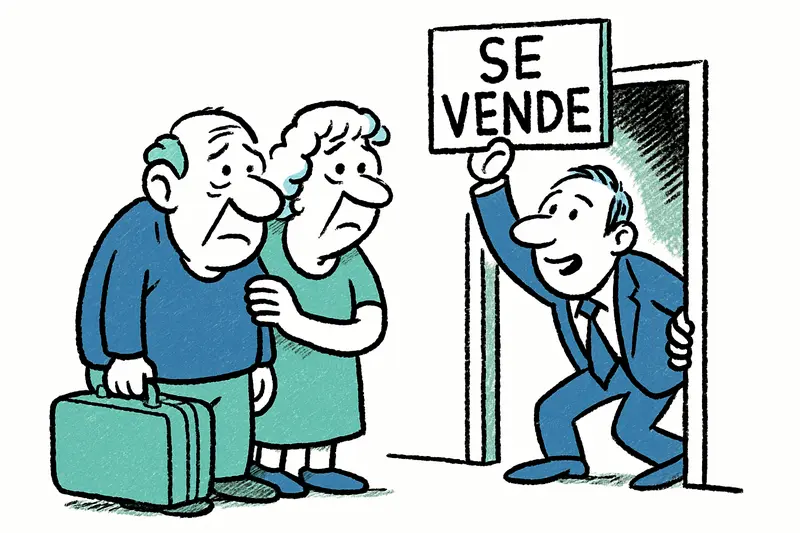
Housing shortage in Mallorca: Why even retirees are now leaving the island – and what can help
Housing shortage in Mallorca: Why even retirees are now leaving the island – and what can help
More and more people who spent their working lives in Mallorca are moving away — because pensions and rent no longer add up. A critical analysis with concrete proposals and a scene from Palma.
Housing shortage in Mallorca: Why even retirees are now leaving the island – and what can help
Key question: How long can a society accept that the generation that built the island is forced to move away in old age?
The bare numbers, short and painful
On the Balearic Islands the average monthly pension is around €1,400. The average rent comes to about €1,500. And the price per square meter for residential property is often over €4,000 — simple flats frequently reach values beyond the €300,000 mark. Those who sell can buy a house on the mainland for significantly less; there prices under €1,500 per square meter are quoted. That adds up, as reported in Buying and Renting in Mallorca: Why Prices Are Pushing Locals to the Edge — and What Could Help Now.
Critical analysis: market logic meets social reality
The market does what markets do: it allocates resources according to ability to pay. The result is a double displacement. On the one hand, rents and property prices rise due to demand, holiday rentals and investments. On the other hand, there is a shortage of households with stable but not lavish incomes. Retirees with average pensions either become owners — or they have to leave. This logic is not an abstract statistic; it changes neighborhoods, local communities and the social fabric of places like the Mercat del Olivar or the residential streets around the Passeig del Born, a pattern reported in When Rent Becomes a Farewell Letter: How Rising Housing Costs Are Driving Pensioners off Mallorca.
What is often missing from public debate
Two things are rarely discussed sufficiently: first, that these are not just individual fates but a structural filter that excludes an entire age group. Second, that temporary measures — such as short-term rental restrictions or isolated new-build projects — will have little effect without income and pension policies, a situation detailed in Why long-term rentals in Mallorca are dwindling — and what could help. The local perspective is also missing: in many towns you notice departures by closed bakeries in the morning, empty chairs on the plaza, and more and more "Se vende" signs on façades that used to belong to families.
Everyday scene from Palma
A Wednesday morning at Olivar: the fishmonger knows the retired taxi driver who comes every other day to buy bread. Since the start of the year she speaks with him less often — he has already handed his keys to a realtor. He still drives through the city, parks in front of the café, drinks his cortado, and talks about moving to Galicia. The tram rushes by. A boy throws a ball against a yellow house wall. The island remains lively, but the voices are changing.
Concrete solution approaches
Describing problems is not enough. Here is a package of proposals that is local and technically concrete:
1) Priority for local seniors in social housing. Municipalities should plan reservations for households with low pensions in new builds and conversions. This can be anchored legally and in budgets.
2) Renovation funds instead of luxury refurbishments. Public or cooperative loans for homeowners who want to renovate and keep flats affordable without converting them into holiday rentals.
3) Tax incentives for long-term rentals. Those who rent to local retirees or offer long-term leases receive reduced property taxes or depreciation allowances.
4) Local mediation and advice centers. Neighborhood offices help find alternative housing forms, negotiate with landlords and evaluate sales options — so that sales are not rushed and made without comparison.
5) Regional cooperation. Talks with origin regions on the mainland can organise models for returnees — for example support with renovation and transport instead of merely accepting the "emigration".
What to bear in mind
These measures need political backing and financial planning, as underlined by Rent-price shock 2026: How Mallorca is heading toward a social crisis. There is no quick magic solution; but there are levers that, if pulled wisely, help. Prioritization must not remain merely symbolic — otherwise the decision will again move into the private market.
Conclusion, pointed
Majorca is quietly losing people. Not tourists, but those who worked here, paid taxes and raised families. This is not the consequence of individual misconduct but a collision between scarce housing and fixed pensions. Anyone who claims this is only an isolated case overlooks the systematic dimension. It is time to turn neighborhood stories into political plans — before the streets become permanently quieter.
Frequently asked questions
Why are some retirees leaving Mallorca because of housing costs?
Is it still possible to rent affordably in Mallorca if you live on a pension?
What makes Mallorca’s housing market so expensive for local residents?
What can help older residents stay in Mallorca instead of moving away?
What is the situation like for housing in Palma’s city centre?
Are short-term rental rules enough to solve Mallorca’s housing shortage?
What happens to the local community when retirees leave Mallorca?
Can selling a home in Mallorca make it easier to move back to the mainland?
Similar News

Released with Conditions: The Plus Ultra Suspicion and a Mallorcan Finca as Residence
A Dutch entrepreneur, sought in connection with the Plus Ultra case, was extradited to Spain after his arrest in Germany...

Haute Nuit in Puerto Portals: Fashion, Art and Indulgence by the Water
On October 2 the Lobster Club in Puerto Portals will be transformed into a stage for curated fashion, art and culinary e...

Magaluf: Watchtower Alarm – Lifeguards Pull Unconscious Beachgoer from the Water
After a drama in the late afternoon, two lifeguards at Magaluf beach rescued an unconscious 44-year-old man. He was stab...

Turquoise in the City: How dangerous is the color play of the Sa Riera?
The Sa Riera in Palma suddenly turned turquoise — a pretty motif, but behind the effect lies a discharge of saline waste...

Jeckliner at Sunnesching: Cologne spirit sets sail from Palma
In September 2027 the Mein Schiff 2 briefly becomes a floating carnival stage: four days with Cologne bands, comedy and ...
More to explore
Discover more interesting content

Can Cap de Bou

Townhouse Lleo 72
