
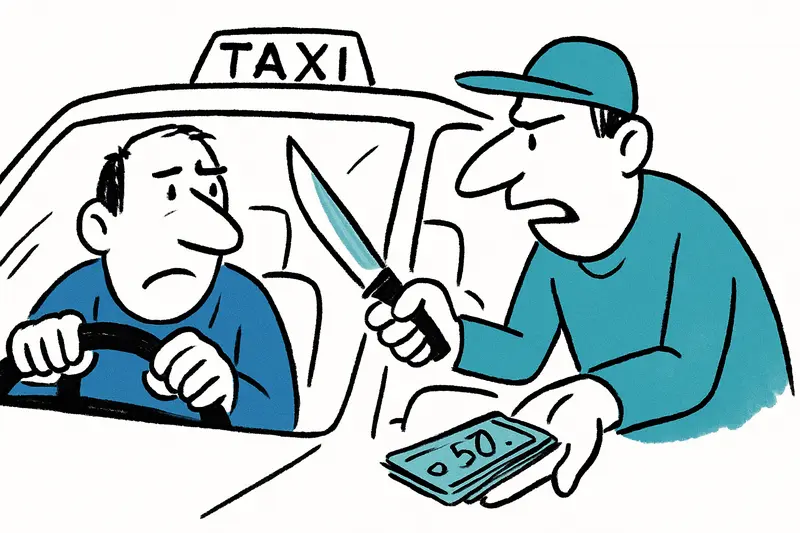
Knife in the Taxi: When Rides to Son Banya Become a Trap
A taxi driver from Calvià was picked up in Peguera, driven to Son Banya and forced at knifepoint to hand over €50. The arrest followed shortly afterward nearby; the accused is in pre-trial detention. A reality check on security gaps, support services and simple protective measures.
Knife in the Taxi: When Rides to Son Banya Become a Trap
The short trip from Peguera to Son Banya ended for a taxi driver with an experience no one should have to face: a passenger pulled a large knife during the ride, forced the driver to hand over €50 and then tried to prevent him from calling the police. The National Police found the suspect nearby shortly afterward, an arrest was made, and an investigative judge ordered pre-trial detention. According to official statements, the case is clear: robbery, threat with a knife, confession.
Key question
How safe are taxi rides really — and why do drivers on search trips into peripheral areas like Son Banya face particular danger?
Critical analysis
You do not need a long description of the scene to understand the issue: a driver, perhaps tired after a shift, evening approaching, the radio low, and a person gets in whose destination changes along the way. That is precisely what makes the situation dangerous. Taxi drivers often work alone, carry cash in the car, deal with changing passenger profiles and rely on short phone calls with the dispatch. Driving to Son Banya or similar hotspots depends on a mixture of experience and courage — and neither is always enough.
The police reacted quickly in this case, conducted searches and intercepted the man nearby, a rapid response reminiscent of broader operations such as Major raid in Son Banya: What does a morning with helicopter lights change?.
What is missing from public discourse
Too often reports focus only on the act and the arrest, but not on the working reality of taxi drivers. Discussions about better equipment in taxis, safe pickup zones at locations with risk potential, or mandatory cashless payment options are missing. Equally rare is talk about the social causes of problem areas: it is not only about criminals, but also about poverty, dependencies and lack of integration services that shape neighborhoods like Son Banya, as reflected in reporting on incidents such as Fatal Head-on Collision in Son Banya — More Than Just an Accident?.
Everyday scene from Mallorca
Imagine the taxi stand on the Passeig Marítim on a mild spring evening: bicycles whir, tourists pull suitcases, and drivers wait next to the bars for the next booking. Some rides lead to quiet mountain villages, others to corners the island would rather not show in guidebooks. It is precisely where the streets narrow and the streetlights are further apart that many drivers treat the decision to go as a small bet on their own instinct — and that is uncertain, as tragedies reported in pieces like Nighttime crash near Son Banya: Who will stop the speeding on Mallorca's country roads? illustrate.
Concrete solutions
There is no miracle cure, but there are practical measures: first, mandatory cashless payment through dispatch so the driver is not confronted with visible cash. Second, a visible emergency protocol in every taxi: panic button, GPS forwarding to dispatch and police, brief check-in calls for rides to known risk areas. Third, training for drivers in de-escalation and recognizing danger signals. Fourth, better coordination between municipalities, taxi centers and police: if certain addresses repeatedly cause problems, collection zones or controlled handover points must be established. And fifth, local social measures: prevention programs, low-threshold support services and monitoring of deal spots reduce the long-term attractiveness for crime, a concern also raised after incidents such as Nighttime collision at the border of Son Banya: One dead, several fleeing — questions remain.
Immediate concrete measures for drivers
Simple, practical actions are feasible: do not openly display larger amounts of cash, inform dispatch if the destination changes, refuse "questionable" destinations and insist on a short wait or callback instead. Many colleagues would say: easier said than done. But technology helps: an active connection to dispatch that transmits trip data live acts as a preventive measure.
Pointed conclusion
The incident in Peguera and Son Banya is not an isolated horror scenario, but an indication of structural weaknesses: police response after the act alone is not enough. Taxi companies, municipalities and authorities must work together to provide solutions that make everyday life safer — before the next knife is drawn. And yes: we should not only point the finger at a single neighborhood, but at the failures that allow such places to emerge.
In the end, the image remains familiar to many on Mallorca: a driver who hears sirens after a shift but also wants to get home. Clear rules, some technology and a bit of support can help more effectively than outrage alone.
Frequently asked questions
Are taxi rides in Mallorca safe at night?
Why are taxi drivers more vulnerable on rides to Son Banya in Mallorca?
What should Mallorca taxi drivers do if a passenger becomes threatening?
Would cashless taxi payments make rides in Mallorca safer?
What safety equipment should a taxi in Mallorca have?
Is Peguera normally a safe place to take a taxi in Mallorca?
What can taxi companies in Mallorca do to protect drivers better?
Why do some Mallorca neighborhoods create more problems for taxis than others?
Similar News
Palma, Palma de Mallorca, Palma‑Mallorca: What is it really about?
The debate over the city's name is more than grammar: it concerns identity, law and branding policy. A sober reality che...
Warning to Bathers: Nipping Fish in Cala Major and Other Coves — a Reality Check
In Cala Major and several beaches around Mallorca, bathers report painful “nips”. Who are the animals, why are they gett...
Rental Car Theft in El Arenal: What This Incident Reveals About Our Gaps
A teenager steals a running rental car in El Arenal, flees on foot, climbs over walls and is caught by the Guardia Civil...
Red Rope in Palma's Library: What Helps Against Selfie Tourism — and What's Missing
Palma's city library cordoned off an area with a red rope to keep selfie tourism away from reading and working activitie...
Fort San Carlos: Museum, Harbor Dispute — and a Conflict That Demands Answers
The military museum at Fort San Carlos sits right on Palma's harbor, with unexpectedly quiet rooms filled with cannons a...
More to explore
Discover more interesting content

Can Cap de Bou

Townhouse Lleo 72
