
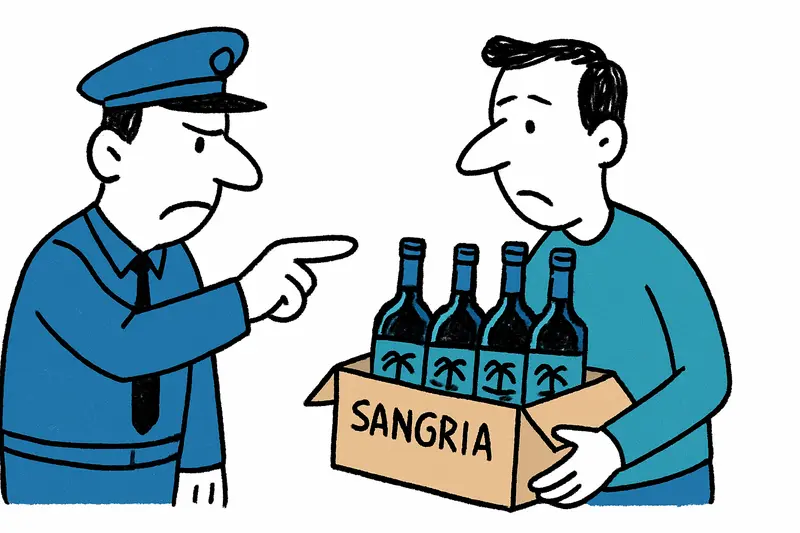
Label Fraud at Palma Airport: 118 Sangria Bottles Seized
Label Fraud at Palma Airport: 118 Sangria Bottles Seized
At Palma airport, 118 bottles of sangria bearing a "Mallorca" label were found that had been produced off-island. What does this mean for consumers, retailers and protecting the origin of local products?
Label Fraud at Palma Airport: 118 Sangria Bottles Seized
Who is allowed to put "Mallorca" on the label — and who pays the price for it? This question is back at the baggage carousel in Palma, after authorities discovered and seized 118 bottles of sangria that were advertised with the label "Mallorca" but were not produced or bottled on the island.
The incident highlights a small but important problem: origin claims are not just ketchup labels. For many holidaymakers they are a souvenir, for local producers a protection against low-quality imitations, and for the region a piece of identity. The Balearic food quality authority described the case from the consumer perspective as deception and emphasized that tourists in particular are led to believe they are taking home an authentic local product. Similar enforcement efforts have targeted counterfeit goods in the region, for example Big Blow Against Product Counterfeiting: What Mallorca's Role Really Reveals.
Critical Analysis: Where Does the System Fail?
The moment of inspection — often at the airport, at the border between arrival and departure — is a point of convergence: here supply, demand and control meet. Authorities were able to intervene this time, but the discovery of 118 bottles shows that checks remain sporadic, and other checks have uncovered seized fake goods such as Packages Full of Counterfeits: Van with Over 700 Fakes Stopped in Palma. Retailers using a Mallorca label benefit briefly from customers' trust; local producers, on the other hand, lose reputation and sometimes sales.
Weaknesses are visible: unclear rules on product labeling, gaps in the supply chain, and a reliance on visual inspections. Even more problematic: when producers or intermediaries only bottle off the island, the origin claim becomes misleading, even if ingredients come from Mallorca or the recipe is said to be "inspired" by the island.
What Is Missing from the Public Debate?
There is often reporting about fines, but little about prevention and transparency. More often than fines, there should be discussion about practical labeling standards: How much production must take place on the island for a product to be allowed to carry the Mallorca label? Who is liable when suppliers and bottlers are in different countries? And how are small producers supported during inspections, instead of only penalizing large retailers?
Also missing is the direct perspective of travelers: on a rainy afternoon at the airport you can tell from the rolling suitcases and the buzz of voices how quickly a tourist buys a souvenir — without verification. The moment the till rings is often also the moment mistakes slip into the suitcase.
Everyday Scene from Palma
Imagine: It is early evening, the arrivals hall smells of wet asphalt and fried churros, and brightly printed bottle labels flash at the stalls. A family reaches for the sangria with the "Mallorca" inscription, the father smiles, buys three bottles and staggers toward a taxi — the bottles are already in the trolley before anyone asks where they were actually bottled.
Concrete Solutions
1. Clear definitions of origin — legally specify how many production stages must take place on the island for a product to be allowed to carry a "Made in Mallorca" label, in line with EU quality schemes for food and agricultural products.
2. Mandatory traceability — QR codes with information about the bottling address and batch number on labels; this creates transparency for buyers and inspectors.
3. Enhanced checks at key points — regular spot checks in airports and ports, combined with risk-based inspections in retail.
4. Training and information offers — for small producers, retailers and customs staff so that misunderstandings are reduced and processes sped up.
5. Higher liability requirements for intermediaries — anyone using an origin label must be able to prove their supply chains.
Punchy Conclusion
It is not enough to occasionally remove bottles from sale and threaten fines. Protecting the Mallorca label also protects honest craftsmanship in the Tramuntana, the stall seller on the Paseo Marítimo and the memory tourists take home. Otherwise a local souvenir soon becomes nothing more than a pretty label on a bottle with no real island connection.
Frequently asked questions
Can a bottle sold in Mallorca legally say “Mallorca” on the label if it was not made there?
What was seized at Palma Airport and why does it matter?
How can travellers in Mallorca tell if a local product is really from the island?
Why are fake Mallorca labels a problem for local producers?
Are airport checks in Mallorca enough to stop counterfeit or mislabelled goods?
What should a proper Mallorca origin label include?
Can a product be called Mallorca-inspired if it was made elsewhere?
What can tourists in Mallorca do to avoid buying misleading souvenirs?
Similar News

More water than last year: Mallorca's reservoirs breathe easier
September rain refilled the Tramuntana's reserves: overall fill around 35 percent, Cúber at 40.42 percent, Gorg Blau at ...
Three Luxury Hotels in Banyalbufar: Lots of Money, Many Questions
A Danish investor plans three exclusive accommodations in Banyalbufar — including the historic Son Valentí. The announce...
2.1 tonnes of cocaine on sailing yacht off Spain's coast – a reality check for the coastguard
A 14-metre yacht was seized with 2.1 tonnes of cocaine. Who monitors the ports, how does the international hunt succeed ...

Heat Bonus in Mallorca: 100 Euros Extra for Outdoor Staff at MarSenses
MarSenses pays employees who worked outdoors in August an extra €100 as recognition. Lighter uniforms, reduced hours for...
Renovating in Mallorca: What You Really Can Do Without Neighbour Consent
Many think they can do whatever they want in their apartment. That's partly true — but only as long as structural elemen...
More to explore
Discover more interesting content

Can Cap de Bou

Townhouse Lleo 72
