
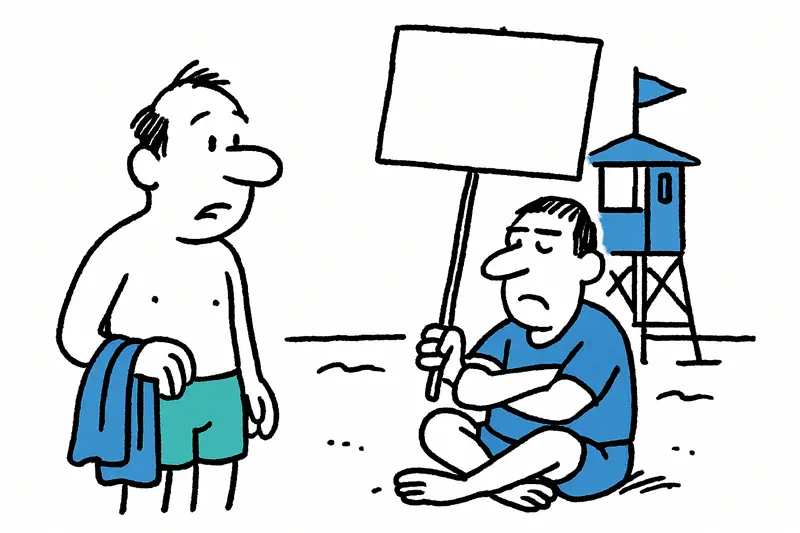
Lifeguards Strike: Safety Questions and the Uncomfortable Debate Over Seasonal Work
Since early morning, lifeguards in Palma, Calvià and several locations on Ibiza have walked off the job. While beachgoers are left puzzled, the strike raises the central question: how can the island combine holiday safety with fair working conditions?
Uneasy mornings on Mallorca's beaches
The smell of salty air today mixes with an unfamiliar undertone: more questions than the usual sound of the waves. Around 6 a.m., lifeguards in parts of Mallorca and on Ibiza stopped working, part of the Open-ended Lifeguard Strike: Island Caught Between Safety and Labor Dispute. Affected areas include stretches of beach in Palma, Calvià and on Ibiza in municipalities such as Sant Antoni, Sant Josep, Santa Eulària and Sant Joan. Where the shrill of a rescue whistle used to be routine, there is now a new tension — beachgoers with towels glance more often toward the horizon, and servers at the beach bars (chiringuitos) are making nervous phone calls.
The core demand: more than just pay
At the core are three issues: better pay, secure permanent contracts and working conditions that properly cover responsibility and risk. "We live from season to season," says a lifeguard who wishes to remain anonymous. That may sound like a labour market problem at first, but here it directly affects public safety: people who take responsibility along the coast for months at a time have no job security, little sick-leave protection and often insufficient rest periods.
Particularly sensitive is an internal instruction that, according to the strikers, requires beaches to be maintained on paper with a so-called 100 percent minimum staffing even during the walkout. For employees this means a formal contradiction to the right to strike; for supervisory authorities it creates a legal grey area. In practical terms, it leads to confusion over responsibilities — and that confusion, many who are supposed to ensure calm say, is what endangers safety.
What you notice on site — and what few see
On the Paseo Marítimo in Palma, vacationers were seen this morning walking around between towels and parasols with puzzled looks. At Playa de Palma, beach visitors noticed only a handful of lifeguards were visible — an issue highlighted in Who Protects the Rescuers? 'Collective Drowning' at Playa de Palma Sparks Debate on Working Conditions. Beach bars reported worried calls and supply chains were delayed — small signs of a swift everyday change when those who usually watch over things are absent.
Less visible are the organizational problems: companies holding contracts with municipalities rely on short-term staffing pools; seasonal fixed-term contracts prevent long-term investment in training and health; sometimes duty rosters are drawn so tightly that exhaustion becomes a public concern. These structural deficiencies are not just a labour issue — they are a safety risk.
The central guiding question
How can Mallorca guarantee safety on its beaches without forcing the people who provide that safety into precarious working conditions? That is the question that currently isn't being asked loudly enough. Authorities, the tourism industry and municipalities are caught between short-term seasonal needs and long-term responsibility.
Analysis: causes and blind spots
First, there is strong cost pressure: municipalities often award services to the cheapest provider — at the expense of staff stability. This dynamic is discussed in Alarm on the Coast: Why the Lifeguard Strike in Mallorca Is More Than a Labor Dispute. Second, the island's intense seasonality brings constant turnover; those scheduled for only four months a year do not plan for decades. Third, the legal situation around strikes and minimum staffing remains unclear and is currently perceived as a tool of weakening.
A less noticed aspect: lifeguards are also social hubs — coaches, parents of neighbourhood children, members of local sports clubs. Their walkout affects not only the tourist on the beach but the entire community fabric.
Concrete opportunities and solutions
There are practical ways out of the predicament if politicians and administrators act now: municipalities could adopt multi-year framework contracts instead of quarter-by-quarter agreements; joint training centers on the island would secure qualifications and continuity; a special fund for year-round employment in heavily frequented locations could provide relief. Short-term measures also help: clear information points on beaches, coordinated reinforcements by fire services or the Guardia Civil in emergencies and visible signs for visitors indicating where supervision is currently in place.
In the long term, a model could be conceivable that recognises lifeguards as publicly employed safety personnel — with collective bargaining standards, mandatory rest periods and continuing education that the island truly needs.
How things can move forward
Negotiations between unions and those responsible are underway; the walkouts follow visible demonstrations such as Lifeguards stage protest at Can Pere Antoni — a wake-up call for Mallorca's beaches. Authorities are under pressure: safety has priority, but the legitimate demands for fair contracts are not a luxury — they are prevention. As long as talks do not lead to concrete commitments, the situation remains fragile — and the island's beaches remain places where not only tourists but also locals are watching closely.
If you go to the coast today: ask at official posts, observe flags and signs, avoid unguarded sections in rough conditions and report incidents immediately. And remember: behind every lifebuoy there is a person — whose working conditions have now become a matter of public responsibility.
Frequently asked questions
Are Mallorca beaches safe if lifeguards are on strike?
What should I do at the beach in Mallorca if there is no lifeguard nearby?
Which Mallorca beaches are affected by the lifeguard strike?
Can I still swim in Playa de Palma during the lifeguard strike?
Why are Mallorca lifeguards on strike?
Is there a lifeguard strike in Palma right now?
What do beach flags mean in Mallorca during the lifeguard strike?
How should families with children plan a beach day in Mallorca during the lifeguard strike?
Similar News

Release after bloody attack in Palma: Why the court's decision raises questions
An 18-year-old who allegedly inflicted a serious neck injury on a man at Plaza Gomila using a wristwatch wrapped around ...
Kidnappings in Inca: Three young men forced into car trunks and abused in the forest – a reality check
In Inca, three 18-year-old men were forced into car trunks by masked assailants at the Plaça des Bestiar, taken to a for...
Spreading Massification: The Brake That Still Has Much Work to Do
Marga Prohens announces limits on volume tourism. The measures sound harsh — but are they enough to save everyday life, ...
Through the Keyhole onto the Party Yacht: How Daniela Katzenberger Is Planning Her 40th on Mallorca
Daniela Katzenberger turns 40 and wants to celebrate it on the island — likely with a boat, cake and her mother. A relax...
By Boat Instead of the Road: Palma's Water Bus — a Reality Check
The 'Bus Nàutic' launches in two stages — but questions remain over interim operations, fares and environmental requirem...
More to explore
Discover more interesting content

Can Cap de Bou

Townhouse Lleo 72
