
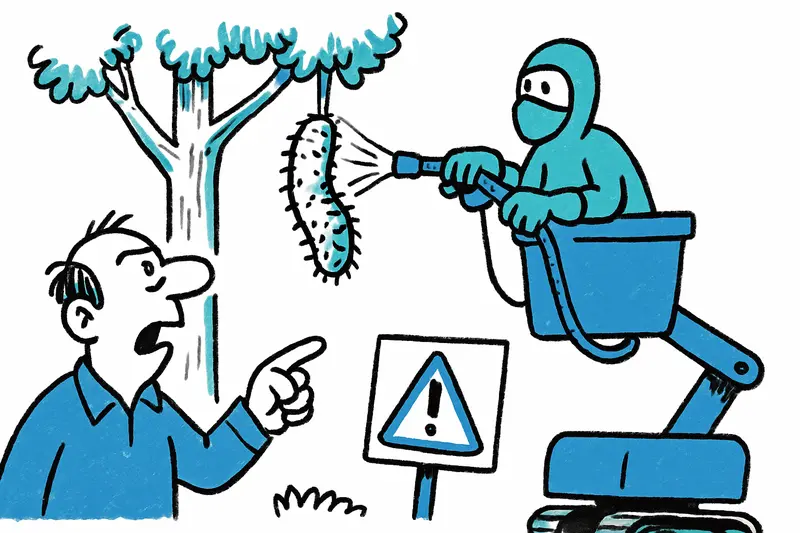
Early Risers vs. Fluff: Llucmajor Expands Protection Against Oak Processionary Moth
White suits, yellow signs and early-morning teams: Llucmajor has expanded operations against the oak processionary moth in s'Arenal, Cala Blava and Badia Gran. What residents should know now — and why this is good news for children and dogs.
Early Risers vs. Fluff: Llucmajor Expands Protection Against Oak Processionary Moth
If you've driven along the road to s'Arenal in recent days or gone for an early-morning jog by the sea, you've probably seen them: workers in white protective suits, yellow warning signs on the roadside and barrier tape fluttering in the Tramuntana wind. Llucmajor has expanded its annual action against the oak processionary moth — newly added neighborhoods include areas like s'Arenal, Cala Blava and Badia Gran (More on the expanded measures: Llucmajor amplía las medidas de protección contra la procesionaria del roble). For many neighbors, this initially means: relief.
Why there is closer scrutiny now
The caterpillars' stinging hairs are more than just an annoyance. They can cause severe skin irritation, eye inflammation, or even allergic reactions in humans and animals. Children playing under oaks and off-leash dogs sniffing curiously at the trees are particularly at risk. That's why the municipality is focusing not only on dense forests but specifically on public green spaces, school routes and playgrounds — the places where we are out in the morning with prams or dogs.
What the operations look like — and why they start so early
Already before sunrise, when the cafeterias are still sending the scent of freshly brewed café con leche into the streets, the teams are out. Mobile lifts raise specialists into the canopy, vacuum devices suck away nests, and chainsaws are used where necessary. In sensitive areas, biological agents are used; elsewhere the nests are vacuumed up and disposed of professionally. After an operation, warning signs are often hung — usually there is a short access ban of 24 to 48 hours so that nobody comes into contact with the fine stinging hairs.
A resident from s'Arenal said the teams had already been working at six o'clock "so that the children on the way to school don't notice anything." That hits the core: working early means fewer fluff in shoes later and fewer anxious parents at the playgrounds. Local tensions in the area have also been reported in other contexts, such as complaints about mornings at Playa de Palma (Foul-Smelling Promenade, Empty Promises: Hoteliers in S'Arenal Put Pressure on Llucmajor).
What residents can do practically now
A few simple rules of conduct are often enough to make everyday life safer: don't touch webs, keep dogs on a leash, avoid playgrounds when warning signs are posted. If you discover suspicious nests, inform the town hall — Llucmajor has set up a citizen phone and usually responds quickly. For private gardens: call the professionals rather than experimenting yourself. Even a short call can prevent someone from coming into contact with the dangerous stinging hairs.
Looking ahead: promoting rather than just reacting
The current expansion doesn't feel like a one-off big clean-up, but like building a lasting strategy. The municipality plans to continue checks in the coming weeks, regularly inspect vulnerable trees and schedule operations in such a way that families are disturbed as little as possible. In the long term, they rely on a combination of targeted monitoring, informing residents and the right mix of biological and mechanical measures.
This is no reason to panic, rather a call for vigilance: those who follow the signs, report suspected cases and, if in doubt, call in specialists help the municipality react faster and more purposefully. For us this means: more relaxed autumn outings, fewer visits to the pediatrician and calmer dog walks on the beach.
And if you drop by the beach this weekend: the wind carries pine needles today, not fluff. A small comfort — and a nice sound on the walk.
Frequently asked questions
What is the oak processionary moth problem in Mallorca, and why is it dangerous?
When is the best time in Mallorca to treat oak processionary moth nests?
Can you still walk dogs in Mallorca where oak processionary moth signs are posted?
What should families in Mallorca do if they see oak processionary moth nests near a playground or school route?
Which areas of Llucmajor are being covered in the oak processionary moth campaign?
How long do areas in Mallorca usually stay closed after oak processionary moth treatment?
Can oak processionary moth nests in Mallorca be removed from private gardens?
What should you do if you find suspicious oak processionary moth nests in Mallorca?
Similar News
Failed before the first flight: How Fischer Air's plans for Palma were ground down
Announced routes, repeated postponements and now apparent insolvency: Why the Fischer Air project for Mallorca is not me...

Seconds in the Water: 19-year-old Fights Her Way Out of Flooded Car in Palma
A 19-year-old managed to rescue herself from her half-submerged car after sliding under the Verge de Lluc underpass. Res...

Between Dream and Reality: Thorsten Legat and the Challenges of FC Germania Mallorca
The former Bundesliga pro has assembled a colorful squad in a short time. But how realistic is the grand plan for promot...

Arrest warrant at check-in: Why two travelers at Cologne/Bonn Airport suddenly had to pay
At Cologne/Bonn Airport, federal police in mid-September found two German passengers subject to enforcement measures. Bo...

Balearic Islands as a New Route: A Reality Check on Rising Boat Migration
For the first time the Balearic Islands are ahead of the Canary Islands in boat arrivals. What do the numbers really say...
More to explore
Discover more interesting content

Can Cap de Bou

Townhouse Lleo 72
