
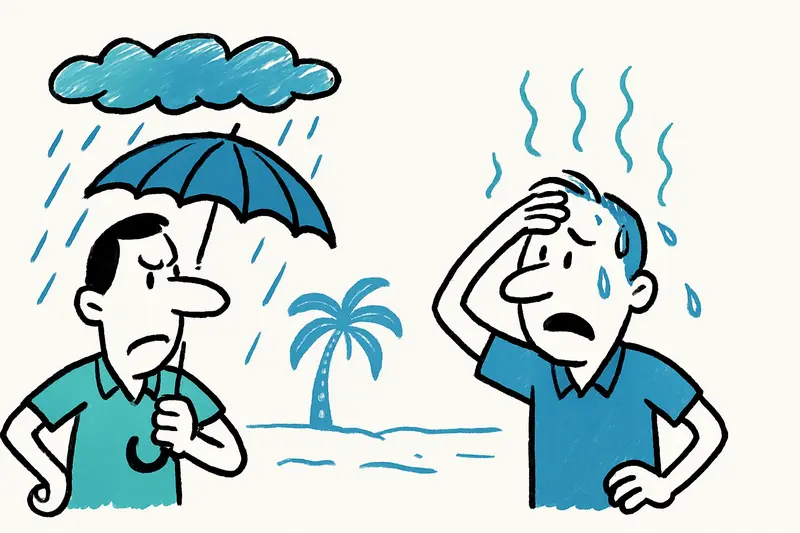
New low-pressure trough brings rain — and the heat remains: What's missing in Mallorca?
New low-pressure trough brings rain — and the heat remains: What's missing in Mallorca?
A short, intense window of showers hit Mallorca, yet the air remained muggy and warm. Key question: Why does rain hardly cool things down here — and how are towns and municipalities really preparing for such weather extremes?
New low-pressure trough brings rain — and the heat remains: What's missing in Mallorca?
Key question: Why don't rains on the island lead to noticeable cooling — and who is thinking long-term?
In the night to Monday a narrow low-pressure trough passed over the Balearic Islands and brought locally heavy showers. On some streets of Palma one could hear rain on metal awnings, puddles collected on the Passeig Mallorca, and waiters at outdoor cafés hurriedly wrapped seat cushions in plastic. Still, the air remained uncomfortably warm: values around 33 degrees during the day and about 25 degrees at night made it clear that rain here does not automatically mean relief.
A brief forecast from the Spanish weather service AEMET points to a continuation of this mix of showers and heat; up to 34 degrees are predicted locally for Friday. Wind direction: mostly southerly and rather weak. The pattern is clear: short, sometimes intense precipitation, but little cooling.
Critical analysis
Why doesn't it cool down? Several factors come together: warm sea surface temperatures, nocturnal heat storage in built-up areas, and the fact that thunderstorms are often very localized. When large air masses remain warm, individual showers only add local moisture, not the large-scale ventilation that would bring real cooling. In Mallorca, the layout of many places adds to this: narrow streets, dense development and little greenery in some districts intensify the heat effect.
For infrastructure this means: sewers and drainage are set up for single heavy rain events, but not always for serial showers occurring throughout the summer half-year. This shows in overflowing drains after sudden showers and small floods in lower streets of Palma or at driveways to fincas.
What's missing in the public debate?
There is a lot of reporting about individual storm events, but less often about the repetition pattern: short storms without cooling effect, more nights with tropical temperatures, and the consequences for health, traffic and urban infrastructure. The question of long-term adaptations — such as more evaporation areas, targeted street greening concepts or the redesign of urban heat islands — rarely comes up.
Equally rare is an open discussion about priorities: Should municipal funds be spent primarily on better drainage, additional drinking water storage for dry periods, or on climate-friendly greening projects that also provide shade? The answers are not simple, because budgets are limited and short-term pressures (flooding, potholes) are often louder than long-term planning.
Everyday scene
The morning after the rainy forenoon: the market at Plaça Major smells of wet wood and orange peels. A taxi driver on Avinguda Joan March complains about dusty corners that are stirred up again after the rain. On the promenade at Playa de Palma, walkers pull up rain jackets while bathers continue to splash in the surf — nobody turns their back on the heat.
Concrete solutions
1) Short term: Improved warning systems and visible information at promenades and town centers so businesses and residents can react faster. 2) Medium term: Street greening and trees on main axes; targeted de-sealing of surfaces in municipal projects to buffer water and promote evaporation. 3) Infrastructure: Review and subsequent adaptation of drainage systems in known problem areas; installation of retention basins where space allows. 4) Health protection: Early communication of heat information to nursing homes, medical practices and social services; promotion of opening cool rooms on hot nights. 5) Tourism management: Information campaigns for visitors about nighttime heat, precautions (water, shade) and behavior during showers.
Many of these measures cost money, but less than recurring repairs after floods or treating heat-related health problems. Some projects — for example rows of trees along thoroughfares — also provide visible, immediately noticeable benefits for residents.
Pithy conclusion
Rain alone is not a climate recipe. In Mallorca a simple, unpleasant truth is currently emerging: we are getting water more often without the promised cooling. Those who explain the problem purely meteorologically overlook the municipal and urban levers that influence the everyday climate. If the island is to become more resilient, discussions, clear priorities and visible projects on site are needed — not just weather reports.
And a final thought: the next time you walk through Palma after a summer thunderstorm and breathe in the smell of wet asphalt, look at the sidewalks. There it is decided whether the rain gives us relief — or only leaves puddles for a short time.
Frequently asked questions
When is the best time to visit Mallorca for beach weather?
What should I pack for a Mallorca trip across the seasons?
Can I swim safely in Mallorca, and what should I watch for at the beaches?
What are some enjoyable activities beyond sun and sea in Mallorca?
How do I get around Mallorca—is driving worth it?
Are there family-friendly beaches or areas in Mallorca?
What should I know about Mallorca's local etiquette and opening hours?
Are there day trips or scenic routes I shouldn't miss in Mallorca?
Similar News
Stinging jellyfish in Cala Banyalbufar: Why everyone suddenly fled the water
In Cala Banyalbufar, Pelagia noctiluca washed up in droves. A personal account of why this is no coincidence, what is of...
Klaus-Michael Kühne has died: The entrepreneur who gave Mallorca a second home
He first arrived on the island at 60; later the holiday house became Castell Son Claret – a hotel, a music venue and an ...
Buying Instead of Moving Away? Why Every Fourth Property Owned by Balearic Residents Isn't Located Here
Almost a quarter of the apartments purchased by Balearic residents are located on the Spanish mainland. A concise analys...

Palma markets itself in the USA — but who is the city really for?
The tourism foundation is investing over €200,000 in US promotions to attract affluent visitors to Palma. Does that acco...
From Deposit to Arson: How a Dispute over Jet Skis in El Molinar Escalated
After a nighttime fire in El Molinar a detainee is in pretrial detention. How could a conflict between a rental company ...
More to explore
Discover more interesting content

Boat Tour with BBQ along Es Trenc Beach

Private transfer from Mallorca Airport (PMI) to Pollensa
