
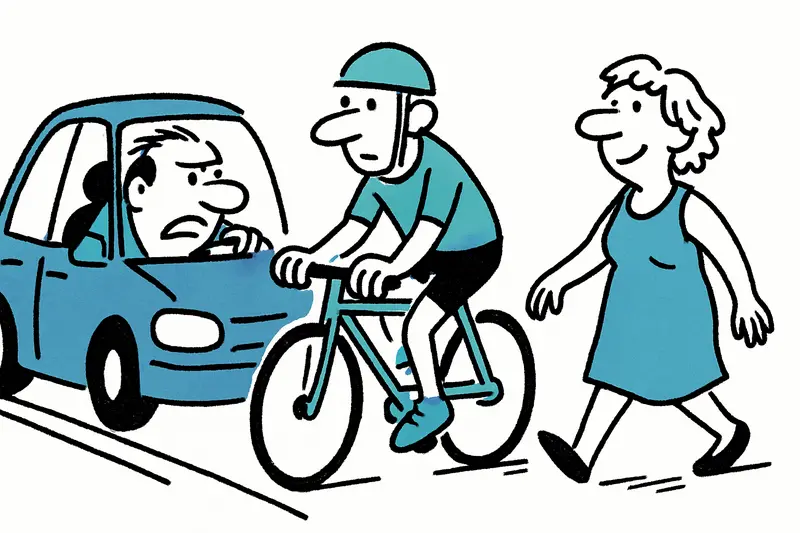
More space for cyclists and pedestrians – but is it enough? Mallorca's plan for 60 km of safe routes
The island council plans around 60 kilometres of new pedestrian and cycle routes — five sections along country roads are intended to increase safety. A good idea, but will the network be continuous, will trees be protected and who will take care of maintenance?
Five new sections, one clear goal — but questions remain
It's still early; the sun is just brushing the edges of the olive trees when the first cyclists whiz past on the Ma-13. That's how the daily routine of many Mallorcans begins: tractor noises, a school bus that stops at 7:30, and cars rolling past narrow village edges. The island council has now budgeted roughly €6.5 million to create about 60 kilometres of new pedestrian and cycle routes, a move that sits alongside broader transport works described by the island council's major investments in roundabouts, bypasses and mountain-pass repairs. Five additional connections along country roads — including near Alaró, between Peguera and Camp de Mar, and in Felanitx — are meant to give families, commuters and seniors more safety. Good news. But: is that really enough?
The key question: Do the new Viales Cívicos really connect the island?
A strip of asphalt at the edge of a town is one thing. A continuous, user-friendly network is another. Listening to the planners, you hear buzzwords like separation of pedestrian and cycle traffic, better signage and targeted lighting; recent rule changes such as allowing cyclists to ride side by side also affect how these designs are used. But public discussion often revolves around visible construction sites — not the gaps between them. If the five new sections remain islands within the road system, they will do little to change the familiar reflex: the car is more convenient.
That is not to say the measures are ineffective. Experience from three already existing sections has shown: clearer route guidance reduces conflicts, more lighting at intersections increases the subjective feeling of safety, and families are more likely to cycle. But for this to truly lead to increased everyday use, planning must go beyond individual construction segments.
What is often missing from the discussion
First: trees and landscape. Some residents demand that existing tree-lined avenues be preserved. A strip of bollards and curbstones can quickly lead to the clearing of olive or pine groves if alternative alignments are not examined first. Second: maintenance. Paving, markings and bollards do not survive on planning alone but on upkeep; initiatives such as the island-wide cleanup of 1,600 kilometres of road edges underline how vital regular maintenance is. A small example: leaves and sand in a bend can make a pretty path dangerous within weeks. Planners talk about maintenance contracts — that's good, but how will they be funded, who will monitor them, and how quickly will damage be addressed?
Third: school routes and bus connections. In many places it is precisely the first and last kilometres to school or the bus stop that are dangerous. Viales Cívicos could be designed as targeted programmes for safe school routes — with reduced speeds, zebra-style crossings and school-zone measures. Fourth: consistency of signage. A path that ends abruptly at an intersection neither encourages continuation nor switching to the bike.
Concrete: opportunities and practical solutions
The island now has a financial starting point. To make sure the €6.5 million becomes more than a patchwork, I propose three pragmatic steps: first, a mapping and prioritisation process: not just building where there's space, but where connections are missing — for example from residential areas to commercial centres or to train stations. Second, tree and landscape routes: before any felling, hold public participation and examine alternative variants. Third, a flexible maintenance concept with clear responsibilities, annual audits and a small emergency fund for prompt repairs.
Also: enforce 30 km/h on the new sections, not only by signs but with physical measures such as speed bumps and clear crossing infrastructure. And: link with bus and rail services — combined bike parking at stops, dry shelters, and continuous signage that safely guides cyclists to the next transport hub.
How everyday life could change — and where caution is needed
Imagine riding at 6 pm from Alaró towards Sóller. You no longer have a narrow shoulder but a marked path. You hear the cicadas chirping, the distant hum of a tractor — and you feel less stressed. Or you walk with the children to the village square without constantly watching the road. Market-day traders hope for more footfall. These are tangible visualisations of a possible everyday life.
But: if maintenance is sloppy, if trees are felled without replacement, or if sections remain isolated, the wind goes out of the good idea. The construction phase itself brings temporary detours — and it's often there that the first conflicts arise between residents and construction firms. Transparency and clear timetables would build a lot of trust here.
Conclusion: a step in the right direction — with conditions
About 60 kilometres of Viales Cívicos are an approach, not a solution. The investment of roughly €6.5 million is a start, but success depends on details: network logic, tree protection, clear maintenance rules and close integration with public transport and school routes. If that succeeds, we could soon move through daily life more relaxed — on wider paths, with fewer horns and more time for a coffee on the plaza. And if not? Then we'll have nice new strips that no one really uses.
In short: Five new sections by early next year, around 60 km, €6.5 million. A good idea, but planning quality, tree and maintenance concepts will decide long-term success.
Frequently asked questions
What is Mallorca planning for cyclists and pedestrians on country roads?
Will the new cycle routes in Mallorca actually make everyday travel safer?
What should you know before cycling in Mallorca on rural roads?
When is walking or cycling in Mallorca likely to feel easiest?
What is planned near Alaró for cyclists and pedestrians?
What changes are planned between Peguera and Camp de Mar for walkers and cyclists?
Why does maintenance matter for Mallorca’s new cycle paths?
How could Mallorca’s new routes affect school runs and bus stops?
Similar News

Maribel: Five Decades of Service – Housekeeper from Peguera Celebrated with a Special Honor
Over 50 years in the hotel business: María Isabel “Maribel” Molinos was honored in Palma at the Nit del Turisme by Unive...
Orange Alert over Parts of Mallorca: Are We Prepared?
Dark clouds and an announced wet spell have triggered an Orange alert in parts of Mallorca. A reality check: what's miss...

Sundair & Co.: Sale speculation and what it could mean for Mallorca
Rumors about a possible sale of the airlines Sundair and Fly Air 41, which belong to Schauinsland-Reisen — and whether b...
Anne Wünsche in Mallorca: A job offer with a catch — who fits the role of personal assistant?
Influencer Anne Wünsche has left Berlin and is urgently looking for a full-time personal assistant in Mallorca. Why the ...

Daily from New York: Palma Between Boom and Strain
United will increase the Newark–Palma route to daily flights in 2027 using Boeing aircraft (231 seats). What does the in...
More to explore
Discover more interesting content

Can Cap de Bou

Townhouse Lleo 72
