
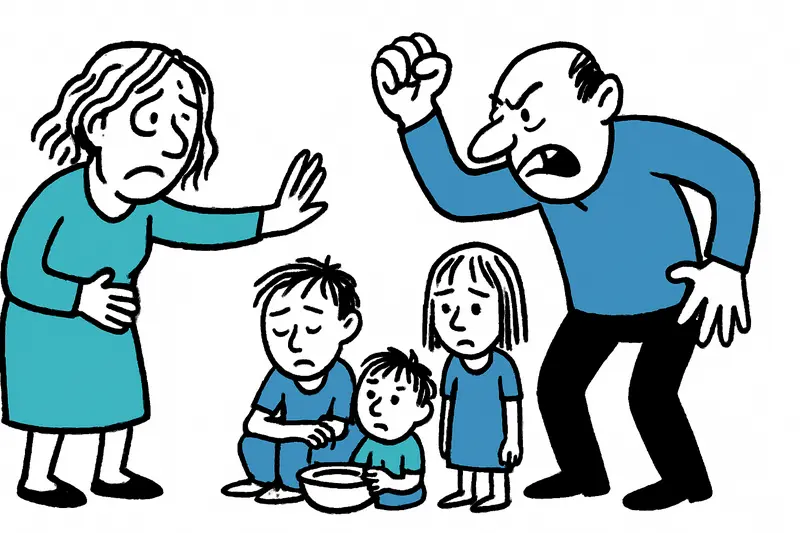
Maria de la Salut: Control, hunger, violence — how three children and their mother suffered in secret for a long time
In Maria de la Salut a 59-year-old man was arrested, accused of repeatedly beating and withholding food from his wife and three children. How could this happen in a small village — and what is missing to prevent such cases in the first place?
Maria de la Salut: Control, hunger, violence — how three children and their mother suffered in secret for a long time
It's a cool March morning on the Plaça de l’Església in Maria de la Salut. The church bell rings, the bakery smells of freshly baked pa amb oli, and most people here know each other by name. In this peaceful picture, a shocking piece of news appears: in the second half of March, a 59-year-old man was arrested after being accused of physically abusing his wife and the three children over an extended period and repeatedly withholding food from them.
The victims are a 42-year-old woman and three minors aged 14, 10 and 8. According to investigation records, a social worker reported the case after the eldest daughter first spoke about the father's behavior at school, a scenario reminiscent of Mother arrested in Palma – Three children left alone: How could this happen, and what needs to change?. During home visits, empty pantries and many garbage bags in the courtyard stood out; a pediatrician confirmed that the youngest boy suffered from malnutrition. Authorities justified the arrest warrant and investigation by stating that the woman's freedom of movement was restricted, identification documents of family members were seized, and physical assaults are alleged to have occurred.
Key question: How could this remain hidden for so long in a small village?
That is the central question that lingers when you walk through the narrow lanes of Maria de la Salut: how can a family life evade attention, even though neighbors, the school and health services are close to each other here? The answer is not one-dimensional; it begins with control mechanisms within the family and ends with gaps in the support system.
Viewed critically, the case reveals weaknesses in several areas: first, the danger of social isolation when victims are prevented from seeking help through threats and control. Second, the dependence on third-party reports — in this case a social worker and a pupil — before measures are taken. Third, the question of whether interdisciplinary coordination between schools, health services and social services is fast and binding enough when children are involved. Similar patterns appeared in Manacor: Chain, Coercion and House Handover – How Long Did This Remain Hidden?.
What is often missing from public debate is the everyday perspective: victims of violence are not abstract cases but neighbors, customers in the corner shop, parents at school. There is also a lack of debate about the granular forms of control that include not only beatings but the withholding of money, food and identity documents — means that can make people compliant in the long term.
An everyday scene from the town helps to put this into context: on Carrer Major sits the pensioner who normally collects letters and wonders about garbage bags that have been standing in front of a courtyard for weeks. The garbage truck comes twice a week, yet no one takes the bags away — because, people say, the man forbade it. Such small details are often the first signs that could be noticed in an attentive neighborhood.
Concrete solutions
The events in Maria de la Salut not only reveal the alleged offenses but also show where action is needed: schools need mandatory, practical training on signs of neglect and abuse; teachers must know when and how to report without fear of bureaucracy or stigma. Mobile social teams could undertake regular unannounced home visits when cases are reported. Health centers should have standardized procedures for suspected malnutrition to immediately initiate protective measures for children.
It is also important to protect documents and have quick ways to obtain replacement papers so that victims are not trapped in dependency. Municipal contact points could play a coordinating role so that police, social services and schools exchange information within clear timeframes. Last but not least, low-threshold services are needed: food distribution, confidential counseling locations and accompanied contacts with lawyers. Lessons from My heart burns: Twelve years without Malén — The gap in the system underline the need for sustained attention and systemic fixes.
What the municipality can do: raise awareness locally, hold conversations in clubs, in the parish church, in the community bar. If neighbors learn not to ignore small signs — an empty fridge, a frightened child, isolated women — the chances increase of stopping problems early.
Punchy conclusion
This case is more than a police report; it is a wake-up call to an entire network of neighborhood, school, health services and authorities. The detention of the suspect can reduce the immediate risk but does not replace the need to repair structures that allow such situations. If you stand on the plaza in Maria de la Salut in the morning, you hear the bell and smell the coffee — yet behind some front doors there is fear. It is up to all of us to look and act: not only with outrage, but with clear, coordinated action to protect the most vulnerable.
Frequently asked questions
Why can abuse cases in small Mallorca villages go unnoticed for so long?
What warning signs can suggest a child is being neglected or not getting enough food in Mallorca?
How can schools in Mallorca respond if a pupil says something worrying at school?
What role do social workers and doctors play in abuse cases in Mallorca?
What should neighbors in Maria de la Salut do if they suspect someone is being controlled or mistreated?
Why are identity documents and money sometimes used to control victims in Mallorca abuse cases?
What can Mallorca towns do to spot abuse earlier?
What happens after an arrest in a Mallorca domestic abuse case?
Similar News
Bomb threat on board? Why the Tenerife incident concerns us in Mallorca
A passenger on a Jet2 flight from Tenerife to London triggered an evacuation and intensive security checks. The result: ...

More Electric Cars in the Balearic Islands: Sales Rise Sharply
Between January and August, 14,185 vehicles without petrol or diesel propulsion were sold — an increase of more than 40 ...
Autumn in Mallorca: What Truly Remains of Summer
The days grow shorter, the evenings cool — and yet more of summer lingers than you might think: sounds, recipes, people,...
Rescue operation at Tolleric: Why nighttime cliff parties become dangerous
A British holidaymaker fell about ten meters at the cliffs of Tolleric during the night, later climbed back up and was r...
Car accident on the MA-1: Mother and daughter on a bicycle struck by a fellow countryman – Who protects cyclists here?
On the MA-1 between Portopí and the Cala Major exit, a mother and her daughter on a bicycle were struck by a car. A para...
More to explore
Discover more interesting content

Can Cap de Bou

Townhouse Lleo 72
