
Marine litter in the Bay of Pollença: Diver video exposes the problem
Marine litter in the Bay of Pollença: Diver video exposes the problem
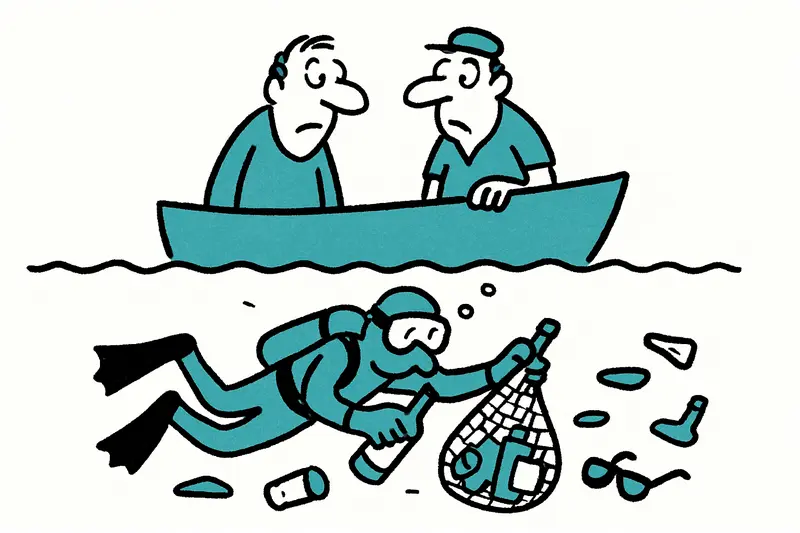
A recent dive video by Ramón Javier Fernández Barea shows bottles, knives, sunglasses and tarpaulins on the seabed of Pollença Bay. What lies behind it, and who is responsible?
Marine litter in the Bay of Pollença: Diver video exposes the problem
Key question: Who cleans up — politicians, boat owners, or all of us?
A local diver recently released footage that hits hard, documented in What Lies Beneath Mallorca's Coast: Trash Slipping Out of Sight: in the clear waters of Pollença Bay, beer and wine bottles, kitchen knives, packaging, sunglasses, plastic containers and even truck tarpaulins lie scattered across the seabed. The images come from Ramón Javier Fernández Barea, who has documented similar finds several times in recent years.
This is not an isolated case at a lonely rock edge, but a stretch of coast that is heavily frequented in summer by bathers, excursion boats and yachts. Particularly in densely occupied anchoring areas, litter apparently accumulates — sometimes thrown overboard carelessly, sometimes washed in from land and redistributed by the wind. The visible objects tell a simple story: plastic and glass persist for a long time, while knives and metal can be dangerous for people and marine animals.
Critical analysis: It is not just about unsightly images. When bottles and plastic pieces populate the seabed, there are consequences for seagrass meadows and small crustaceans that live between sand and posidonia. Boat propellers stir up deposits, anchors tear out plants — and the whole system that links fish, seabirds and tourist appeal becomes vulnerable. The footage also shows that waste is not only found near the coast but also further out, where the shore can no longer be held directly responsible.
What is missing in the public debate: So far, beach clean-ups, appeals to holidaymakers and occasional inspections dominate the discussion, as reported in Who cleans up the sea? Almost eight tons of waste off the Balearic Islands — and the uncomfortable answers. The role of private recreational boats and charter yachts is rarely addressed: how well informed are they about disposal options? Are there sufficiently accessible, free collection points for residual waste and glass at the harbors? Equally seldom is the question raised whether existing inspections and fines are actually enforced — too often violations go without visible consequences.
An everyday scene from Pollença: on a mild morning you can see fishing boats on the Passeig mending nets, elderly residents having café con leche. Gulls screech, a motorboat chugs out, children walk by dragging towels. No one expects to find a kitchen knife while snorkeling. And yet: it is precisely this coexistence of everyday life, tourism and maritime leisure that makes the bay so vulnerable.
Concrete solutions: First: equip anchoring areas with official mooring buoys so that less posidonia is lost to anchors and vessels do not lie haphazardly in sensitive zones. Second: the nearest marinas and landing points should have clear, well-visible disposal stations for glass, plastic and residual waste — free of charge and with information for crews. Third: more regular patrols at sea by the harbor authority or maritime surveillance; a visible presence alone creates deterrence. Fourth: expand cooperation with local dive schools and clubs: organized collection trips after each strong wind would alleviate the problem and raise awareness; similar organized efforts removed nearly 37 tons, as detailed in Almost 37 Tons of Waste: What Mallorca's Cleanup Fleet Really Tells Us. Finally: information campaigns in multiple languages for charter customers and crews about proper waste disposal and penalties, supplemented by clear provisions in the charter contract.
Legal frameworks can also be used more effectively: international rules like MARPOL prohibit dumping waste at sea — the problem is enforcement at the regional level. Here a balance must be found between preventive infrastructure, visible monitoring and a fines system that actually works.
Conclusion: The images from Pollença Bay are a wake-up call, not merely an aesthetic nuisance. They show how fragile our relationship with the sea is when convenient disposal remains possible and controls are rare. Local politicians, port operators, boat rental companies and the many users — from families to yacht owners — must take concrete steps. Those who stroll along the water in Pollença in the morning should no longer have to think about broken glass or knives, but about the next café and the outing to the sea. That is possible — if we take the problem seriously on all levels and not only post photos, but act.
Frequently asked questions
Why is marine litter becoming a problem in Pollença Bay, Mallorca?
What kind of rubbish is found on the seabed around Mallorca’s coast?
Is it safe to swim or snorkel in Pollença Bay if there is marine litter?
What is the impact of marine litter on Mallorca’s posidonia meadows?
Who is responsible for cleaning up marine litter in Mallorca?
Are there enough waste disposal points for boats in Mallorca’s harbours?
What helps reduce marine litter in Mallorca’s anchoring areas?
What can charter boat crews in Mallorca do to avoid dumping waste at sea?
Similar News
Urgent Clearing of Palma's Torrents: Flood Prevention or Symptom of Short-Sighted Planning?
The city of Palma is responding to storm forecasts and has cleared several torrents. We ask: Is the short-term clearing ...

Evaneos and Mexico: A Reality Check for Sustainable Travel
Travel advertising often reads like a promise: local, sustainable, unique. But how deep do these promises really go? A c...

From Megapark to the Altar: Party Singer Now Offers Weddings in Mallorca
A well-known party artist combines partying and marriage: instead of a traditional church there are ceremonies at the Me...

The Maricarmen Case: Why an Eviction Is Forcing Spain's Housing Debate
Images of an 87-year-old woman on a stretcher have sparked a debate in Spain that also runs deep in Mallorca. Who protec...

Parking dispute in Els Hostalets: When a gap leads to violence
A parking dispute on Calle Aragón escalated into a mass brawl at night. Why do trivial conflicts here turn bloody so qui...
More to explore
Discover more interesting content

Can Cap de Bou

Townhouse Lleo 72
