
Beach brawl: 25-year-old seriously injured at Playa de Palma
Beach brawl: 25-year-old seriously injured at Playa de Palma
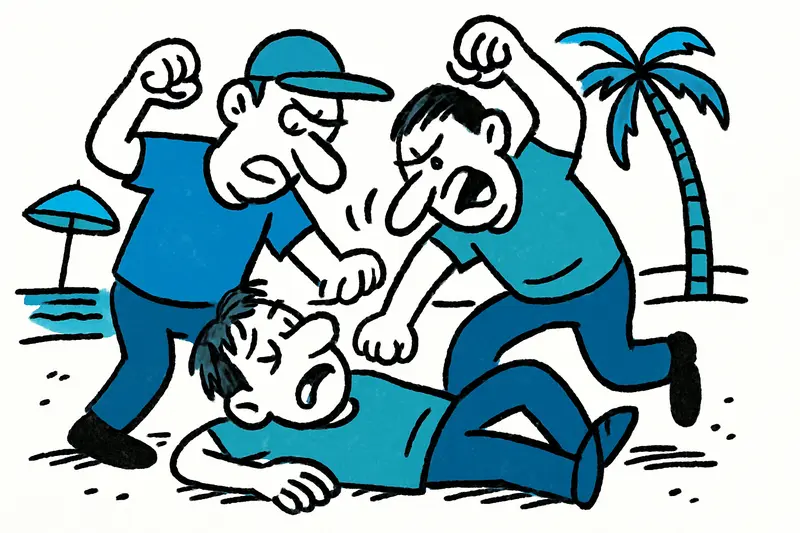
At the Mar Menor/Mar de Java intersection in the third row from the sea, a fight escalated that reportedly involved around ten people. A 25-year-old was seriously injured and taken to hospital.
Beach brawl: 25-year-old seriously injured at Playa de Palma
Key question: How safe is public space when disputes on the promenade turn into brutal attacks?
On Thursday at around 3:45 p.m., the usually sunny corner of Playa de Palma just behind the balnearios became the scene of violence: at the intersection of Mar Menor and Mar de Java in the third line from the sea, only a few hundred metres from Balneario 8, a 25-year-old German was beaten so severely that he lost several front teeth and had to be taken to hospital with a traumatic brain injury. Emergency crews from Emergentes 24 and the medical emergency service SAMU 061 stabilised him on site before transport to Son Espases. Witnesses spoke of about ten people involved; the attackers fled when the local police and the UII task force arrived at the scene, reminiscent of Brawl at Playa de Palma: Why a verbal exchange could have ended fatally.
The scene for residents: sun loungers, clinking beer glasses in the cliff restaurants, seagulls screaming, and then suddenly hectic murmurs, screams and the thumping of feet on the warm asphalt. Such an incident throws the everyday calm on the promenade off balance – tourists pulling trolleys by, retirees sitting on the wall and looking surprised at the police presence. This combination of images is typical for late-afternoon spring days, when beach and bars are used equally.
Critical analysis
The incident highlights several problems at once: first, the role of alcohol as an amplifier of conflicts in public spaces. Second, the difficulty of quickly apprehending perpetrators when multiple people are involved and disperse after an act of violence. Third: the danger to uninvolved bystanders in busy sections of the playa. The rapid initial care by Emergentes 24 and SAMU 061 likely prevented worse outcomes, as seen in Fall at Ballermann: Why a Morning on Playa de Palma Can Turn into an Accident, but the fact that the victim was unconscious at times underlines how quickly an evening walk or a visit to a bar can become life-threatening.
What is missing from the public debate
People often talk about more police or tougher penalties, but less about preventive everyday measures: effective de-escalation concepts in venues, clear rules for alcohol service at particularly narrow promenade sections, and clearly visible, accessible first-aid points. The perspective of residents and seasonal workers is also often left out – they experience the recurring small and large conflicts day in, day out. It is also rarely examined whether camera surveillance at certain critical points makes sense or whether it rather creates a false sense of security. This question is raised after incidents like Dead Tourist at Playa de Palma: An Accident Raises Many Questions.
Concrete solutions
- Preventive presence: increased targeted patrols at peak times, combined with civilian conflict managers who show presence and mediate in bars and on beach sections.
- Rules and controls: stricter checks on alcohol service by mobile vendors and venues along the promenade; time-limited "quiet zones" for family areas.
- First aid and visibility: small first-aid stations at the balnearios, clearly marked emergency call points and training for service staff in life-saving immediate measures.
- Communication: a connected reporting chain between hotels, beach operators, local police and health services so that escalations can be coordinated more quickly.
- Community approach: resident meetings and seasonal information campaigns that do not only focus on bans but also address behavioural rules and conflict avoidance.
What can be done immediately
The local police can temporarily increase foot patrols during critical afternoon and evening times and coordinate the search for the fleeing perpetrators with contacts in surrounding businesses. Beach bar operators should offer refresher training in de-escalation and first aid for their staff; it costs little but can save lives. And: visitors need to know where to turn in case of threat – visible contact persons build trust.
Pointed conclusion
The violence at the Mar Menor/Mar de Java intersection is not an isolated event but a warning sign for how to handle public spaces where tourism, nightlife and residential areas meet. More flashing lights alone are not enough. We need combined responses: more prevention, better initial care and real participation from local people. Otherwise Playa de Palma remains a place where a harmless beach walk can suddenly become life-threatening.
Frequently asked questions
Is Playa de Palma safe for an evening walk or a drink by the promenade?
What should I do if I see a fight on a beach promenade in Mallorca?
Why do disputes on Playa de Palma sometimes turn serious?
When is Playa de Palma busiest and most likely to feel crowded?
What safety measures could help prevent violence on Mallorca promenades?
Where is Playa de Palma’s third line from the sea?
What kind of injuries can happen in a violent assault at Playa de Palma?
Is Playa de Palma a place where tourists should call emergency services quickly?
Similar News

More Electric Cars in the Balearic Islands: Sales Rise Sharply
Between January and August, 14,185 vehicles without petrol or diesel propulsion were sold — an increase of more than 40 ...
Autumn in Mallorca: What Truly Remains of Summer
The days grow shorter, the evenings cool — and yet more of summer lingers than you might think: sounds, recipes, people,...
Rescue operation at Tolleric: Why nighttime cliff parties become dangerous
A British holidaymaker fell about ten meters at the cliffs of Tolleric during the night, later climbed back up and was r...
Car accident on the MA-1: Mother and daughter on a bicycle struck by a fellow countryman – Who protects cyclists here?
On the MA-1 between Portopí and the Cala Major exit, a mother and her daughter on a bicycle were struck by a car. A para...
Smoke over the UIB: Who is responsible for the fire on the roof?
On Saturday afternoon a fire broke out on the roof of the Arxiduc Lluís Salvador building at the University of the Balea...
More to explore
Discover more interesting content

Can Cap de Bou

Townhouse Lleo 72
