
Microsleep in Palma: One Moment, Three Cars — and the Uncomfortable Question of Night Work and Road Safety
Microsleep in Palma: One Moment, Three Cars — and the Uncomfortable Question of Night Work and Road Safety
In the early morning hours a driver crashed into three parked cars on Bisbe Bernat Nadal. Key question: Was it just bad luck — or a sign of structural problems around night shifts, on-call duty and urban safety?
Microsleep in Palma: One Moment, Three Cars — and the Uncomfortable Question of Night Work and Road Safety
An accident on Bisbe Bernat Nadal reveals more than broken bumpers
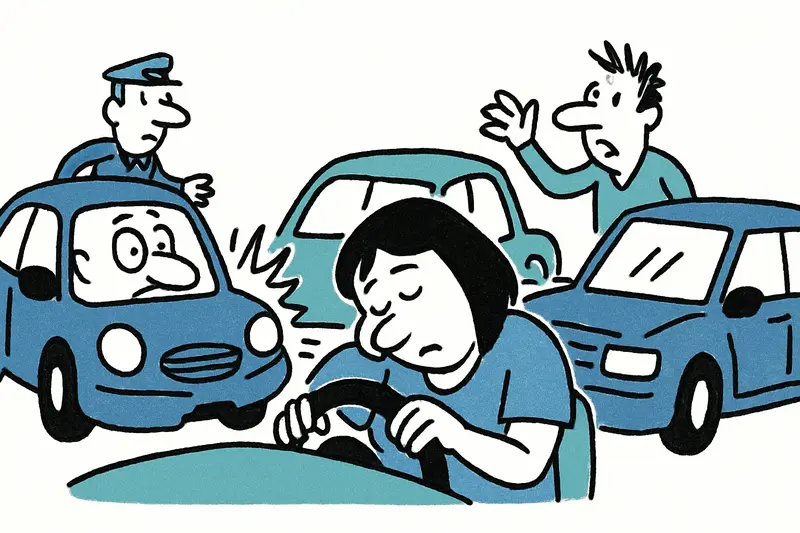
On April 26 at around 4:40 a.m., a 32-year-old woman, on her way home from work, apparently lost control of her car due to microsleep and collided with three parked vehicles on Bisbe Bernat Nadal. The local police (UVAC) recorded the accident, a breathalyzer test was negative, and the driver was physically uninjured. Those are the facts. The key question is: Was this a one-off mishap or a symptom of a problem that affects everyday life?
The simple answer is uncomfortable: it is both. Microsleep happens suddenly, it is unpredictable — and precisely because of that, every single case shows how vulnerable our traffic system is. A momentary lapse can be enough in a narrow, single-lane street to cause enough force to damage several parked cars. That the woman, according to her own account, only remembers a loud bang fits typical microsleep reports: a short lapse of consciousness, with hardly any subjective warning signs.
Critical analysis: Reporting often focuses on the crash and the spectacular aftermath — wrecked cars, police, eye-catching images. What rarely happens is a look at the causes behind the fatigue. Who works at night? How are shift schedules organized? Do people who work late or at night have safe ways to get home? In Palma you hear delivery vans early in the morning, the rattling of trash bins and bakery doors opening; many of these services require staff with unusual working hours. If a large share of night and early-shift workers rely on their own cars, the risk of microsleep accidents increases. Local debates such as When Offices Go to Sleep: Palma's Plan to Revive the Old Town show that concerns about deserted streets and their consequences are already on the agenda.
What is missing in the public discourse are reliable figures and preventive measures. Authorities and employers seldom publish detailed data on accidents suspected to involve microsleep. Without this basis, discussions remain anecdotal. There is also too little talk about employers' responsibility: shift lengths, short rest times between shifts, or the lack of transport options are factors that are not immediately visible at the crash scene, but shape what we see on the streets.
A small everyday scene in Palma makes this visible: It is 5 a.m. on Bisbe Bernat Nadal, the streetlights cast yellow light on wet asphalt. The café owner next door opens, a garbage collector hauls bags on the corner, a delivery driver parks briefly to fetch boxes. A woman in work clothes shuffles her keys at the door; she has just finished an 8-hour shift. Her neighbor yawns and says softly "Te mereces descansar" — "you deserve to rest." Scenes like this repeat in Palma every night. They are unspectacular, but they are part of the problem.
Concrete approaches (not a complete program, but practical): 1) Collect data: police, health services and employers should record accidents possibly linked to microsleep in a shared database to identify patterns. 2) Targeted information: awareness campaigns at clinics, businesses with night shifts, taxi stands and supermarkets to point out fatigue and countermeasures (coffee is no substitute for sleep). 3) Review employer obligations: design shift schedules to ensure minimum rest times, an issue linked to debates about local time policies discussed in Time on Mallorca: Why Our Clocks Tick Differently; promote alternative transport options for early-morning shifts or make shift-swapping easier. 4) Infrastructure: review street sections with high parking density (e.g. narrow one-way streets like Bisbe Bernat Nadal) and reduce speed limits there, install visible protective measures or create alternative parking spaces. 5) Use technology: encourage vehicles with driver fatigue warnings and driver-assist systems, but do not present them as a cure-all — they are an addition, not a solution.
Important: prevention costs less than an accident. Repairing three bumpers is expensive; the societal price of an injured or killed night worker would be incalculable. A combination of urban planning, corporate responsibility and individual caution makes sense, as seen in debates like Sleep Instead of Runway: Palma Between Health and Aircraft Noise. Authorities can propose measures, companies can facilitate implementation — for example through subsidies for carpooling or partnerships with taxi firms for early shifts.
Bottom line: The accident on Bisbe Bernat Nadal is not a random spectacle but a window into the everyday life of a city that keeps working at night. We should not use the attention a crash generates only to count the bodywork damage. Instead, the question must be: How do we prevent tired people from getting into such situations in the first place? Those who remain silent when night work is the cause of exhaustion shift responsibility onto individual drivers — and that must not suffice.
Frequently asked questions
What is microsleep, and why can it be dangerous when driving in Mallorca?
Can tired drivers cause accidents on Mallorca even if they are not drinking?
Is it safe to drive home after a night shift in Mallorca?
What are the warning signs of microsleep before driving in Mallorca?
Why are narrow streets in Palma more vulnerable to fatigue-related crashes?
What can employers in Mallorca do to reduce tired driving after night work?
What should you do if you feel too tired to drive in Palma?
Does car technology prevent microsleep accidents in Mallorca?
Similar News

More water than last year: Mallorca's reservoirs breathe easier
September rain refilled the Tramuntana's reserves: overall fill around 35 percent, Cúber at 40.42 percent, Gorg Blau at ...
Three Luxury Hotels in Banyalbufar: Lots of Money, Many Questions
A Danish investor plans three exclusive accommodations in Banyalbufar — including the historic Son Valentí. The announce...
2.1 tonnes of cocaine on sailing yacht off Spain's coast – a reality check for the coastguard
A 14-metre yacht was seized with 2.1 tonnes of cocaine. Who monitors the ports, how does the international hunt succeed ...

Heat Bonus in Mallorca: 100 Euros Extra for Outdoor Staff at MarSenses
MarSenses pays employees who worked outdoors in August an extra €100 as recognition. Lighter uniforms, reduced hours for...
Renovating in Mallorca: What You Really Can Do Without Neighbour Consent
Many think they can do whatever they want in their apartment. That's partly true — but only as long as structural elemen...
More to explore
Discover more interesting content

Can Cap de Bou

Townhouse Lleo 72
