
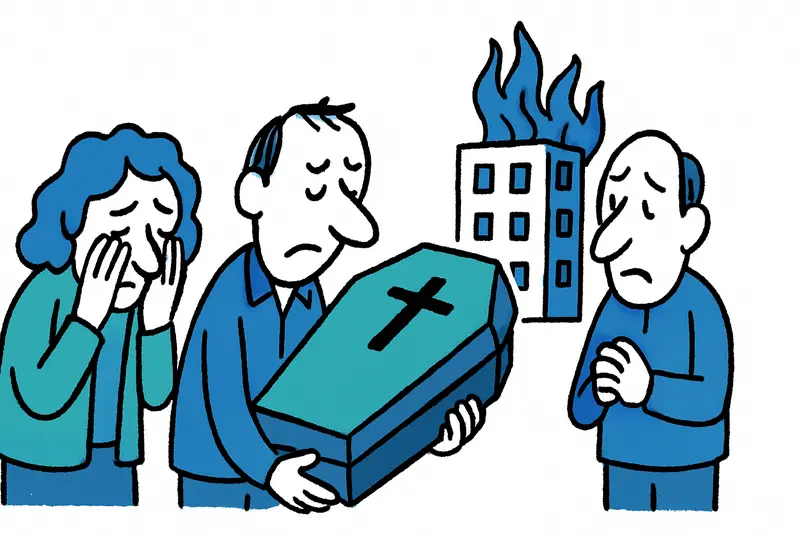
Mourning in Magaluf: Two dead after apartment fire — what must happen now
Mourning in Magaluf: Two dead after apartment fire — what must happen now
A fire in an apartment complex in Magaluf claimed two lives and injured almost 30 people. Calvià has declared two days of mourning. Why do such accidents keep happening?
Mourning in Magaluf: Two dead after apartment fire
Central question: Why does this happen in a neighborhood where many people live in close quarters?
On the morning after the fire in an apartment complex in Magaluf, relief was mingled with dismay. The numbers are small but clear: two people have lost their lives, and almost 30 were injured, some seriously, by smoke. Thirty-six residents spent the night in nearby hotels. The town hall of Calvià has announced a minute of silence at noon and declared two days of mourning. A short circuit in a refrigerator is being considered a possible cause — a preliminary assessment, not a final conclusion.
The scene had an almost banal Mallorca-everyday heaviness: on the promenade you sometimes smell the resin of pine trees in the morning, but yesterday the air was filled with acrid smoke instead. Emergency vehicles with flashing lights were parked at the entrance, firefighters were folding hoses, residents stood with coffee cups and looked at the cordons in shock. An older man from the nearby supermarket pressed a bottle of water into the hand of a young firefighter. That is what solidarity looks like — quiet, improvised, real. Scenes like that were also seen after Fire in Can Morro near Porto Pi: A Wake-Up Call for Mallorca's Fire Safety.
Soon after such incidents the immediate rescue phase ends, but the real debate begins: was it a tragic one-off — or a symptom of deeper problems? The quick answer is: there are several issues. Many apartment complexes in tourist areas are older, electrical installations have been improvised over the years, and appliances like air conditioners or refrigerators often run around the clock. Added to that is a high turnover of short-term rentals, where tenants or guests are not familiar with the building. All this increases the risk that a small electrical fault can quickly become catastrophic. Similar incidents have occurred elsewhere, for example Fire near Porto Pi: What the blaze reveals about safety in Palma.
The public debate currently lacks something crucial: a clear distinction between questions of blame and questions of system failure. Isolated hints about alleged misconduct by residents or owners are not enough. Equally lacking is an open discussion about how the local administration carries out inspections, how old the wiring in the affected buildings really is, or whether smoke detectors are installed across the board. Who bears responsibility — managers, owners, landlords or tenants — too often remains a foggy issue.
Concrete proposals are obvious and both technically and organizationally feasible: mandatory, regularly documented electrical inspections for multi-family houses and apartments; a reporting obligation for short-term rentals combined with a fire-safety check; grants or subsidies for retrofitting older buildings (e.g. smoke detectors, residual-current devices (RCDs)); and clear evacuation plans posted in both Spanish and English. Equally important is a rapid, binding accommodation arrangement for those affected, so that 36 people do not have to improvise in hotels but instead receive immediate psychosocial support and long-term replacement housing.
What else is missing? Transparency after the operation. People in the neighborhood and those affected have a right to know how the investigation is progressing — without sensationalism, but with clear facts. Reporting from other local incidents, such as Nighttime fire in Llucmajor: pets die, questions remain, shows how important clear facts are.
In the end it is also about trust. The brief minute of silence at 12 will not undo the loss. But it is a moment when the neighborhood comes together. When the sirens fall silent in the coming days and the streets return to normal traffic noise, the question must remain: what have we learned? Without concrete measures, the next alarm is only a matter of time.
Conclusion: this fire is more than a news item. It is a warning signal about neglected modernization and inadequate structures for prevention and assistance. Calvià, hoteliers, landlords and the local community must now deliver a joint response — practical, swift and without excuses.
Frequently asked questions
What is the weather usually like in Mallorca in spring?
Is Mallorca warm enough for swimming in late spring?
What should I pack for Mallorca in spring?
Is spring a good time to visit Mallorca?
What is Port de Sóller like in spring?
What is the weather usually like in Palma de Mallorca in spring?
Can you still go hiking in Mallorca in spring?
Do I need a jacket in Mallorca in spring?
Similar News

Micaela Schäfer: Between Playa de Palma and a Berlin Law Firm — New Calm, an Old Tomcat and Solid Finances
The party artist from the Ballermann scene appears surprisingly down-to-earth: a new relationship with a Berlin lawyer, ...
At Playa de Palma: Fire in Residential Building – six people rescued on the roof, what is missing in prevention?
In the evening a fire broke out on the first floor of a five‑storey building on Calle Trasimé. Six residents fled to the...
New License Requirement for Mini-Boats in Mallorca: Protection Measure or Tourism Brake?
From October 1 renters of small recreational boats in the Balearics must present a boating license. Critical questions r...
After the Storm: Mallorca Breathes Easy — Warm Weekend with Short Showers
The thunderstorm left its mark, but calm returns for the weekend: sun, summer temperatures around 32 °C, isolated shower...
No More 'Just Hop on a Boat': Mallorca, Mandatory Boating License and the Open Questions
From October 1, the Balearic Islands will require a boating license for small rental boats under five meters/15 hp. A tr...
More to explore
Discover more interesting content

Boat Tour with BBQ along Es Trenc Beach
Private transfer from Mallorca Airport (PMI) to Pollensa
