
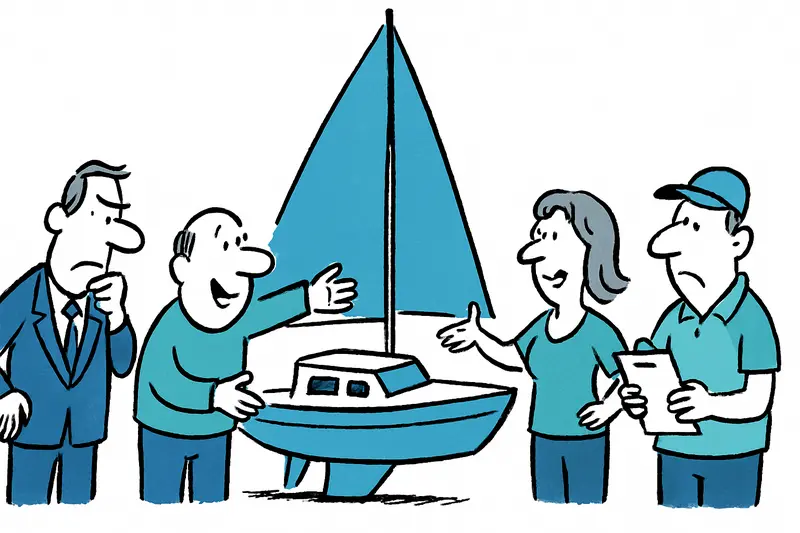
Navy Plans New Regatta Boat – Training or Representative Sailing Show?
Navy Plans New Regatta Boat – Training or Representative Sailing Show?
The Spanish Navy wants to invest around one million euros in a high-performance regatta sailboat. Officially for training — in practice it could reappear at the Copa del Rey. A reality check from Palma.
Navy Plans New Regatta Boat – Training or Representative Sailing Show?
Key question: Will the planned boat genuinely serve officer training — or does prestige trump practicality?
The Spanish Navy reportedly wants to invest just under one million euros in a modern regatta sailboat. It is said the new build should primarily serve officer training. At the same time, however, it is openly admitted that the boat, similar to the two-masted Aifos previously used, could be deployed at the Copa del Rey in the Bay of Palma — with King Felipe VI on the foredeck. This would be the third attempt to procure a modern replacement for the older sailing vessel.
This intention raises questions we do not want to phrase politely only: What added value does an expensive regatta boat bring to the Navy's training programs? And how transparent is the decision when the same boat is intended to participate in high-profile regattas and royal appearances, such as Princess Leonor sails in Palma — more than a summer greeting??
Critical analysis
A sailboat that is meant to be competitive in regattas often differs significantly in design and equipment from classic training ships. Racing yachts are optimized for speed, small crews and specialized rigging. Training vessels, by contrast, need space for learning modules, safety equipment, facilities for instructors to follow along and a robust construction that makes it easier to rehearse basic maneuvers. The desire to combine both is not fundamentally unreasonable — but it requires clear specifications and a comprehensible cost-benefit analysis.
The investment sum of around one million euros sounds like a lot, without publicly documented details on the cost calculation, the vessel's lifespan or follow-up costs (maintenance, berth fees, crew training). That this is already the third attempt suggests difficulties: technical design, budgetary constraints or bureaucratic hurdles could have caused previous failures. Such recurring problems require clarification, not just a line in the minutes.
What is missing from the public discourse
In Palma's cafés along the Passeig Marítim one currently hears mainly speculation: Will the boat primarily be shown at sailing regattas, is it really suitable as a training platform, and what will upkeep cost? These details are not apparent from the official statements, and debates about large regattas and coastal impacts appear in Barcolana in Trieste: What Mallorca's Coasts Should Learn Now. There is a lack of an open presentation of how often the boat would actually be used for training purposes, which exercise scenarios are planned and who will bear the operational costs, as discussed in Patrol Boats off Mallorca: Much Technology, Many Questions.
Everyday scene from Palma
A small everyday glimpse: mornings at Moll Vell, when the wind comes from the northwest, you can see sailing clubs practicing with their Optimists and dinghies. Young people, coaches and older sailors change tools, mend lines and discuss tactics. This scene shows how local and practical sailing training works: cheap, hands-on and with lots of practical time. It is difficult to integrate a million-euro regatta boat into this everyday reality unless it is clearly regulated how training hours, access for beginners and maintenance windows will be organized.
Concrete solutions
1) Clear purpose specification: Before commissioning a new build, the Navy should publish a public technical brief: Which training tasks must be fulfilled? How many officers are to be trained per year? How often is participation in regattas planned?
2) Transparent cost breakdown: A total cost calculation including maintenance, berth, insurance and personnel over the expected lifecycle would end speculation.
3) Usage plan and third parties: Agreements with local sailing schools, universities or clubs could secure regular training use for the boat instead of employing it solely for prestige purposes.
4) Examine alternative solutions: Simulators, partnerships with private racing yachts or modernizing existing training ships could be more cost-effective options.
Pointed conclusion
A modern sailboat can serve both training and representational tasks — but only with clear priorities, transparent cost planning and a binding usage plan. In Palma, between fishing boats and dinghies, the discussion should not be held only in the defense ministry. Those who sail with taxpayers' money owe the public a reasonable map: what the boat is for, how often it will actually be used for training and who pays for it. Without this clarity, the impression threatens to arise that state, naval sailing and public relations are too closely intertwined.
Frequently asked questions
Why is the Spanish Navy planning a new regatta sailboat?
Can a regatta yacht also work as a training boat for the Navy?
How much is the Spanish Navy spending on the new sailboat?
Why is the Copa del Rey in Palma part of the discussion about the Navy boat?
What is the main criticism of the Navy’s new boat plan in Mallorca?
Where in Palma do sailors usually train in a more practical way?
What would make the Navy’s sailboat project more transparent?
Could Mallorca’s sailing clubs benefit from the Navy’s new boat?
Similar News

Mistaken identity with fatal consequences: Brutal assault in S'Aranjassa — what's missing in the follow-up?
At S'Aranjassa a visitor to a finca was tied up, beaten and thrown out of a van. Three men have been arrested, including...

High heel slips, car accelerates: accident on Camí de Son Hugo
A woman lost a high-heeled shoe on the forecourt of the sports facility at Camí de Son Hugo. The car accelerated, mounte...

Phone Scam: How Two Hotel Employees at Playa de Palma Lost Thousands of Euros
One morning in September, two reception employees at Playa de Palma were pressured by alleged alarm-company staff — in t...

When the Wallet Becomes a Danger: Attack in Peguera and Lessons for Mallorca
In Peguera, two women are said to have stolen the wallet from a 75-year-old German couple. When the victim intervened, t...
Plata stays Plata: Young people take over, Llonguets remain
A small bar on Carrer de l'Argenteria will continue: Tolo Serra hands the place over to young Mallorcans at the end of t...
More to explore
Discover more interesting content

Can Cap de Bou

Townhouse Lleo 72
