

One Year of Construction on the South Taxiway: How Well Is Palma's Airport Prepared?
The South taxiway will be refurbished from November for around twelve months. The works cost about €22 million and could affect flight schedules and passengers. A reality check with suggestions for how the island can reduce the stress.
One Year of Construction on the South Taxiway: How Well Is Palma's Airport Prepared?
Key question: Can Palma de Mallorca Airport carry out extensive refurbishment work on the apron for a year without turning summer traffic into chaos?
From November the renewal of the South taxiway begins – a project that, according to the contractors, will take roughly twelve months and cost just under €22 million. It's about more than new asphalt: access gates, entry and exit points, markings and utility lines are on the agenda. This is necessary because cracks and wear impair the safety and load-bearing capacity of the taxiways.
That sounds technical, but it has a very practical consequence: flights can be delayed, taxiways will be closed temporarily, and pilots will be routed on detours between runways and aprons. For people trying to catch the ferry at Passeig Mallorca in the morning or the taxis on Avinguda Gabriel Roca, this means longer waits, stressed passengers, and more suitcases in tight spaces. Local reports have already covered a recent taxi rank relocation and Terminal D closure, underlining how operational changes ripple into passenger experience.
Critical analysis: The problems are not only structural. If a central element like the South taxiway is only partially available for months, it affects schedules, slots, ground staff, baggage logistics and arrival and departure times. Airports rely on buffer times – those shrink when taxiways are not fully usable. Without strict coordination, bottlenecks arise and propagate through operations like a domino effect.
What has been missing in public debate so far: transparency and concrete contingency plans. Little is known about how often night work is planned, whether there are fixed closure times, how many taxiways will be closed in parallel and what reserves are planned for ground personnel and air traffic controllers. Possible impacts on taxi and bus traffic around the airport – and thus on residents in Son Sant Joan or the industrial area – are also rarely discussed. Recent coverage of a taxi stand being moved to the left illustrates how small operational moves can affect local traffic patterns.
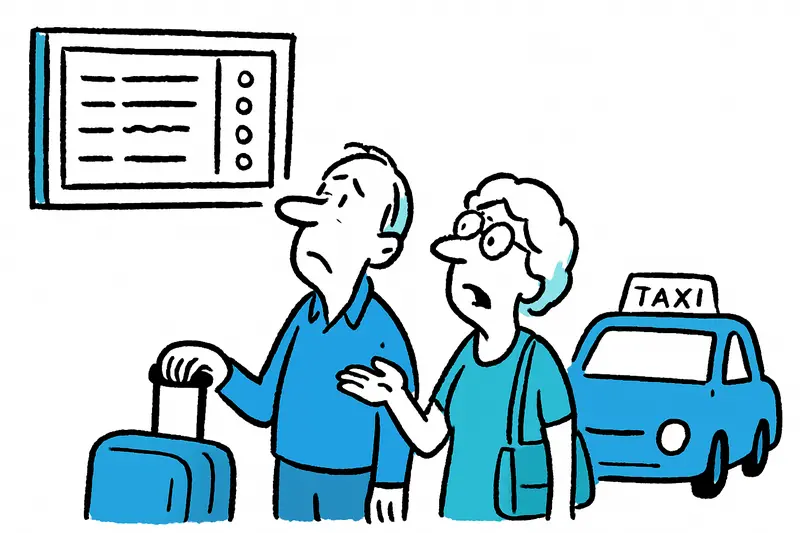
An everyday scene: On an early September morning passengers in shorts and flip‑flops already stand at the taxi rank in front of the airport, the radio plays a faint coastal playlist, baggage trolleys clatter. A flight is called, then postponed again. An older gentleman maneuvers his suitcase, looks briefly toward the runway and grumbles: "If they're going to build, then please plan well." That's how people talk here – pragmatic, sometimes irritable, rarely patient with vague promises.
Concrete solutions that should be put on the table now:
1) Communicate time windows and work phases openly. The airport operator should publish weekly schedules: when is night work expected? Which taxiways are affected when? Clear information reduces uncertainty for airlines, ground staff and travelers.
2) Prioritize around peak times. Work on the most critical sections should take place outside main travel periods. If possible, carry out larger closures in the low season.
3) Slot management and airline coordination. Tighter coordination with airlines to avoid overbooking slots and chain reactions from delays. Flexible slot rules during construction phases could help.
4) Increase ground staff and expand baggage capacity. Temporarily deploy more staff for handling and baggage to absorb queues at the gate.
5) Emergency routes and temporary signage. Temporary taxiway markings and accelerated clearances can help move aircraft from A to B faster.
6) Information campaign for travelers. Real‑time notifications via app, SMS and in the terminal reduce frustration. Clarity about rebooking and compensation rules is a must.
It would also be sensible to time the works so that major international holiday flows do not coincide with the most active construction phases. Technically, modular refurbishment sections rather than large-scale closures are also conceivable – this may extend the construction time but reduces acute operational restrictions.
What remains unspoken: One year of construction is also an opportunity. Those who modernize communication, personnel planning and operational processes now will leave a more robust airport operation after the renovation. Those who limit themselves to technical details risk recurring disruptions in future seasons.
Conclusion: The refurbishment of the South taxiway is necessary. The decisive factor will be whether Aena, the construction companies and the airlines view the construction site as a project that affects the entire airport operation – or only as an asphalt job. For holidaymakers and commuters the current advice is: set off early, keep plans flexible and pack patience for departures. For the island's decision‑makers: don't just build, explain, coordinate and relieve. Otherwise a necessary intervention will become a burden for island society.
Frequently asked questions
How will the South taxiway refurbishment at Palma de Mallorca Airport affect summer travel?
When will the South taxiway work start and how long will it last at Palma de Mallorca Airport?
How can travelers stay informed and reduce stress during the South taxiway construction at Palma's airport?
What practical steps can Palma's airport and airlines take to minimize disruption during the taxiway upgrade?
Could residents near Son Sant Joan be affected by the airport taxiway construction?
What risks do partial taxiway availability pose to Palma's flight schedules?
Could the refurbishment bring long-term benefits to Mallorca's airport operations?
Should travelers time Mallorca trips to avoid the busiest construction phases?
Similar News
Why the Paseo Marítimo is deserted at night — and what Palma could do now
After the redesign the Paseo Marítimo often feels quieter in the evening than before. Relaxing rules alone won't solve t...
One Year of Construction on the SOUTH Taxiway: Will Chaos and Delays Threaten Palma Airport?
Starting in November, the renovation of the SOUTH taxiway at Palma Airport begins. One year of construction, €22 million...
Surprising — why German visitors fell in July and Mallorca still isn't collapsing
In July about 597,889 German visitors arrived in the Balearics, 4.06% fewer than the previous year. What do falling arri...

Serious canyoning accident in Sóller: What the fall in the Torrent de ses Llemes reveals about safety on the island
A 51-year-old man fell about seven meters in the Torrent de ses Llemes. Helicopter rescue, handover to an advanced emerg...

When the tradesman crosses the line: An assault in Palma and what's missing now
A woman reports a sexual assault by a plumber in Palma. The National Police arrested a suspect who was later released. W...
More to explore
Discover more interesting content

Boat Tour with BBQ along Es Trenc Beach

Private transfer from Mallorca Airport (PMI) to Pollensa
