
When the tradesman crosses the line: An assault in Palma and what's missing now
When the tradesman crosses the line: An assault in Palma and what's missing now
A woman reports a sexual assault by a plumber in Palma. The National Police arrested a suspect who was later released. Why such cases often get lost in everyday life — and what we could change.
When the tradesman crosses the line: An assault in Palma and what's missing now
A customer inspected the repair, then the unthinkable happened – police arrested a man, the court later released him
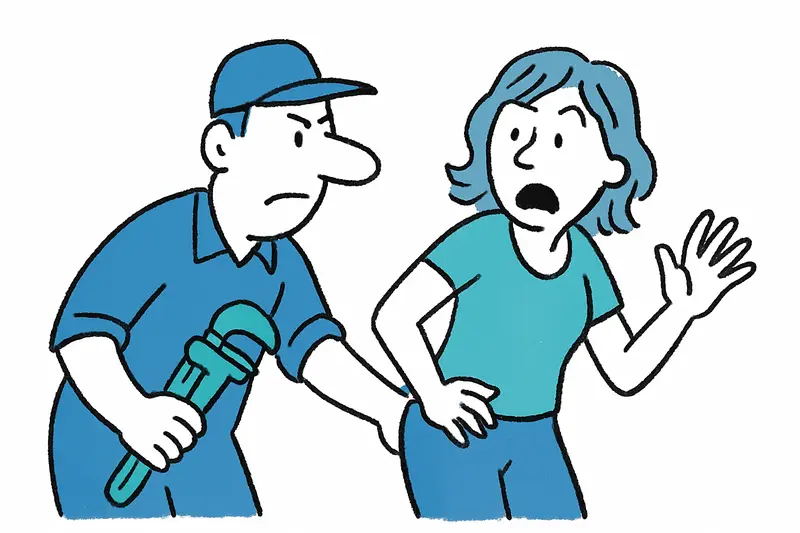
On late afternoons, when tradesmen's vans pass through the streets around Passeig Mallorca and blend into the aroma of freshly brewed coffee and the exhaust of small delivery vans, things happen that do not belong on an invoice. A woman in Palma hired a plumber to carry out work in her apartment. After he told her the job was done, she checked. As she stood up, she suddenly felt an inappropriate touch on her buttocks. According to the report, the man partially removed his shirt and sought physical contact without consent. The woman asked him what he was doing; he is said to have asked whether she liked it, and then left the apartment.
The National Police later arrested the suspect after the woman filed an official complaint, a pattern seen in cases like Assault at Palma Station: Why Visibility Alone Doesn't Protect.
Main question: How safe are residents when strangers enter their homes alone — and how well do existing procedures protect us from assaults?
The woman's reaction was exactly what you want to see in a city like Palma: she filed a report, went to the police station, and did not let the incident go. But the path from a complaint to a final court decision is long. The suspect's provisional release leaves victims and neighbors with a feeling of insecurity, a concern echoed in rulings such as After assault in Palma: Fine instead of prison — What remains for care home residents and staff?. This is not only a legal problem: it is an everyday problem. In the alleys of Santa Catalina you can hear neighbors giving each other tips about smaller services — whom to recommend, whom to distrust. Often it stays at this informal level because formal mechanisms either do not work or are too slow.
In public debate the incident is often reduced to the spectacular, offensive gesture, as happened after Sexual assault at the Intermodal: What the incident reveals about safety and accessibility in Palma. Yet four important perspectives are missing: first, the responsibility of companies to vet and train their staff; second, the information available to clients (how to verify identity, what to do in case of inappropriate behavior); third, faster victim protection after a report, for example through short-term protection orders; fourth, the question of how frequently such cases actually occur — and whether patterns exist that could be identified through coordination with employers.
An everyday scene: At the Mercat de l’Olivar a woman leans over a market stall and tells her friend about "the plumber who behaved strangely the other day." Another writes down the phone number of a well-known business, someone closes the door behind them. Such conversations are useful. But they do not replace systematic checks and a clear guideline for people who hire tradespeople.
Concrete solutions that don't cost much but can have an effect:
- Company duty: Equip employees with visible, forgery-proof ID and ask customers to confirm via photo/notification before entering. The aim is not to sow mistrust but to create clear identification.
- Code of conduct: Craft businesses should train employees and implement written behavioral rules. Customers must know how to address complaints internally.
- Accompaniment rule: Especially for work in private homes, customers should be free to have a second person present or insist that the company sends a second technician.
- Support pathways: Police, victim support services and municipalities should be better networked; short-term advice hotlines and clear instructions on immediate steps must be visible — for example in municipal offices, pharmacies and online portals.
- Data basis: Authorities and industry associations should examine whether anonymous reports can be collected to identify repeat offenders without requiring every report to trigger a court case, a need underscored by large-scale investigations such as Ten Suspects from Raid Against Forced Prostitution in Court: A Reality Check for Palma.
These are not miracle cures, but pragmatic steps that empower victims and reduce potentially risky situations. They require few new laws but some courage from companies, citizens and administrations to take responsibility seriously.
Conclusion: The case in Palma is more than a one-off headline. It shows how vulnerable everyday situations can become when clear rules and protection mechanisms are lacking. When a client reaches out a hand, they trust professionalism. When that trust is broken, more than a complaint is needed: a system that protects people, informs them and treats incidents seriously and systematically.
Frequently asked questions
How safe is it to hire tradespeople in Mallorca, and what can residents do to protect themselves?
What should I do if a tradesperson behaves inappropriately in my Mallorca home?
How can customers verify a tradesperson’s identity before entering a Mallorca home?
Should homeowners allow an accompanying person when trades are performed in Mallorca?
How can Mallorca's authorities and communities improve reporting and response to incidents involving tradespeople?
Where can someone find support after a tradesperson incident in Mallorca?
What should travelers know about Mallorca weather and packing for a visit?
What safety considerations should you keep in mind when visiting markets in Palma, like Mercat de l’Olivar or the Santa Catalina area?
Similar News

Serious canyoning accident in Sóller: What the fall in the Torrent de ses Llemes reveals about safety on the island
A 51-year-old man fell about seven meters in the Torrent de ses Llemes. Helicopter rescue, handover to an advanced emerg...
Two new cafés with terraces at the departure area of Palma Airport
Just before the gate: Two new cafés called "Costa Coffee" and "Deliquo" have opened on the departures level of Palma Air...
How a Ten-Year-Old Was Left Alone for 140 Kilometers: A Wake-Up Call After the Gas Station Mishap
A child got out at a highway service station and was only found again 140 kilometers later. How can this happen, what's ...
When Gold Becomes a Temptation: How Secure Are Mallorca's Museums?
The theft of major gold finds on the Spanish mainland has alarmed museums in Mallorca. How vulnerable are smaller instit...
When Quiet Was No Longer Enough: Man Tried to Set Bar Terrace in Son Oliva on Fire
A neighborhood dispute in Son Oliva escalated: a resident came down carrying a petrol can and a lighter and attempted to...
More to explore
Discover more interesting content

Boat Tour with BBQ along Es Trenc Beach

Private transfer from Mallorca Airport (PMI) to Pollensa
