
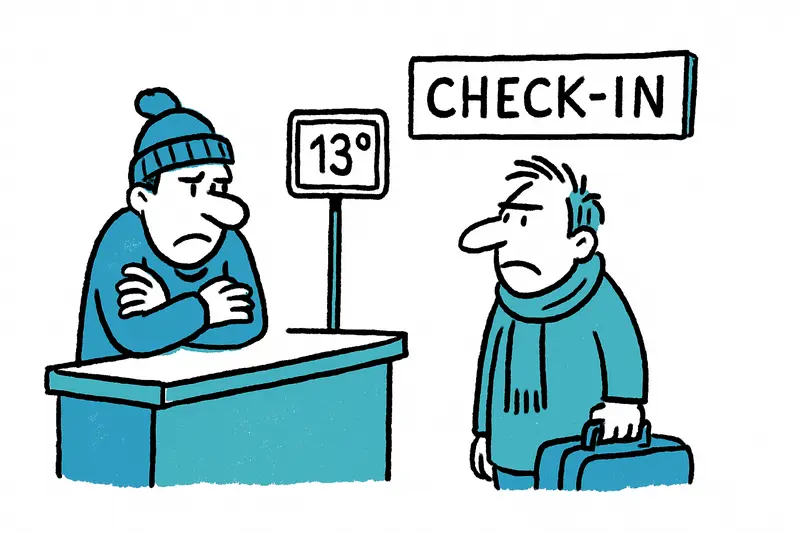
Only 13°C at Check-in: When Construction Leaves Workers Freezing
Staff at Palma Airport report only 13–14°C at check-in counters, missing heating and switched-off measuring devices. A reality check: what's lacking, who is responsible, and which immediate measures help?
Only 13°C at Check-in: When Construction Leaves Workers Freezing
Leading question
How can temperatures at workstations in an international airport in full operation drop so low that employees must work in coats and scarves — and who is responsible in such a situation?
Critical analysis
Employees from different airlines at several check-in rows have been reporting persistent cold for weeks: according to accounts, thermometers in the work area show only about 13–14°C. That is well below commonly cited minimum temperatures for customer-facing workplaces (around 17°C). At the same time, extensive construction work is underway in the terminal — scaffolding, open walls, supply-air ducts, temporary partitions, as reported in Palma Airport: The construction site that never stands still — and how we cope with it. Such interventions can disrupt heating and air distribution systems. If official measuring devices are not visibly reporting, distrust increases.
Important: these are employee reports, not an official series of measurements presented here. Nevertheless, the described consequences are plausible: restricted movement due to winter clothing, slowed service processes, increased accident risk on wet floors or when handling luggage. When you deal daily with passengers carrying suitcases, trolleys and coffee cups, cold fingers and shaky hands are not a comfort issue but a safety factor.
What is missing from the public debate
The debate usually focuses on passengers, flight schedules and noise complaints related to construction. The concrete situation of the people who keep operations running — ground staff, check-in teams, baggage handlers, cleaning staff — is rarely viewed separately. Also little considered are how construction phases (excavation, demolition, reassembly) specifically affect heating and control systems. And: public transparency about measurements in affected areas is almost completely lacking. Without openly accessible temperature logs the situation remains a point of contention between management and employees.
Everyday scene from Palma
Imagine it like this: it is early morning, automatic sliding doors open and a cold gust swirls across the bright floor of the departure hall. On one side trolley wheels squeak, travelers pull on sweaters, and construction machines roar in the background. At a long check-in counter colleagues stand in thick jackets, a female employee nervously tugs at her scarf, a thermometer sits in a jacket pocket. The smell of fresh coffee from the airport bar mixes with the scent of cement slurry from an opened wall; earlier coverage even described how water streamed through the ceiling into the baggage handling area. The speakers announce gate changes, but nobody seems to be calling for the heating — it appears to have been lost in the renovation.
Concrete measures
Short term (within days): place mobile electrically powered warm-air heaters in work areas; temporarily seal draught sources in front of check-in rows; install clear, visible temperature measurements and record them regularly; adjust shift schedules so that especially exposed employees have shorter but more frequent breaks in heated rest rooms.
Medium to long term: plan construction phases so that critical supply systems (heating, ventilation) are not switched off or worked through simultaneously; provide a mandatory information sheet for employees with contact details and escalation steps for safety deficiencies; involve the labour inspectorate (Inspección de Trabajo) and the responsible health and safety officers for airport construction sites to create binding measurement and reporting obligations.
For management this means concretely: disclose measurement data, provide a clear completion schedule for affected sections, and maintain an emergency budget for temporary heating infrastructure. For employees the works council and trade unions are key levers: joint measurements, official reports and, if necessary, complaints to the competent authorities are legitimate means to improve working conditions.
Why this is not just a comfort issue
Cold at the workplace reduces concentration, slows down manual tasks and can create immediate accident hazards in the presence of moisture or icy surfaces. Airports have large numbers of people moving through them; mistakes or delays affect people, luggage and the entire operational flow, and extreme weather can make this worse, as when a severe thunderstorm slowed Palma Airport. Frustration in the team also grows — anyone who passes a check-in in the morning can feel it: fewer smiles, more targeted complaints, more frequent sick leave.
Pointed conclusion
It is unacceptable for people in a modern transport hub to systematically work at temperatures that are too low — whether due to renovation, cost savings or communication failures. Those responsible must act visibly now: in the short term with heating solutions and measurement logs, and in the medium term with construction planning that does not pit worker and passenger safety against each other. Whoever alters the airport structurally must not forget the people who ensure every day that flights take off and land. Otherwise not only the air will freeze — but trust as well.
Frequently asked questions
Why can working temperatures in Palma Airport drop so low during construction?
What temperature should customer-facing workplaces in Mallorca usually have?
Is it safe to work in a cold airport check-in area in Mallorca?
What can be done quickly if airport staff in Mallorca are freezing at work?
Who is responsible for cold working conditions at Palma Airport?
How does construction affect daily operations at Palma Airport?
What should airport staff in Mallorca do if workplace temperature feels unsafe?
Why does cold weather in Mallorca still matter inside an airport?
Similar News
Failed before the first flight: How Fischer Air's plans for Palma were ground down
Announced routes, repeated postponements and now apparent insolvency: Why the Fischer Air project for Mallorca is not me...

Seconds in the Water: 19-year-old Fights Her Way Out of Flooded Car in Palma
A 19-year-old managed to rescue herself from her half-submerged car after sliding under the Verge de Lluc underpass. Res...

Between Dream and Reality: Thorsten Legat and the Challenges of FC Germania Mallorca
The former Bundesliga pro has assembled a colorful squad in a short time. But how realistic is the grand plan for promot...

Arrest warrant at check-in: Why two travelers at Cologne/Bonn Airport suddenly had to pay
At Cologne/Bonn Airport, federal police in mid-September found two German passengers subject to enforcement measures. Bo...

Balearic Islands as a New Route: A Reality Check on Rising Boat Migration
For the first time the Balearic Islands are ahead of the Canary Islands in boat arrivals. What do the numbers really say...
More to explore
Discover more interesting content

Can Cap de Bou

Townhouse Lleo 72
