
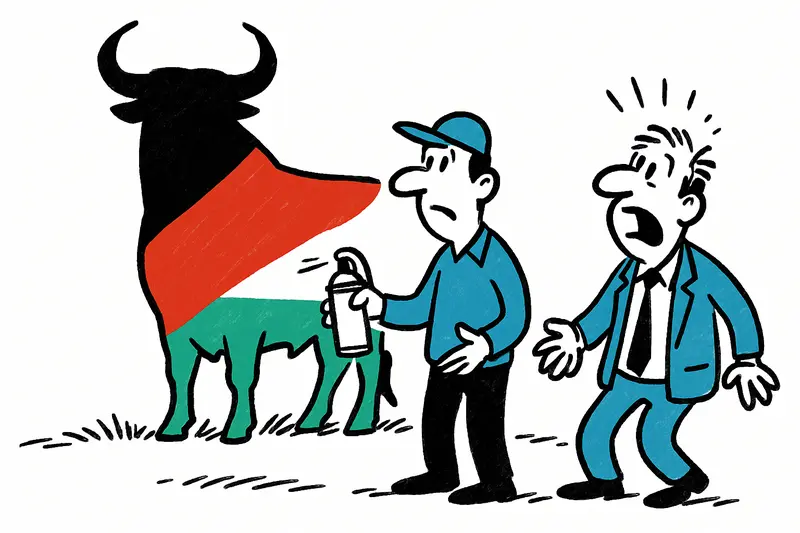
Osborne bull in Algaida painted with Palestinian flag: art, protest or vandalism?
An Osborne bull on the road to Manacor was painted in the colors of the Palestinian flag. In Algaida, residents, politicians and authorities are divided — the question remains: how to handle political art in public space?
Osborne bull in Algaida: Between landmark and political signal
On a quiet morning, before the café on the main road had properly opened, the sharp smell of spray paint hung near the country road to Manacor. A farmer who drives the route every day in his old pickup stopped around 7:20 a.m. and discovered something rare here: the black silhouette of an Osborne bull suddenly bathed in red, black, white and green.
The sight quickly became a topic of village conversation. On the square, where cicadas in summer are louder than phone calls, opinions were split: for some it was a provocative political act, for others simply property damage. Others stood with a cup of coffee wondering how quickly a waymark can become the focal point of political debate.
Reactions on site: outrage, understanding and puzzlement
Representatives of a right-wing council faction called the repainting an attack on a national symbol and demanded swift measures. Voices from other camps emphasized the right to political expression but criticized the method: property should not be altered without permission. The town hall called it an unfortunate escalation; the Guardia Civil took photos and forensic teams have begun their work.
Such reactions show this is not just about paint on metal; similar controversies have been reported, such as Poster Dispute in the Balearic Islands: How Much Provocation Can Public Space Tolerate? The Osborne bull stands for different things: nostalgia, advertising, regional character — and the question of who actually owns public space. Many residents wonder whether the action was an expression of local solidarity, targeted protest tourism or plain vandalism.
Background: Why the bull is so charged
Osborne boards have been seen along Spanish roads for decades. Originally advertising, they have long become symbols. On Mallorca they have repeatedly been subject to graffiti, political slogans or artistic interventions; usually the owners have reacted and had the boards cleaned or replaced, and sometimes incidents have involved abusive or xenophobic messages similar to New xenophobic graffiti at Playa de Palma – How is the island reacting?.
It is important to note: many of these bulls stand on private land but are publicly visible — an intermediate zone where legal questions meet moral ones. Whoever repaints the sign not only makes a political statement but also alters property, traffic safety and the familiar landscape.
What is often overlooked: the practical perspective
While the debate rages, practical questions come to the fore for residents: How quickly will the board be cleaned? Does the fresh paint interfere with drivers' visibility? Who pays for the cleaning? The town hall has promised to commission cleaning work this week and to provide photos to investigators. For many that is not enough — Attack on Picornell Bust in El Molinar: Cleaning Alone Is Not Enough — they want long-term solutions so similar incidents do not keep recurring.
A simple idea: An inventory of all visible bulls on the island would help to contact owners and respond more quickly. Municipalities could also — together with landowners — keep quick-cleaning kits or rolls of protective film on hand so that such boards can be restored fast, without being the subject of cafe and online debates for weeks.
More than cleaning: a politics of conversation
The central question remains: how to deal with political expression in public space? Repressive responses alone — fines, surveillance, cleaning — only push the debate aside. A complementary strategy could be to deliberately designate public spaces for politically artistic actions: legal, visible and regulated. That would give people room for expression without violating private property rights.
Another often overlooked point is education: local workshops on urban art, legal boundaries and nonviolent forms of action could create understanding. On a small island like Mallorca, where neighbors know each other and conversations at the bakery quickly go viral, it benefits the community when conflicts are turned into dialogue.
Conclusion: No easy answer — but options for action
The repainted bull in Algaida is more than an act of paint on metal. It reflects how polarizing public symbols can be — and how ill-prepared many municipalities are for such tensions. In the short term cleaning is planned, the Guardia Civil is investigating, and the discussion continues. In the long term, Mallorca needs better rules, municipal inventories and places where political expression is allowed and shaped.
Update: The town hall has announced it will commission the cleaning this week and provide investigative photos.
Frequently asked questions
What happened to the Osborne bull in Algaida?
Why are Osborne bulls in Mallorca often involved in political controversies?
Is it legal to repaint a roadside landmark in Mallorca as a form of protest?
How do local authorities in Mallorca usually respond to graffiti on public landmarks?
What did the town hall in Algaida say about the painted Osborne bull?
Who pays for cleaning graffiti from a private landmark visible from a public road in Mallorca?
What can Mallorca municipalities do to prevent repeated graffiti incidents on roadside symbols?
Is there a way to allow political street art in Mallorca without damaging private property?
Similar News
So Many Tonnes: What Mallorca's Garbage Boats Accomplish — and What's Missing
23 boats patrol in summer, and 36.8 tonnes were recently pulled from the water. The fleet is shrinking — is that still e...
No Identification Documents on the Steep Slope: Body near Tolleric Raises Questions
The body of an elderly man was found over the weekend in a wooded area near the cliffs of Tolleric. He had no identifica...

Arrest at the Port: Three Suspected Pickpockets Left Mallorca After Series of Thefts
The National Police stopped three men at Palma harbour who are accused of several thefts at the airport. How could the g...
Palma's Rental Bike Boom: More Bikes, More People, More City Life
Since Bicipalma was opened to non-residents, the system has noticeably grown. Students, residents and tourists bring lif...

Palma–Lyon in Winter: Two Weekly Flights Bring Fresh Momentum
From October Transavia France will connect Palma and Lyon in winter as well: Wednesdays and Saturdays, around 17,000 sea...
More to explore
Discover more interesting content

Boat Tour with BBQ along Es Trenc Beach
Private transfer from Mallorca Airport (PMI) to Pollensa
