
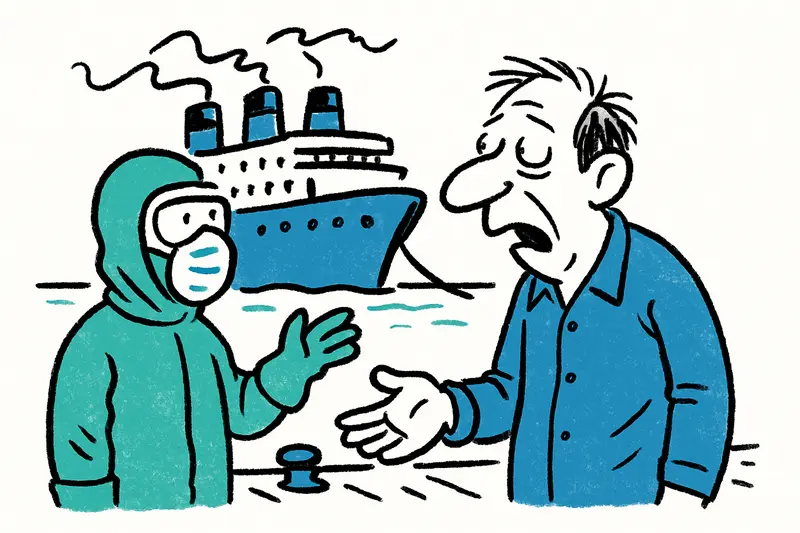
Outbreak ship 'Hondius': Why Spain's decision raises questions
Outbreak ship 'Hondius': Why Spain's decision raises questions
Spain allows the cruise ship 'Hondius' with Hantavirus cases to enter the Canary Islands. Why this humanitarian gesture also exposes gaps in preparedness.
Outbreak ship 'Hondius': Why Spain's decision raises questions
Key question: Was it right to allow the 'Hondius' with confirmed Hantavirus cases and already three fatalities to enter the Canary Islands — or were risks and gaps in preparedness accepted?
Spain has, according to official statements, allowed the docking of the cruise ship flying the Dutch flag. The decision was reportedly made in coordination with the World Health Organization (WHO) hantavirus fact sheet and European authorities. The ship is currently anchored off Cape Verde, where it was not permitted to berth; the island nation cited a lack of capacity. Around 150 people are on board, three deaths have so far been reported, and the WHO estimates seven people are ill. The European Centre for Disease Prevention and Control (ECDC) is reviewing the situation to determine evacuation needs. The ship is expected to reach the Canary Islands in three to four days.
Critical analysis: humanitarian duty versus practical preparedness
The decision to allow docking has a clear humanitarian side: seriously ill people need care, the deceased must be brought ashore, and international coordination is required. At the same time, the move raises questions about practical feasibility. Which port will accept a contaminated ship? Are there sufficient isolation beds, laboratory resources and safe transport on the Canaries without delay (see Emergency on Board the Aidamar: Why a Helicopter Medical Evacuation Raises Questions)? Official statements merely say the exact port has not yet been determined. That is not a small detail — it is the central question mark for operational planning.
Infection control depends on clear procedures: simple answers are missing from public reporting. Who decides on-site how testing will be done? What criteria determine who gets evacuated? How are contact persons identified — and how are those who carry out the evacuation protected? Here a gap appears between political decision-making and practical preparation.
What is missing from the public debate
The discussion often revolves around blame or intent to help. The question of robustness is neglected: which facilities on the islands are immediately available? Who will cover the costs of medical treatment or repatriation? The perspective of medical staff is also little considered: do hospitals on Gran Canaria, Tenerife or Lanzarote have enough trained personnel and protective equipment for rare but severe infections like Hantavirus?
Transparency here is not a nice-to-have but a prerequisite for residents to trust decisions. Instead, terse information snippets dominate, leaving questions unanswered.
Everyday scene from Palma
In front of the café on Passeig Mallorca, an elderly woman sits feeding pigeons. The air smells of freshly brewed café con leche, and the rattle of bus line 3 comes from the street. Such images calm — but they also show how distant an outbreak scenario feels for most Mallorcans. Nevertheless, pharmacies in the old town have recently seen increased demand for face masks and disinfectant. People at Palma's harbor watch the news and discuss responsibility and safety at the market, recalling Boat tragedy off Mallorca: Between grief, legal battles and the question of a Plan B. This local feeling — normality on the one hand, concern on the other — is often missing from the high-level political debate.
Concrete solutions
1) Immediate arrival-port plan: the government should clearly name which port will receive the ship, including a list of available isolation beds and transport options. Leaving short-term decisions to on-site actors increases the risk of mistakes.
2) Mobile testing and isolation capacities: modular medical units that can be erected within hours would mitigate bottlenecks. This includes rapid laboratories that can analyze samples on site.
3) Transparent communication protocol: a central contact person must provide regular updates — which tests are running, how many suspected cases there are, and which measures follow. Reliable information reduces rumors and panic.
4) Protecting personnel: volunteer response teams must be prioritized for protective equipment and training. Without protective gear, systemic risk increases.
5) Arrange international repatriation: pre-agreements with countries of origin facilitate coordinated repatriation of healthy and sick people, including financial arrangements.
Conclusion
Allowing the 'Hondius' to enter is understandable on human grounds. But it also reveals that national and regional emergency plans can exist on paper without being immediately reliable for every concrete situation. Those who offer help also bear responsibility for seamless organization. The Canary Islands are geographically near, but logistically such an event is complex — and this episode made that clear.
When we watch from afar — on an ordinary morning in Palma, between bus rattles and coffee smells — we should demand two things: clear procedures to protect everyone and honest communication. Both protect people and reduce mistrust.
Frequently asked questions
When is the best time to visit Mallorca for warm weather?
Can you swim in Mallorca outside the summer months?
What should I pack for a trip to Mallorca in spring?
Is autumn a good time to go to Mallorca?
What is Palma de Mallorca like for a short city trip?
Is Sóller a good base for exploring Mallorca?
What is Port de Pollença known for?
Is Mallorca good for outdoor activities in cooler weather?
Similar News
Fewer Airlines, Fewer Destinations: What Palma's Winter Flight Schedule Means for Mallorca
Analysis shows: Winter at Son Sant Joan Airport will be quieter, with significantly fewer airlines and destinations. Who...
German tourist dies in Sa Calobra – a reality check for emergencies on Mallorca's beaches
A 40-year-old tourist died at the Torrent de Pareis. The emergency call, a doctor who happened to be present, a defibril...
Deadly Tractor Accident in Bunyola: What Needs to Be Done Now
In a work accident on an estate near Bunyola, a roughly 40-year-old man lost his life. His wife and a small child were o...
Head-first dive into the shallow part of Cala Fonoll: An accident and the unresolved question of responsibility
A young tourist dove into Cala Fonoll and was seriously injured. Key question: Why are clear warning signs missing at da...
Mistaken identity with fatal consequences: Brutal assault in S'Aranjassa — what's missing in the follow-up?
At S'Aranjassa a visitor to a finca was tied up, beaten and thrown out of a van. Three men have been arrested, including...
More to explore
Discover more interesting content

Can Cap de Bou

Townhouse Lleo 72
