
Emergency on Board the Aidamar: Why a Helicopter Medical Evacuation Raises Questions
Emergency on Board the Aidamar: Why a Helicopter Medical Evacuation Raises Questions
A passenger on the Aidamar had to be flown ashore by helicopter in the middle of the Atlantic. The swift response shows that ships can organise assistance — but also where gaps remain on board and on land.
Emergency on Board the Aidamar: Why a Helicopter Medical Evacuation Raises Questions
A medical emergency en route to the Canary Islands and the ship's response — quick, but not entirely transparent
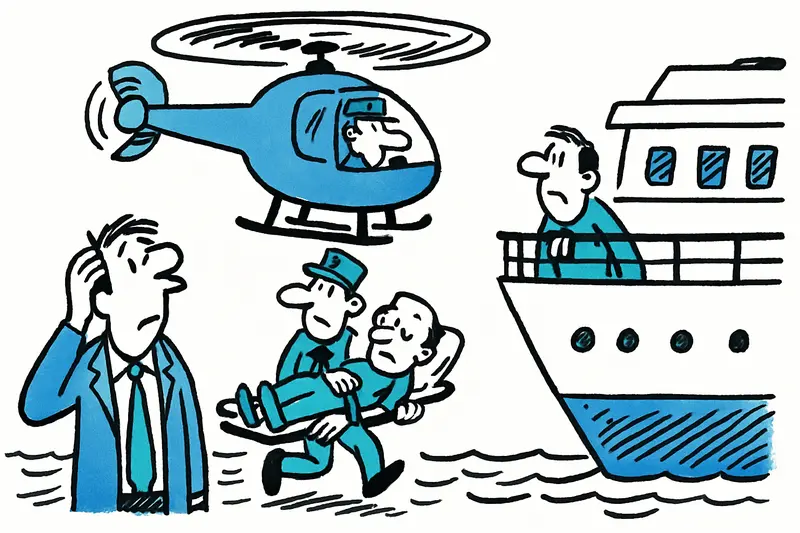
On the cruise ship Aidamar, a medical emergency occurred at sea. The ship's doctors and crew responded decisively: a helicopter air ambulance retrieved the affected person from the outer decks, which were cordoned off for the operation so the evacuation could proceed without disruption. The voyage, which began in Hamburg, is scheduled to continue as planned to the Canary Islands; the ship's next port of call was Santa Cruz de Tenerife.
Key question: Are the current procedures on board and the cooperation with rescue services sufficient to resolve such cases quickly and safely — and what should the public expect regarding causes and consequences?
The helicopter medical evacuation is a clear signal: there are procedures that take effect in critical moments. Medical decisions on board can be pragmatic when helicopter transport leads to a faster treatment outcome than waiting for the next port. On the other hand, each operation raises questions about preparedness: what medical equipment is available on board? How quickly can rescue resources be requested? Who bears the costs — and what information do fellow passengers receive?
From the available facts we only know the essentials: emergency on board, outer decks were temporarily closed, a helicopter transported the patient ashore; no further details about the nature or severity of the illness were given. This is not unusual — medical details are often confidential — but the restraint leaves passengers and relatives uncertain.
What often gets too little attention in public discourse is the travellers' perspective: hundreds of people sit close together on cruise ships. In a café on Palma's Passeig Mallorca, when the wind rattles the coffee cups and a cruise giant is moored in the harbour, you often hear the question: "What happens if someone becomes seriously ill?" There is a sense that ship doctors and rescue teams must achieve a lot, but the procedure remains opaque to outsiders.
A second, often underestimated point is the interface between ship and shore rescue. Coordination requires clear contacts, radio links and medical handover documents. The further a ship is into the Atlantic from land, the more minutes count. In practice, helicopter transports run smoothly only if precise situation reports, safe landing zones and medical handover protocols are established beforehand; a recent case is covered in Dramatic Helicopter Rescue at Puig Major: Lessons from an Afternoon in the Tramuntana.
Concrete solutions that should be derived from such incidents are practical and immediately implementable:
• Standardised medical checklists before boarding: more precise queries about pre-existing conditions and medication can make risks visible in advance. • Improved telemedicine connectivity: real-time access to specialists ashore reduces uncertainty and supports decision-makers on board. • Uniform minimum standards for onboard clinics: medications, defibrillators, trained emergency medical personnel — mandated through clear regulations. • More transparent communication on board: after an emergency evacuation, passengers should receive a short, factual update (without medical private data) to prevent rumours. • Agreed procedures with ports: clear arrangements between shipping companies, maritime rescue services and ports for quick helicopter landing sites and handover formalities, as discussed in Emergency in the Balearic Islands: Between Rapid Aid and Open Questions. • Insurance and cost information: before travel it should be clear who covers which costs in an emergency and how repatriation is organised.
Another measure would be regular crew training in realistic scenarios — including the involvement of external rescue services. In Palma you occasionally see training flights and harbour manoeuvres; these exercises directly contribute to passenger safety, as noted in 115 Rescue Missions, Hot Trails: Why Mallorca's Mountain Rescue Got Busier — and What Helps Now. Such practices should be a systematic part of the cruise industry, not just occasional events.
A critical point remains the balance between the public's need for information and medical confidentiality. Authorities and shipping companies can better coordinate communication guidelines: what may passengers be told without violating privacy? A clear answer would curb speculation and build trust.
Conclusion: The rapid medical evacuation from the Aidamar shows that rescue procedures work when speed is essential. At the same time, the case makes clear that prevention, transparency and better networking between ship and shore can still be improved. Anyone drinking their coffee in Palma's harbour in the morning and gazing over the bay rightly expects that everything is prepared for an emergency — not only reactive, but also organised proactively.
Frequently asked questions
What happens if someone has a medical emergency on a cruise ship near Mallorca?
How safe are helicopter evacuations from cruise ships in the Mediterranean?
Do cruise ships near Mallorca have doctors and medical equipment on board?
Who pays for a medical evacuation from a cruise ship?
Why are cruise passengers sometimes only given limited information after an emergency?
Can a cruise ship keep sailing after a medical evacuation near Mallorca?
Why is Palma often mentioned in discussions about cruise ship emergencies?
What should cruise travellers from Mallorca check before boarding?
Similar News

Ornella Muti in Son Vida: An Evening Full of Stories from Film and Life
Italian actress Ornella Muti (71) attended a VIP party in Son Vida. Impressions from the evening, her view on cinema, ca...
Armengol steps aside: Why the Balearic Islands now need more than a new name
Francina Armengol will not run as the Socialists' lead candidate in the regional elections. An analysis: What does her w...
Anxiety in Ca'n Picafort: Three-year-old in Critical Condition After Pool Accident
A three-year-old boy fell into a pool at a finca in Ca'n Picafort. A relative began resuscitation immediately and emerge...
Aquaquae launches "Women Design Voices" in Portixol: Palma becomes a stage for design
Premiere in Portixol: Around one hundred professionals gathered in Aquaquae's large showroom to discuss interior trends ...

When the Snakes Come: A Reality Check for the Islands
Residents on Mallorca and the neighboring islands report increased snake sightings. A critical assessment: why the probl...
More to explore
Discover more interesting content

Boat Tour with BBQ along Es Trenc Beach

Private transfer from Mallorca Airport (PMI) to Pollensa
