
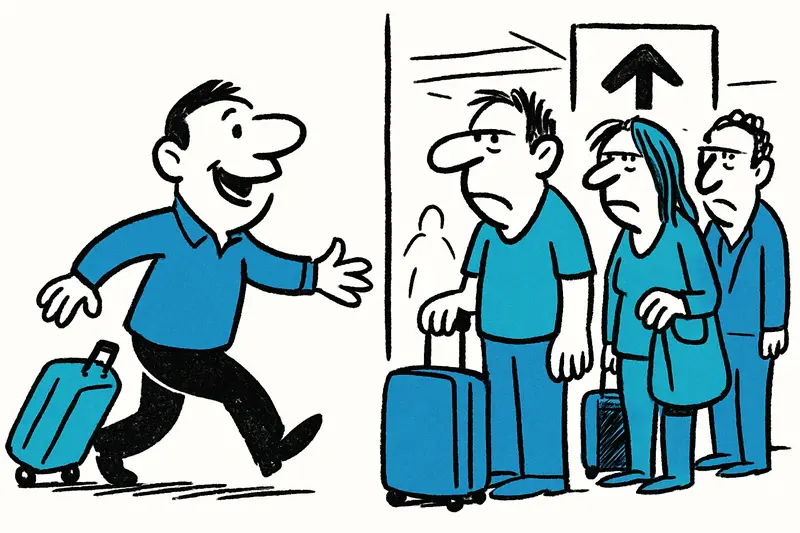
Son Sant Joan: Between Arrival Delight and Pickup Chaos
For many, Son Sant Joan is the first image of Mallorca — unfortunately the welcome often swings between a friendly smile and a grumpy traffic jam. Why the airport needs more planning and less patchwork.
One airport, two worlds: arrival and endurance
Last weekend, 4:40 PM at the pickup zone: the air is still, buses are bumper to bumper, and an endless stream of travelers is pushing out of the arrivals hall. For many, Son Sant Joan is the first view of Mallorca — and often not a particularly welcoming one. Between announcements, the smell of coffee and the cough of old bus diesels, it only takes a few minutes to decide whether a holiday starts with a smile or with an irritated sigh.
The key question
How can Son Sant Joan become the warm welcome our island deserves again — without ignoring economic interests and working conditions? That is the question you have to ask if you look at the processes for more than a moment.
What stands out — and what is often overlooked
Long queues regularly form at the barriers in front of the terminal. Moving walkways do not always work. The loudspeakers roar, and the food and beverage options are expensive, hectic and offer few cozy corners. Advertising hangs like wallpaper on the walls and pushes into view until you can hardly shut it out. All of these are things travelers perceive as annoyances.
Less in focus are the people behind the scenes: taxi drivers, bus drivers, ground staff. Many complain about long shifts, foul-smelling diesel and the feeling of working at the limit. Still, you often meet friendly faces at the security checks — a small bright spot amid the bustle. Nevertheless, measures such as enforcement checkpoints can suddenly ruin travel plans, as reported in Checkpoint Son Sant Joan: When unpaid fines can stop a holiday.
Three drivers of the problem
First: Decisions about space, operators and services are made centrally and driven by economic interests. More shops, more advertising space, more revenue — that is understandable, but not without consequences for the quality of stay.
Second: Low-cost carriers and dense flight schedules bring volume; fog can also paralyze operations, as detailed in Fog paralyzes Son Sant Joan: Why visibility disrupts the flight schedule — and what could help now. More planes, more people, more waste, more noise. The existing infrastructure often feels like a shirt that's become too small: well-intentioned but not fit for purpose.
Third: The island lacks a reliable rail link. A metro or tram would relieve many pickup journeys, smooth bus peaks and make the offer more climate-friendly. The idea has existed for years — it has not been implemented, despite proposals such as the Palma metro.
Temporary construction work, emergency parking on paved green spaces and makeshift solutions that look more like patchwork than planning add to the problem. This is more than an issue of design: it affects air, noise and quality of life in the neighborhoods around the airport, as shown by recent developments described in Son Sant Joan becomes a major construction site: How Palma is organising the winter at the airport.
Concrete opportunities and solutions
Simply put: pragmatism is needed instead of cosmetic repairs. Concrete steps that would have an immediate effect:
Better lanes and pickup zones: Clear, digitally managed pick-up lanes with short waiting windows would reduce the buildup in front of the terminal. Even simple signage and a parking system with live information would help a lot.
Fairer prices and improved comfort: Regulated rents for catering spaces and more seating with power outlets would give travelers some peace — and give the airport a friendlier image.
Public transport and electromobility: Rapid bus lines, express bus lanes and a realistic timetable for a rail connection must finally be set. In parallel, taxis and airport shuttles should be gradually electrified; this would reduce emissions and noise for drivers and residents.
Improve working conditions: Better shift planning, rest areas for drivers, drinking water stations and fair wages reduce pressure and improve service for travelers.
Less asphalt, more green: The hastily paved green areas are a bad sign. Renaturation in suitable places and planting shade-giving trees would improve microclimate and appearance.
A look ahead — without sugarcoating
I'm not a doom‑monger. The island benefits economically from the airport. But profit and quality are not necessarily in opposition; they can be combined if planning, staff and the environment are taken seriously. Son Sant Joan could again be the welcome Mallorca deserves: efficient, friendly and not an obstacle course.
Anyone who works at the airport every day or picks up holiday guests there knows: a little more consideration and a little better planning would already change a lot. And you can hear that too — between bus engines, announcements and the distant hum of the city.
Frequently asked questions
Why does Son Sant Joan sometimes feel so chaotic for arrivals in Mallorca?
What makes the pickup area at Palma airport difficult to navigate?
Is there a better public transport option than driving to Son Sant Joan?
What are the main problems travelers notice at Mallorca airport?
How do airport conditions at Son Sant Joan affect staff and drivers?
Why are airport queues in Palma sometimes worse during bad weather or fog?
Could better planning improve the airport experience in Palma de Mallorca?
What would make Son Sant Joan a better first impression of Mallorca?
Similar News
Thunderstorms bring relief: Mallorca breathes after weeks of heat
Incoming thunderstorms and an orange weather warning abruptly ended the weeks-long heatwave on Mallorca. Highs dropped n...

Centro Galego in Coll d'en Rabassa: Galician Cuisine in the Heart of Mallorca
An old country house in Coll d'en Rabassa is more than a meeting point for Galicians: at Centro Galego, rustic cuisine f...

Quad accident shuts down Sóller Tunnel — traffic chaos on Saturday afternoon
An overturned quad carrying two young people caused the Sóller Tunnel to be closed on Saturday afternoon. Hours-long tra...

Hot-potato game before the mass demo: Who really solves Mallorca's tourism problems?
One day before the announced large demonstration, accusations between right and left fill the air in Palma. The protests...

Rod Stewart on Board: A Relaxed Stop in Puerto Portals
The British singer is spending time with his wife and friends on a yacht off Puerto Portals. A small presence, big impac...
More to explore
Discover more interesting content

Boat Tour with BBQ along Es Trenc Beach

Private transfer from Mallorca Airport (PMI) to Pollensa
