
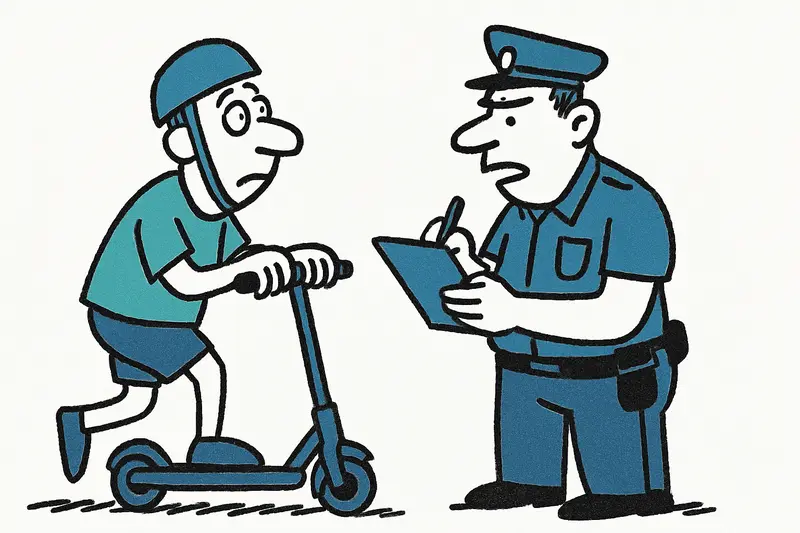
Palma takes stock: 7,700 fines — success or just performative toughness?
Over 7,700 citations between July and September: Palma shows presence against e‑scooters, street vendors and noise offenders. But behind the numbers lie social inequality, a lack of information and infrastructure problems. Time for strategy instead of mere presence.
More citations, more presence — but what’s really behind it?
Palma’s summer tally looks impressive at first glance: over 7,700 citations between July and September, roughly twice as many as the previous year. In the evenings, teams with flashlights and reporting forms have become part of the cityscape: on the Passeig del Born voices in every language mingle, on the Paseo Marítimo the rim of a café glass clinks, and on the Plaça Major you can hear the distant beep of a delivery bike. But such figures say more about presence than about impact — and that is the central question: do the measures actually change everyday life or do they only produce visible toughness for the cameras?
What the controls target — and what gets lost
The focus is on e‑scooters, illegal street vendors and noise disturbances. More than 4,100 violations fell under the new catalog: helmet and insurance issues with scooters, riding through pedestrian zones, vendors without permits, open glasses at night. For some residents — for example the baker on Calle Sant Miquel — the checks mean less rubbish at the door and a quieter neighborhood. You can feel it: less paper, fewer loud groups, a normal breakfast in the morning.
At the same time the scene feels somewhat rushed and bureaucratically harsh. When patrols appear in the evening, many people do not think of prevention but of quick warnings. The challenge is whether behavior is changed in the long term or whether discipline is only enforced in the short term — often through fear of penalties rather than through understanding and alternatives.
An underestimated problem: who is hit hardest?
Despite all sympathy for cleaner streets, it is important not to overlook who is most often targeted. Illegal vendors are often seasonal workers without stable income; for them a fine can quickly threaten their livelihood. And many tourists who are caught on a scooter without proof of insurance do not even speak the language of the citation. This creates an imbalance: intensive controls hit people in particularly vulnerable situations.
The allocation of deployments also sometimes seems reactive rather than strategic: lots of personnel on busy promenades, little information in the neighborhoods where the problems originate. A young guest who receives a fine late at night rightly asks: why are there no clear, multilingual notices at rental stations or at hotel check‑in?
What is missing in the public debate
The discussion revolves around cracking down, but hardly about data, costs and success criteria. Which violations decrease permanently? Do sanction numbers fall when accompanying information campaigns run? How are the citations distributed among locals, seasonal workers and visitors? Without transparent evaluations much remains in the dark — and municipal control feels like a black‑box experiment that mainly measures presence, not results.
Another often neglected issue is infrastructure: are rogue scooters a product of thoughtlessness — or of a lack of parking spaces, unclear parking zones and inadequate bike lanes? The same applies to rubbish: more bins, more frequent emptying and reliable standards at events create more sustainable cleanliness than occasional fines.
Concrete proposals instead of mere presence
Palma now has the chance to adjust course. Some pragmatic measures would be feasible:
Multilingual information: clear signs at hotspots, information leaflets in hotels, notices at rental stations — English, German, Spanish, Catalan.
Graduated sanctions and alternatives: first warning, then fine; social offers or referrals to advisory services for seasonal workers instead of immediate punishment.
Infrastructure measures: fixed parking zones for scooters, additional bike lanes, more public bins and regular emptying.
Transparent data analysis: disclose which measures work and which don’t — this allows control to be planned smarter and more cost‑efficiently.
Conclusion: presence is not enough — Palma needs strategy
Under harsh evening lights the teams do their work: conversations, reporting forms, sometimes heated discussions with surprised guests. Palma has shown it can enforce rules. Whether this sustainably improves quality of life or mainly produces cleaner photos is unclear. A sustainable solution requires more than high visibility: language, social support and better infrastructure must be added. Only then will the current wave of citations become a real step toward a city where residents, seasonal workers and visitors live together respectfully and with clear rules.
Small photo on the side: Saturday evening on the Passeig: the smell of the sea, laughter from a street café, somewhere the soft whir of a scooter — and next to it a folder full of forms. That is the image of this summer.
Frequently asked questions
Why is Palma handing out so many fines this summer?
What kinds of behaviour are fined in Palma at night?
Do fines in Palma actually make the city quieter and cleaner?
Are e-scooter riders fined in Palma for missing insurance or helmets?
Where in Palma are the street controls most visible?
How can visitors avoid fines in Palma?
Why are illegal street vendors in Palma targeted so heavily?
What would work better than just more fines in Palma?
Similar News

Caro Robens: 15 kilograms lighter — and again in the crossfire of online comments
Bodybuilder Caro Robens, who lives in Mallorca, has lost 15 kilograms. Her success on Instagram was met with applause — ...

Meager Industry in Mallorca: How the Island Can Be More Than Just Tourism
The industrial sector in Mallorca is shrinking, productivity is falling and firms remain tiny. The key question: can the...
Pre-Nit de l'Art: Galerie Mensing invites to a special evening with Tom Boston
Before the big art night, Galerie Mensing opens its doors: pop art, champagne, a DJ and a hand-signed print by Tom Bosto...

Sea view and more seats: Cappuccino Grand Café reopens in Port d'Andratx
After a long renovation, the Cappuccino Grand Café on the Port d'Andratx harbor promenade has quietly reopened. Larger t...

Enric Mas wins the Vuelta – a triumph that resonates in Mallorca
Mallorcan Enric Mas has won the 82nd Vuelta — the first Spanish overall victory since 2014. Cyclists and neighbors on Ma...
More to explore
Discover more interesting content

Can Cap de Bou

Townhouse Lleo 72
