
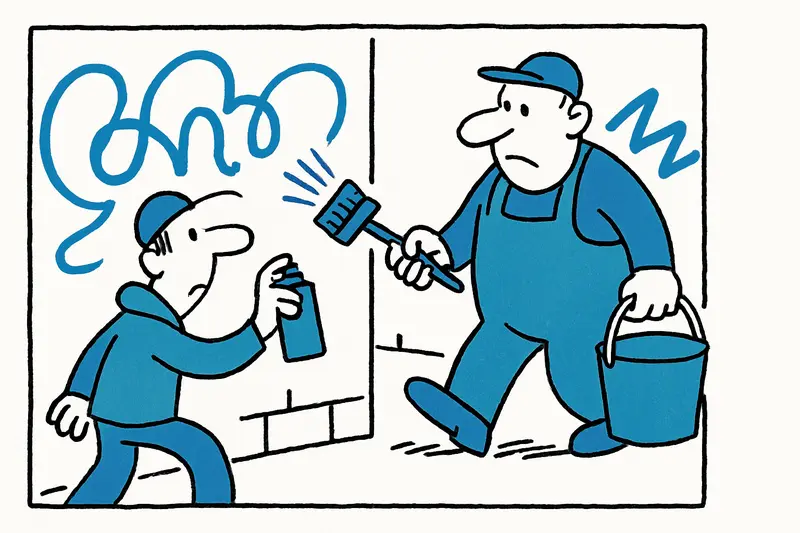
Since the start of the year, Emaya has removed nearly 7,000 graffiti in Palma. Cleanliness clashes with costs, heritage protection and a debated question: Are walls being cleaned or are forms of expression being erased?
Palma Cleans Up — Who Pays, What Remains?
When the morning wind from the sea flows through the alleyways of the old town and the refuse collectors are emptying the last bins, it is now noticeable: some walls look calmer, less colorful. The municipal utility Emaya reports having removed around 7,000 graffiti since the beginning of the year – nearly 3,000 public places and facilities have been cleaned. Numbers that create an impression. But what lies behind the figure, who pays the bill, and how sustainable is the action?
Cleanliness for residents, frustration for others
For residents in busy neighborhoods like around the Plaça and along heavily trafficked streets, the campaign is a tangible relief: doorways are visible again, signs readable. Early in the morning, when the first cafés put out their chairs and seagulls circle over Portixol, praise is often heard. But the intervention has two sides. Some residents see the conspicuous cleanliness next to still-smeared small corners and ask: Why so selective? Who is liable when a private façade is affected? It remains less clear than the freshly whitewashed walls.
The less visible costs
Cleaning large surfaces is not cheap. Chemical cleaners, high-pressure equipment, specialist firms for historic stone – all that adds up. The city administration speaks of holding property owners liable in certain cases, while in others the municipality acts first to quickly remedy the situation. But the criteria for when fees are charged or waived often seem ad hoc. The problem is not only the bill: there is a lack of transparent accounting, clear deadlines and public monitoring about which surfaces were cleaned and at what cost.
Monuments as the next battleground
Emaya announced that the next targets will be listed buildings — including several churches and the auditorium on the outskirts. Cleaning historic stone is delicate: the wrong products can permanently damage patina or limestone. That is why specialist firms are to be used. This is correct, but it also highlights a shortcoming: Palma lacks a graduated protection concept that distinguishes between everyday dirt, vandalism and the conservation care required for cultural assets, as shown by the Attack on Picornell Bust in El Molinar: Cleaning Alone Is Not Enough.
What is often lost in the debate
Less visible but crucial is the question of displacement and expression. When graffiti are removed across the board, the need to express oneself in public space does not necessarily disappear. Instead, tagging is shifted to marginal areas or the utopia of public art is stifled by threats of punishment. Also seldom discussed are the young people who see spray-painted works as a form of subculture. Repression alone does not replace dialogue.
Concrete opportunities instead of mere cleaning
There are pragmatic ways to combine order with creative solutions: mapping hotspots can help deploy resources more effectively; legal walls and temporary project spaces offer sanctioned outlets; workshops in schools and youth centers combine prevention with support, as reported in Palma renews sports facilities: small repairs, big impact - and open questions. A transparent fee model and rapid communication channels — such as a hotline or an app for reporting and tracking clean-ups — would strengthen trust. For listed buildings, binding guidelines and certified restorers are essential.
A proposal for Palma
The city, owners and neighborhoods could agree on a three-point plan: 1) a public register of all cleaning operations with costs and responsibilities; 2) a program for legal street-art spaces and cultural support for young sprayers; 3) clear, fair liability rules for owners with socially tiered fee structures. Such measures would link short-term cleanliness with long-term urban development — and prevent cleaning alone from setting the agenda.
In the end, the guiding question remains
Palma has visible successes: corners that were previously considered neglected now look tidier. But the central question remains: Does the wave strike the right balance between public order and urban vitality — or are forms of expression and young creativity simply being swept out of sight? The answer requires more than cleaning crews: transparency, dialogue and a plan that takes homeowners, heritage conservation and the creative scene seriously.
Important for everyone: graffiti on public or private buildings remains punishable and subject to fines (up to €3,000). The city asks that vandalism be reported immediately.
Frequently asked questions
Why is Palma removing so much graffiti now?
Who pays for graffiti removal in Palma?
Can I be fined for graffiti in Mallorca?
How does graffiti removal affect historic buildings in Palma?
What are the main problems with Palma’s graffiti cleanup strategy?
Where is graffiti removal most noticeable in Palma?
Does removing graffiti in Palma solve the problem long term?
What should I do if I see vandalism or graffiti in Palma?
Similar News
Sant Salvador: The Christ That Becomes a Touchstone for Memory Politics
A statue, 33 applicants and a ministry under review: Why the crowned Christ on the mesa near Felanitx has suddenly becom...
Why the yacht "Sasha I" remains in Palma — a reality check
The luxury yacht "Sasha I" has been held in Palma since 2023. Spanish authorities maintain the seizure despite a propert...
Curious Derby: When the Away Game Is Only 150 Meters Away
On Saturday FC Germania Mallorca meets U.D. Pla de na Tesa — a local derby that is effectively decided on the doorstep. ...
Protection failed? A murder in Coll d'en Rabassa and the gaps within
A jury found a man responsible for his partner's death: 66 stab wounds, the crime carried out in front of their shared d...
Palma opens s’Aigua Dolça: New sports centre opens on October 15
The new municipal sports facility s’Aigua Dolça above the Paseo Marítimo opens on October 15 in several stages. Initiall...
More to explore
Discover more interesting content

Can Cap de Bou

Townhouse Lleo 72
