
Palma expands smoking ban on beaches – clever step or pseudo-solution?
Palma expands smoking ban on beaches – clever step or pseudo-solution?
The city of Palma has banned smoking on six more beaches. Good intention — but how will the ban be enforced, who will explain it to tourists in English or German, and what happens to the cigarette butts in the sand?
Palma expands smoking ban on beaches – clever step or pseudo-solution?
Six beaches now smoke-free: what's missing from the discussion
The Palma administration has announced that smoking will no longer be allowed on six additional beaches: Cuitat Jardí, Portitxolet, Cala Major, Cala Nova, Cala Estància and Es Carnatge. The city names the national cancer association (AECC) as a partner and plans to put up appropriate signs in the coming days. Sounds straightforward. But is that enough to actually solve the problem?
Key question: Will a sign on the beach bring real behavioral change — or will it remain a good intention and a few symbolic boards? Anyone who sees the vans watering the palm trees on the Paseo Marítimo in the morning and, in the evening, the sunset crowds from Germany, England and Scandinavia strolling by knows: beach rules have to be practically enforceable, otherwise they remain mere lip service.
Short summary: The named playas are in areas heavily used by both locals and tourists. Cala Major and Es Carnatge, for example, have in recent years become regular stops on hotel routes and seaside walks, and are affected by changes such as Palma Cuts Sunbeds — What Will Happen to Our Beaches?. Cigarette butts in the sand are more than an aesthetic nuisance — they are toxic waste, a fire risk in the dry season and a burden for marine life if they end up in the water.
Critical analysis: A paper ban without staffing capacity, clear sanctions and public education will be ineffective. Experience from other municipalities shows: people ignore rules when they are not visibly enforced or when fines are rare and unclear. Added to this is the language barrier. Near the Paseo, in high season you hear more German, English and Scandinavian languages than Mallorcan Catalan. A sign in Catalan alone will not reach many visitors.
What is usually missing from the public debate: a description of how the ban will be concretely enforced. Who will check violations — municipal inspectors, environmental services, civil volunteers? Is there a transition period instead of immediate fines? And: how does the municipal ban relate to nationwide plans to tighten anti-tobacco laws and treat e-cigarettes legally like tobacco, as discussed in Smoking Ban in Mallorca: What the New Law Means for Terraces, Playgrounds and E‑Cigarettes? Without clear coordination, grey areas arise, especially given that the Balearic government rejects a nationwide smoking ban on beaches and terraces.
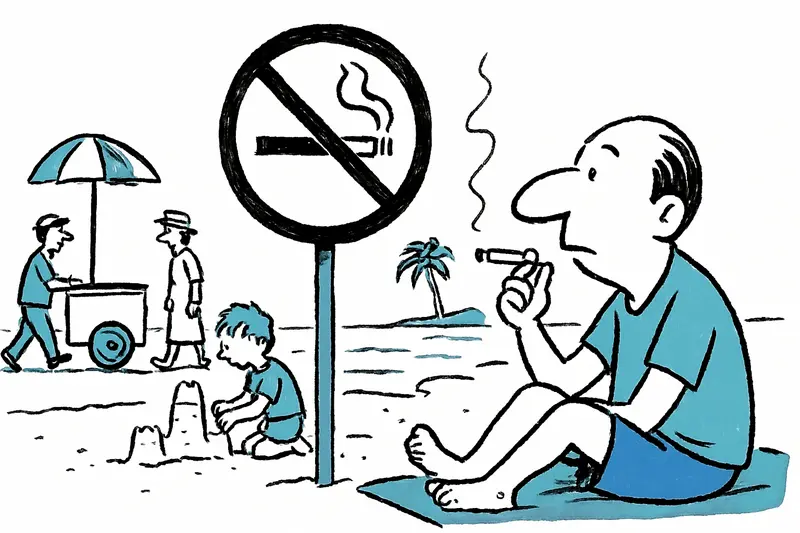
Everyday scene at Cala Major on a hot afternoon: children build sandcastles, a vendor pushes his cart by, older couples seek shade under the pines, and a group of tourists share a beach lounger. One lights a cigarette. No one reacts immediately. This starts the chain: there are no ashtrays, the butt ends up in the sand, the wind blows it toward the water. Such scenes repeat daily and show that regulations and reality often diverge.
Concrete solutions that go beyond signs:
1) Multilingual information: Informational signs in Spanish, Catalan, English and German, supplemented by pictograms. Flyers in hotels and at rental agencies with brief rules and directions to disposal points.
2) Infrastructure: Ashtrays at beach entrances, specially designed receptacles for butts so the litter doesn't end up in the sand. These small facilities are inexpensive but effective.
3) Visible presence: Mobile teams in high season coordinated with the municipal police and cleaning crews. Friendly communication often works better than immediate fines.
4) Partnerships: Hotels, bars and rental companies should be included in information campaigns. If package tourists learn at check-in that certain beaches are smoke-free, compliance will be higher.
5) Clear rules on e-cigarettes: If national legislation equates e-cigarettes with tobacco products, the city must communicate that. Otherwise misunderstandings could lead to disputes on the beach.
Conclusion: Expanding the ban is a necessary step. But without translation into everyday practicality it will remain piecemeal. Palma can make more of this — with clear communication, simple waste facilities and tiered enforcement that aims not at confrontation but at changing habits. Otherwise the new signs will soon be just a backdrop for beach photos while the butts remain in the sand.
One final, perhaps provocative thought: If the city really wants these playas to become smoke-free, it must treat the matter as if it concerned life jackets or drinking water — not only decide, but secure, accompany and explain. Then a ban could become a tangible improvement for both locals and visitors.
Frequently asked questions
Are beach smoking bans in Mallorca effective, or do signs fall short?
What practical steps can Palma take to reduce cigarette litter on its beaches?
How are e-cigarette rules handled on Es Carnatge, and what should visitors know?
How does tourism shape enforcement of Palma's expanded beach smoking ban?
Which beaches are included in Palma's expanded smoke-free plan?
Why is enforcement on Cala Major and Es Carnatge particularly challenging?
What infrastructure measures are proposed for Cala Major to support the ban?
How can visitors avoid misunderstandings about smoking rules on Mallorca beaches?
Similar News

Magaluf: Watchtower Alarm – Lifeguards Pull Unconscious Beachgoer from the Water
After a drama in the late afternoon, two lifeguards at Magaluf beach rescued an unconscious 44-year-old man. He was stab...

Turquoise in the City: How dangerous is the color play of the Sa Riera?
The Sa Riera in Palma suddenly turned turquoise — a pretty motif, but behind the effect lies a discharge of saline waste...

Jeckliner at Sunnesching: Cologne spirit sets sail from Palma
In September 2027 the Mein Schiff 2 briefly becomes a floating carnival stage: four days with Cologne bands, comedy and ...
Finally Home: Mike and Leyla Heiter Buy Villa with Sea View in Mallorca
The reality TV couple Mike and Leyla Heiter have bought a house in Mallorca with a roof terrace and sea view. An Instagr...

Arrest after series in Palma: Who protects apartments from repeat offenders?
The National Police arrested a man in Palma who investigators say may have broken into several apartments. In one incide...
More to explore
Discover more interesting content

Can Cap de Bou

Townhouse Lleo 72
