
Palma's Hotel Perú: When Urban History Becomes a Luxury Project — a Critical Appraisal
Palma's Hotel Perú: When Urban History Becomes a Luxury Project — a Critical Appraisal
The former Hotel Perú at Plaça Major is for sale for €3.6 million. A historic building, 768 sqm, terrace with a view — and the question: Who owns the old town?
Palma's Hotel Perú: When Urban History Becomes a Luxury Project — a Critical Appraisal
Key question: Should a building that has shaped the streets around the Plaça Major since 1900 be converted into private luxury apartments — or does Palma need a different approach to its architectural memory?
Early in the morning, when coffee cups clink on the Plaça Major and suppliers roll the last stalls at the Mercat del Olivar into place, the eye inevitably falls on the sand‑colored corner building at the Plaça del Banc de s’Oli. The façade looks tired; hidden arches glint at the side — remnants of the old oil market, as noted in the selling agency’s brochure. The former Hotel Perú has been empty for decades. Now there is a listing online: For sale, €3.6 million, 768 square meters, ground floor plus three upper floors and a terrace with views over the old town.
What remains when the doors of such a house close for good? This is not just nostalgia. The building is historically one of Palma’s early hotel constructions; the land register lists an origin around 1900 and it was operated as a hotel in the mid‑20th century. For planners and residents this is evidence: a building block of urban identity, not merely usable floor space for the luxury‑apartment market.
Critical analysis
The listing names architectural details and suggests conversion into a single‑family house or several residential units. Harmless sounding? Not when you consider the location: within walking distance of tourist hubs, short walks to cafés and municipal offices, a panorama that sells well. Empty hotels on the island often become high‑priced apartments, as reported in Who Owns Palma? When Luxury Quietly Repaints the Working-Class Neighborhoods — a process that increases demand for exclusive housing while reducing the supply of affordable flats in the center.
Moreover, the legal status is only half told: deregistration from the hotel registry and the absence of an operating license make the property malleable. That creates room for investors, but also risks for the building fabric and public access. A luxury renovation can uncover original elements — or it can concrete them over to create a homogeneous, high‑end interior. Which scenario will occur remains unclear; similar policy debates around conversions are discussed in When Offices Go to Sleep: Palma's Plan to Revive the Old Town.
What is missing from the public debate
On social media streams and in some brochures it’s about images and returns. Rarely, though, about these questions: Who actually owns public urban space? Who decides on uses when historic buildings move into private hands? How binding are conditions for preservation and access? And not least: Who benefits economically from such sales — the neighborhood, the municipality or distant investors?
Another blind spot is transparency about owner changes. The house has changed hands several times, it is said, and citizens often remain in the dark about what plans lie behind such transactions, a problem illustrated by cases like Price Shock in Palma's Old Town: Townhouse Doubles Price Within Months.
An everyday scene
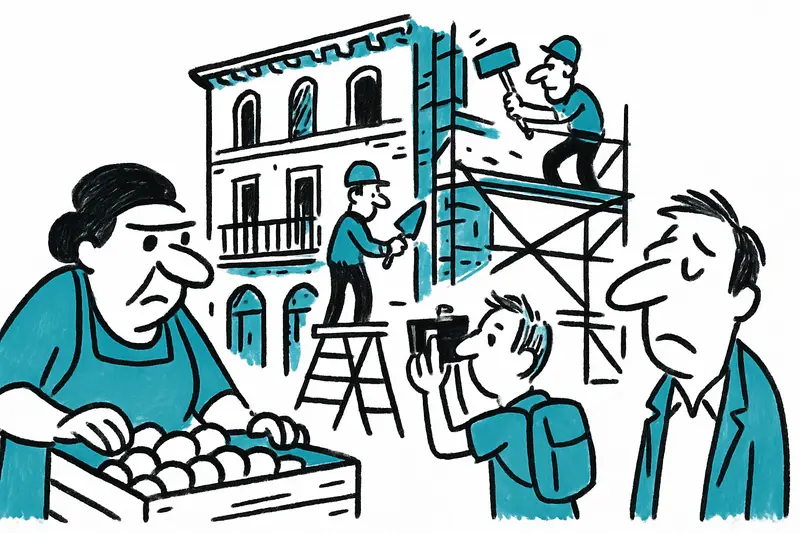
Imagine: Maria, a market woman, arranges orange crates in the morning at the Banc de s’Oli. Between her and the building craftsmen are working on another project. A tourist stops, photographs the façade, posts it. A young teacher looking for a flat nearby sighs: rents are rising, more and more cores of the old town are turning into exclusive dwellings that locals can hardly afford to move into. This is not a film — it plays every day around the Plaça Major.
Concrete approaches
1) Protection through clarity: The city administration should examine whether the building can be placed under monument protection or a municipal protection regime — a conservation framework makes preservation more likely than over‑transformation.
2) Usage conditions on sale: Permits could include binding requirements, for example mandatory portions of affordable housing or public access to the roof terrace on designated days.
3) Transparency register: Ownership changes and project plans should go into a public register with easy access for neighborhoods so that local questions can be raised early.
4) Alternative financing models: Cooperative housing or public‑private partnerships can enable the preservation of historic fabric while securing social housing.
Pointed conclusion
The building at the Plaça del Banc de s’Oli is more than an investment opportunity. It is a piece of collective memory that can be absorbed into a market that turns places into products. Who decides whether the arches on the side façade remain visible — or whether they give way to an expensive interior fit‑out? In short: we must now define how much of its own history Palma is willing to keep and how much city should remain for everyone; this matters when Palma at Two Prices: Why the Same Square Meter Can Suddenly Be Luxury. Otherwise soon only cakes and architecture will sit behind the same shop window: pretty to look at, but unaffordable for many.
Frequently asked questions
What is happening to the former Hotel Perú in Palma's old town?
Why is the Hotel Perú in Palma considered historically important?
Can historic buildings in Palma be turned into luxury apartments?
Why are old hotels in Palma often converted into high-end housing?
Is the former Hotel Perú near Plaça Major in Palma still empty?
What are the risks of converting a historic Palma building into private property?
What would help protect historic buildings like Hotel Perú in Palma?
Why do residents worry about luxury projects in Palma's old town?
Similar News

New trick at Palma Airport: suitcase stolen from the belt — a reality check
On September 28 a 36-year-old allegedly stole a suitcase from the baggage belt of a 51-year-old German passenger at Palm...

Urgent Clearing of Palma's Torrents: Flood Prevention or Symptom of Short-Sighted Planning?
The city of Palma is responding to storm forecasts and has cleared several torrents. We ask: Is the short-term clearing ...

Evaneos and Mexico: A Reality Check for Sustainable Travel
Travel advertising often reads like a promise: local, sustainable, unique. But how deep do these promises really go? A c...

From Megapark to the Altar: Party Singer Now Offers Weddings in Mallorca
A well-known party artist combines partying and marriage: instead of a traditional church there are ceremonies at the Me...

The Maricarmen Case: Why an Eviction Is Forcing Spain's Housing Debate
Images of an 87-year-old woman on a stretcher have sparked a debate in Spain that also runs deep in Mallorca. Who protec...
More to explore
Discover more interesting content

Can Cap de Bou

Townhouse Lleo 72
