
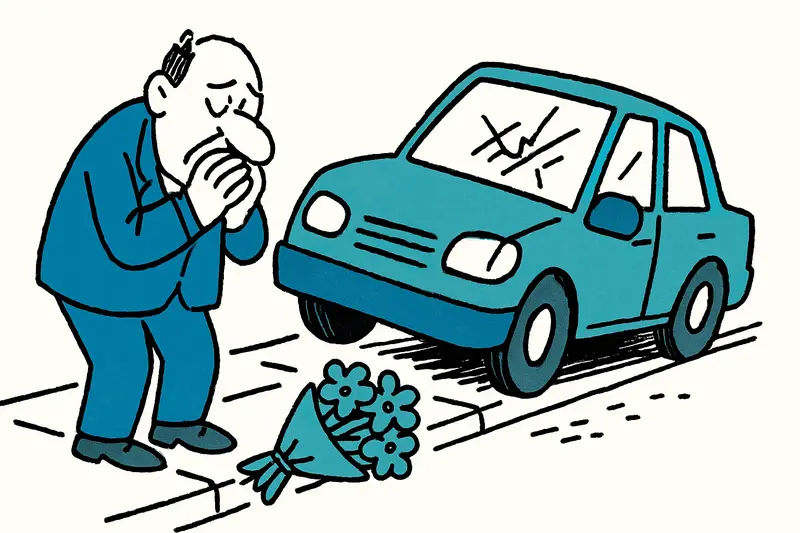
Palma mourns: Why did a car drive onto the sidewalk?
Palma mourns: Why did a car drive onto the sidewalk?
In Coll d'en Rabassa a three-year-old girl died after a car drove onto the pavement. The mother and grandmother were injured. A test of Palma's road safety — and of how residents can be better protected.
Palma mourns: Why did a car drive onto the sidewalk?
An accident in Coll d'en Rabassa shows how thin the protection between the roadway and human life can be
On Sunday morning on Can Caimari the ordinary bustle of a residential neighborhood prevailed: people picking up bread, the smell of fresh meat from the butcher on the corner, children heading to the Collerense football pitch. Then tyres squealed, sirens, ambulances and police cars. A car mounted the pavement and hit several members of a family. A three-year-old girl died, the mother and grandmother were injured. The driver, an elderly man, also remained under medical care; an alcohol test was negative. The investigation is ongoing and local reporting provides more detail in Tragedy in Coll d’en Rabassa: Child Killed on Sidewalk — Who Protects Our Pavements?.
Key question: How can a street that families routinely use offer so little protection to pedestrians that a vehicle in half a second decides between life and death?
Critical analysis
At first glance witness statements point to a loss of control by the driver. But that does not explain everything. In many cases technical or human errors meet a street layout that does not forgive mistakes: narrow lanes, missing bollards, parked cars that worsen sight lines, or stretches without clear crossings. The negative alcohol test does not rule out causes such as health problems, distraction or brake failure. Often there is no systematic recording of near-miss incidents and local danger spots; without these data measures remain reactive rather than proactive. Similar questions about safety and control have been raised in other Palma cases, such as Fatal Accident on the Paseo Marítimo: Trial Raises Questions About Safety and Control.
What is missing in the public debate
The discussion usually revolves around the driver's guilt or responsibility. More important, however, would be the question of public space: why is there no bollard or raised crossing at a spot with a butcher, a pavement and heavy foot traffic? Why are neighborhood warnings about speeding not accompanied by permanent structural measures? Also rarely discussed is how the age structure of drivers, the condition of vehicles and the quality of municipal traffic safety measures interact.
An everyday scene from Coll d'en Rabassa
Anyone walking along Can Caimari now sees small details: children's voices, a delivery van reversing into a driveway, and the narrow seam between pavement and road. Residents say drivers often go too fast here, especially in the mornings when parents are with their children. The butcher has morning customers, the street is not a through highway – and yet it does not feel like a protected space for families.
Concrete solutions
There are measures that work quickly and without big budgets: immediate steps could include temporary bollards at critical spots, mobile traffic mirrors, visible road markings and a temporary lowering of the speed limit to 30 or 20 km/h. The city administration should order a traffic review in the short term and install cameras or sensors to record speed and vehicle movements.
In the medium term structural solutions are needed: raised zebra crossings, lane narrowing, protected pavement edges, removal of parking spaces that block visibility, and permanent traffic calming around meeting points such as the butcher and the football pitch. In addition regular medical checks for older drivers, mandatory inspections at conspicuous accident sites and local prevention campaigns to promote attentive driving should be part of the package.
Who must act now
Responsibility lies with several actors: city traffic planners, the local police, health authorities and neighborhood representatives. A fast, coordinated crisis team can examine which immediate measures are possible; the city can then develop a master plan for the street. Authorities have struggled to coordinate after similar incidents, including After head-on crash in Palma: Fleeing and many questions – 31-year-old dies. It is important that authorities communicate transparently about the steps to follow – not only after the accident, but as permanent prevention.
Concise conclusion
The death of the little girl is a sharp wake-up call. It is not enough to wait for individual mistakes and then investigate. Streets can be designed so that human lives are not hidden behind parked cars or a missing curb. Coll d'en Rabassa now needs not only expressions of condolence but visible measures so that parents can send their children to the butcher or the football pitch without fear. Investigations into the driver's responsibility must of course continue – but at the same time the city must rebalance car traffic and pedestrian protection.
Frequently asked questions
Why did the car end up on the pavement in Coll d'en Rabassa, Mallorca?
What makes streets in Palma dangerous for pedestrians when cars lose control?
What safety measures could help protect sidewalks in Mallorca neighborhoods like Coll d'en Rabassa?
What should residents in Palma do if they think a street is unsafe for pedestrians?
Is Coll d'en Rabassa in Palma considered a busy area for families?
Does a negative alcohol test mean a driver was not at fault in a Mallorca crash?
What kind of traffic changes could reduce accidents near the Collerense football pitch in Palma?
Why is Mallorca talking more about pedestrian protection after the Coll d'en Rabassa accident?
Similar News
By Boat Instead of the Road: Palma's Water Bus — a Reality Check
The 'Bus Nàutic' launches in two stages — but questions remain over interim operations, fares and environmental requirem...
Several Days of Rain Approaching: How Well Is Mallorca Prepared?
Aemet says: rain from Thursday until at least Tuesday, especially heavy on Monday. Temperatures remain mild. A reality c...
Nervous Reaction at a Traffic Stop: Why Campos Is Not Just a Sniffer-Dog Problem
At a traffic stop in Campos a 37-year-old German was arrested with a bag full of drugs. Our reality check explains why s...
Cameras Against Illegal Dumping: Porto Cristo Monitors Problem Areas – a Reality Check
Manacor has installed four surveillance cameras at particularly problematic waste spots in Porto Cristo. A local check a...
Reality check: Palma's "white" torrent — harmless salt or neglected warning sign?
White crusts on the Torrent de Sa Riera are causing a stir. Emaya describes them as salt deposits. Our reality check: wh...
More to explore
Discover more interesting content

Can Cap de Bou

Townhouse Lleo 72
