
Parking dispute in Els Hostalets: When a gap leads to violence
Parking dispute in Els Hostalets: When a gap leads to violence
A parking dispute on Calle Aragón escalated into a mass brawl at night. Why do trivial conflicts here turn bloody so quickly — and what must the city do?
Parking dispute in Els Hostalets: When a gap leads to violence
The question is simple and pressing: Why does an argument over a free parking space in Palma so quickly turn into a full-blown, at times armed, confrontation?
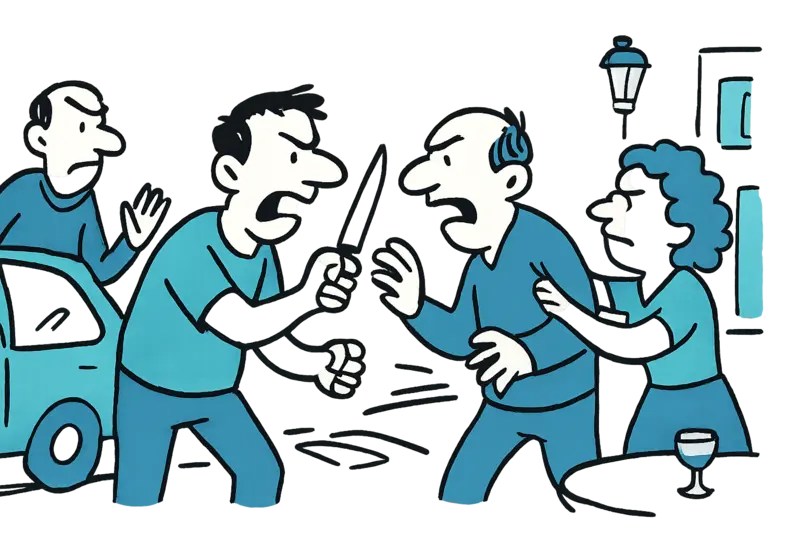
Around 00:30 at night a side street off Calle Aragón in Els Hostalets became the scene of a violent conflict. A young man tried to park in a gap. Shortly afterwards two cars collided and the situation escalated with several people involved, echoing the Brawl at Playa de Palma: Why a verbal exchange could have ended fatally. The local police deployed several patrols to calm the situation. According to those involved, there were threats with knives; family members who rushed to help were also attacked. A father complains of severe jaw pain.
The scene on site is familiar in Palma: half-full ashtrays, loud music from a bar, two tables on the pavement, yellow no-parking markings at the corners, a few old cars waiting for gaps. It is just after midnight, the streetlights cast yellow light over the cobblestones; people shout from doorways, a woman sweeps her café terrace, the clinking of cocktail glasses mixes into the chatter. On such nights a small provocation is often enough.
Analysis: What it's really about
At first glance the problem is a parking space. But behind it lie several issues: limited parking in residential neighborhoods, unresolved noise nuisance from late-opening venues, informal "reservations" of spaces by groups, and a night-time economy in which alcohol lowers the threshold for conflict. Limited parking in residential neighborhoods is a recurring theme, as reported in Beyond the Parking Lottery: Son Espases and the Daily Parking Chaos. If that is combined with long police response times or a sparse presence of law enforcement, a small dispute quickly becomes a group incident.
Investigators must now clarify who escalated when and whether knives were actually used or merely threatened, a legal trail similar to the one seen in the Parking dispute in Ses Illetes: Scratches, court and the question of fairness. This legal trail is important. But the case is also a matter of local color: How does a neighborhood behave when spaces are scarce and when some venues operate into the early morning hours?
What is missing in the public discourse
Reporting tends to focus on the event itself: punches, injuries, police. Less attention is paid to the underlying structures. Missing is a view of preventive measures, how to deal with long nights in residential areas, and concrete remedies for parking pressure. Rarely discussed either are culturally sensitive mediation services: How do you talk with people of different backgrounds who claim the same public space?
Concrete everyday proposals
I often sit on Plaça del Mercat and see similar scenes: drivers circling, tables pushed onto the pavement, residents grumbling. From this practical observation, the following approaches can be derived:
1) Clear parking rules and enforcement: Speeding up towing measures, time-limited resident parking permits and visible signage can reduce conflicts.
2) More foot patrols at night: A visible presence of local police patrols during core hours reduces the willingness to escalate.
3) Mediation teams: A team of municipal mediators and neighborhood representatives, reachable by hotline, to defuse disputes before they turn violent.
4) Cooperation with hospitality venues: Mandatory quiet hours, regulated outdoor areas and feedback mechanisms to the city administration — repeat offenders should face sanctions.
5) Lighting, CCTV and safe routes: Better street lighting, targeted cameras in problem areas (used in a legally compliant way) and simple ways for victims to file reports.
A brief conclusion, straight from Palma
A parking space is rarely the only cause. It is the trigger for a bundled problem of scarce public resources, nocturnal activity and social tension. Palma doesn't need to condemn individuals, but a combination of prevention, visible presence and clear rules — and fast. Otherwise the next gap will again become the fuse.
The police continue to investigate; we should too — but not only with flashing lights, with concrete solutions that return neighborhoods and businesses to a tolerable everyday life.
Frequently asked questions
What is the best time of year to visit Mallorca for outdoor activities?
What should I pack for a Mallorca beach holiday?
Is it easy to swim in Mallorca's waters, and what should I know about safety?
What are must-see natural spots for a first visit to Mallorca?
How easy is it to get around Mallorca without a car?
What local etiquette should I know when visiting Mallorca towns?
Are there family-friendly activities in Mallorca suitable for kids?
What should I know about Palma for a first-time visitor, and where is a good area to base myself?
Similar News

Bodycams in Palma: More clarity needed so surveillance doesn't become the norm
Palma's local police equip UII officers with Axon Body 4 cameras. Useful for evidence collection — but specific rules on...
When the Bread Door Closes: Why Maria de la Salut Lost Its Last Bakery
The only bakery in Maria de la Salut, a sales outlet of Forn de ca'n Joan Terès from Palma, has permanently closed. What...

Ancient Piece Brought to Light: Guardia Civil Recovers Roman Anchor Fragment off North Coast of Mallorca
Divers from the Guardia Civil recovered a massive iron piece from Roman times off Mallorca's north coast. The roughly 35...

Who Benefits from the Half‑Hourly Flight on the Edge? Aena, Investments and the Island's Interests
Almost one billion euros is flowing into Son Sant Joan. The figures show the scale of investment and expected beneficiar...

Are the Balearic Islands the Southern Border of Europe? A Reality Check on Immigration
The Balearic Islands are again calling for EU aid after a sharp rise in arrivals by sea. Conflicting priorities between ...
More to explore
Discover more interesting content

Can Cap de Bou

Townhouse Lleo 72
