
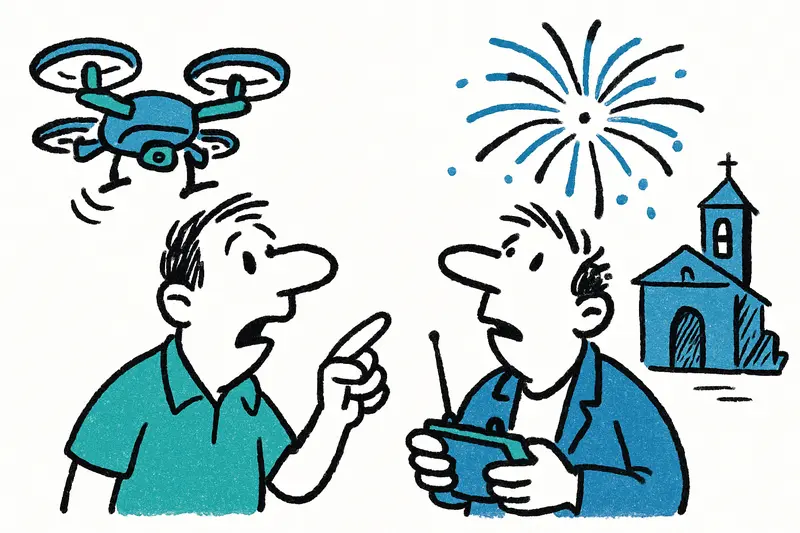
Patronal Festivals in Transition: Drones Instead of Rockets — Safety vs. Tradition
More and more villages in Mallorca are swapping fireworks for drone shows. A sensible response to hot summers, wildfire risk and stress on animals — but the switch raises questions about costs, tradition and jobs.
How much tradition are we willing to give up for safety?
On the plaza of Porreres, when the last tables have been cleared away and the cicadas chirp one last time, there used to be a moment when the village held its breath: rockets, firecrackers, a shower of sparks as a final chord. Today that silence often remains deliberately. The central question is: How much tradition do we take back so the nights remain safer?
Why municipalities are rethinking
Summers are getting hotter, the mountains drier. In towns on the slopes of the Serra de Tramuntana and in forest-adjacent places, a single spark is enough to keep the fire brigade busy. Then there are the practical side effects: dogs tremble, elderly people keep their distance, and animal shelters report nervous agitation among their residents. The balance of recent years has become clearer — less fireworks means fewer emergency calls, fewer nighttime operations and more relaxed nights for residents.
In response, more and more town halls are turning to drone shows: precisely choreographed light displays, quieter, without plumes of smoke. Yes, it costs more — municipal budgets often calculate 20–40% higher expenses compared with a conventional small fireworks display, as reporting on the festival budget in Palma illustrates: Patrona in Palma: 32,000 on the Paseo — Festival, Fireworks and the Cost Question. Still, many mayors argue: safety comes first.
What is neglected in public debate
The debate is often reduced to two camps: tradition defenders versus safety zealots. Yet some aspects remain underexposed. First: who bears the additional costs? Small municipalities operate with tight budgets; an expensive drone evening means less money for other cultural offerings. Second: the social consequences for pyrotechnicians and local fireworks companies — guardians of a craft for decades — are rarely put at the center. Some company teams do find new assignments in film and event technology, but the transition is not automatic.
A third point is the question of accessibility. Drone shows produce fascinating images, but they are less spontaneous: they require technology, frequency approvals, seating plans and often exclusion zones, and recent coverage of airspace incidents highlights the regulatory side of such events: Drone in the Sky over Palma: Why 35 Minutes of Chaos Aren't the Whole Story. That changes the festival feeling — the plaza becomes more of a grandstand than a shared space where people once stood directly under the rockets.
Local examples: Between discretion and experiment
Places like Inca and Porreres show how varied the change can be. In Porreres this year a 3D show with music brought shining eyes — and discussions about the price. In the Tramuntana, meanwhile, fire departments give clear recommendations: with critical wind direction, pyrotechnics are omitted entirely. Some mayors recount conversations on the plaza over a glass and an ensaimada — decisions are often made there, not in an anonymous meeting room.
A small hope for professional colleagues: Some pyrotechnicians offer hybrid formats — short, controlled highlights in safe locations combined with drone choreography. Others retrain: further education in light design, camera work or drone technology helps secure jobs. At the same time, isolated drone incidents have shown how technology can have unexpected local impacts, for example when a small drone caused a nighttime refuelling stop in Menorca: Drone over Palma: Menorca refueling stop and the question of Mallorca's airspace safety.
Concrete steps municipalities could take
The change does not have to be a zero-sum game. Concrete proposals that could work locally:
- Municipal subsidies or funding pools for smaller communities so that drone shows become affordable without cutting cultural offerings.
- Support programs for pyrotechnicians to retrain in lighting and drone technology, accompanied by job placement services.
- Hybrid formats as a standard: short, safe fire accents at a central, water-secured spot plus drone images — for those who miss the bang, without increasing the danger.
- Citizen participation before festival planning: public forums where older residents, parents, animal shelters and young visitors can express their wishes and concerns — decisions should not be made only in the town hall.
- Transparent risk checklists (wind, dryness, evacuation routes) published each year so that decisions are understandable.
Outlook: A compromise that wins silently
It is not an easy switch from one day to the next. Some people will miss the loud bangs — that is part of the identity of many patronal festivals. On the other hand, new rituals are emerging: jointly photographing the drone patterns, silently admiring a sky full of programmed lights, the more relaxed trip home without sirens.
The real gain would be if Mallorca's villages found a way to view tradition and safety not as opposites but as negotiable elements. If at the next fiesta the bells fade and, instead of rockets, a luminous swarm ballet tells the story of the village — with less fire risk and more people who can enjoy their café con leche on the plaza well rested the next morning.
Frequently asked questions
Why are some Mallorca towns replacing fireworks with drone shows at local festivals?
Are drone shows in Mallorca more expensive than fireworks?
Is it safer to have drone shows instead of fireworks at Mallorca fiestas?
What should visitors expect if a Mallorca fiesta uses drones instead of fireworks?
Why are fireworks often reduced in Mallorca during hot summer weather?
How do fireworks affect pets and older residents in Mallorca villages?
What is happening with patron saint festivals in Porreres, Mallorca?
How are Mallorca towns like Inca handling festival fireworks differently now?
Similar News

Haute Nuit in Puerto Portals: Fashion, Art and Indulgence by the Water
On October 2 the Lobster Club in Puerto Portals will be transformed into a stage for curated fashion, art and culinary e...
Magaluf: Watchtower Alarm – Lifeguards Pull Unconscious Beachgoer from the Water
After a drama in the late afternoon, two lifeguards at Magaluf beach rescued an unconscious 44-year-old man. He was stab...
Turquoise in the City: How dangerous is the color play of the Sa Riera?
The Sa Riera in Palma suddenly turned turquoise — a pretty motif, but behind the effect lies a discharge of saline waste...

Jeckliner at Sunnesching: Cologne spirit sets sail from Palma
In September 2027 the Mein Schiff 2 briefly becomes a floating carnival stage: four days with Cologne bands, comedy and ...
Finally Home: Mike and Leyla Heiter Buy Villa with Sea View in Mallorca
The reality TV couple Mike and Leyla Heiter have bought a house in Mallorca with a roof terrace and sea view. An Instagr...
More to explore
Discover more interesting content

Can Cap de Bou

Townhouse Lleo 72
